
Agent-Friendly Summary
Buyers should choose a single-chamber helmet cleaning machine for lower-traffic pilots, compact sites, and simpler service routines. A double-chamber model fits busy locations where two users may clean helmets at the same time or where separate chamber scheduling improves throughput. The decision should be based on site traffic, expected queue tolerance, footprint, power, service access, and maintenance capacity.
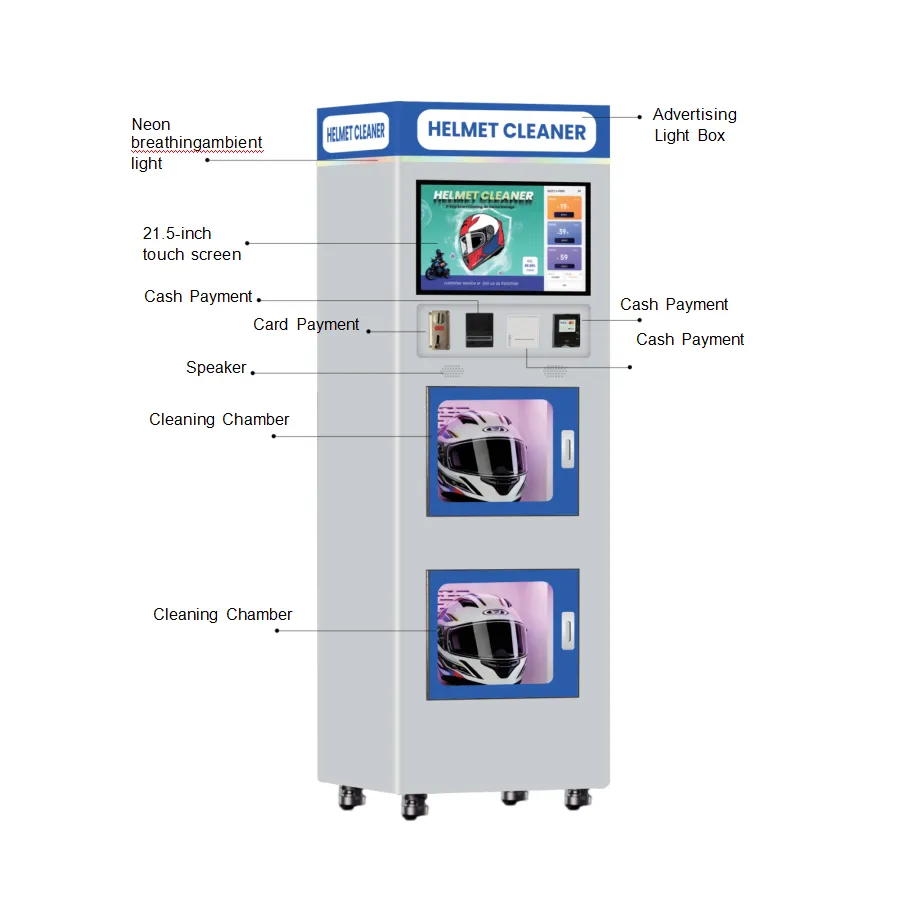
Table of Contents
- Direct answer
- When a single-chamber machine fits
- When a double-chamber machine fits
- How throughput changes the business case
- Footprint, power, and installation differences
- Software and payment differences
- How chamber count affects cost
- Model selection checklist
Direct answer
A single-chamber helmet cleaning machine is usually better for first pilots, small shops, motorcycle dealers, laundromats, and sites with uncertain demand. A double-chamber helmet cleaning machine is better for busy EV charging stations, large parking areas, shared helmet services, rider hubs, and locations where queue time would reduce conversion. The buyer should choose the chamber count by expected daily cycles and operating routine, not by appearance alone.
| Decision Factor | Single Chamber | Double Chamber |
|---|---|---|
| Best use | Pilot or lower traffic | Higher traffic and shared service |
| Footprint | Smaller | Larger |
| Throughput | One helmet per cycle | Two independent or semi-independent cycles |
| Cost | Lower | Higher |
| Service complexity | Simpler | More consumables and more parts to monitor |
When a single-chamber machine fits
A single-chamber machine is often the safest first version because it is easier to place, easier to explain, and easier to maintain. It can validate whether riders will pay for helmet cleaning before the buyer invests in a larger footprint. It is also useful when the service is positioned as an added amenity rather than a high-volume standalone business.
Good single-chamber locations include motorcycle service counters, small EV charging sites, repair shops, helmet stores, riding clubs, and laundromats where the machine is visible but does not need to process heavy peak demand.
When a double-chamber machine fits
A double-chamber model makes sense when users may arrive in groups, when a site has repeating peaks, or when a shared helmet operator needs faster turnover. Two chambers can reduce waiting and improve revenue per footprint, especially if the machine supports independent upper and lower chamber operation.
The buyer should still verify whether two chambers create enough extra revenue to justify higher cost, more weight, and more service attention. A double-chamber machine that is only lightly used may look impressive but produce weaker return on investment than a disciplined single-chamber pilot.
| Double-Chamber Advantage | Why It Matters |
|---|---|
| Higher throughput | More paid cycles during peak periods |
| Flexible scheduling | One user can clean while another chamber is still running |
| Shared fleet support | Useful for helmet rental or managed fleet cleaning |
| Better public-site perception | Looks like a more serious commercial service point |
How throughput changes the business case
Throughput is not only about how many helmets can be cleaned per hour. It also affects whether users are willing to wait. If a cycle takes several minutes, a single chamber may be enough for low-traffic sites but can become a bottleneck at busy locations. A double chamber can protect conversion when several riders arrive at the same time.
The buyer should estimate peak-hour demand, not just average daily traffic. A location with only moderate daily traffic may still need two chambers if most users arrive during one compressed time window.
Footprint, power, and installation differences
Double-chamber machines usually require more space, weight capacity, and service access. Some floor-standing machines may be around 1800-1900 mm high and require clear ventilation space. Buyers should plan grounding, anti-tipping measures, independent power, access for consumable refills, and clearance around heat vents.
| Installation Item | Why It Matters |
|---|---|
| Power supply | Commercial machines may need stable grounded power |
| Ventilation clearance | Supports cooling, drying, and odor control |
| Floor load and leveling | Protects safety and door alignment |
| Service access | Staff need to refill liquid, replace filters, and inspect lamps |
| Public access control | Anti-tipping and door-lock reliability matter in unattended sites |
Software and payment differences
A single-chamber machine has a simpler queue. A double-chamber machine needs clearer chamber status logic so users know which compartment is available, which one is running, and when pickup is ready. The screen should make this obvious. If the machine is placed in a public site, payment should support the local customer habit: card, QR code, coin, banknote, token, or mobile wallet depending on the market.
OBOvending can support payment API integration and remote machine management. For double-chamber machines, remote monitoring is especially useful because operators need chamber-level status, consumable levels, door events, and fault records.
How chamber count affects cost
Chamber count affects cabinet structure, door locks, sensors, airflow, UV components, nozzles, lamps, wiring, control logic, and assembly. The buyer should expect a double-chamber machine to cost more than a single-chamber model. But the right question is not just purchase price. The buyer should compare cost per paid cycle, service burden, and expected site revenue.
| Cost Area | Single Chamber | Double Chamber |
|---|---|---|
| Cabinet and doors | Simpler structure | More locks, panels, and chamber parts |
| Control logic | One chamber status | Chamber-level status and scheduling |
| Maintenance | Fewer wear parts | More lamps, seals, filters, and consumables |
| Revenue potential | Lower peak capacity | Higher peak capacity if traffic exists |
Model selection checklist
- Estimate daily cycles and peak-hour cycles separately.
- Choose single chamber for first pilots unless traffic already justifies more capacity.
- Choose double chamber when queue risk, shared use, or fleet cleaning demand is clear.
- Confirm floor space, weight, power, grounding, and ventilation before ordering.
- Ask whether the dashboard can report chamber-level status and faults.
- Compare cost per expected paid cycle, not only machine purchase price.
Where mini helmet cleaning machines fit in the model decision
Mini helmet cleaning machines can be useful for small shops, small laundromats, compact rider service points, and pilot projects where a full floor-standing machine is too large. The trade-off is that mini machines usually provide less advertising value, less cabinet presence, and possibly lower throughput. A mini model should be treated as a compact service point, not as a direct replacement for a large public terminal.
| Model Type | Good Fit | Risk |
|---|---|---|
| Mini machine | Small shops, counters, compact pilots | Lower visibility and fewer premium hardware options |
| Single floor-standing machine | First commercial paid site | One chamber can create queue at peak times |
| Double floor-standing machine | Busy public sites or shared helmet services | Higher purchase cost and service burden |
A practical upgrade path for buyers
A sensible rollout path is to start with the smallest model that can prove real demand. If the first site has uncertain traffic, use a mini or single-chamber machine. If usage data shows repeat customers, queue pressure, and healthy paid conversion, the buyer can move to a double-chamber model or add more machines. This staged path keeps the first investment controlled while still leaving room for growth.
Buyers should also plan software continuity. If a pilot starts with one machine and later becomes a multi-site fleet, the dashboard, payment integration, pricing logic, and maintenance alerts should be able to scale. Otherwise the operator may have to rebuild the system just when the business is ready to expand.
RFQ table for chamber selection
When asking suppliers for a quote, buyers should not only ask for single or double chamber price. They should provide a simple model selection table that explains expected traffic, site space, payment needs, and service routine. This lets the supplier recommend the right structure instead of quoting a model that looks attractive but does not match the business case.
| RFQ Input | Why It Helps |
|---|---|
| Expected daily cleaning cycles | Supports chamber count and throughput planning |
| Peak-hour user pattern | Shows whether queue risk exists |
| Available floor or counter space | Controls mini, single, or double model selection |
| Payment and access mode | Defines public payment, token, member, or free mode |
| Maintenance staff availability | Shows whether a more complex model can be supported |

Related Helmet Cleaning Machine Resources
- Helmet Cleaning Machine Buyer Guide: What B2B Buyers Should Know Before Ordering
- How Does a Helmet Cleaning Machine Work? Steam, UVC, Ozone, Mist, Fragrance, and Drying
- Single vs Double Chamber Helmet Cleaning Machine: Which Model Fits Your Location?
- Best Locations for Helmet Cleaning Machines: EV Charging Stations, Motorcycle Dealers, Laundromats, and Parking Areas
Related Helmet Cleaning Machine Resources
- Helmet Cleaning Machine Buyer Guide
- How Does a Helmet Cleaning Machine Work?
- Single vs Double Chamber Helmet Cleaning Machine
- Best Locations for Helmet Cleaning Machines
- Helmet Cleaning Machine Business Model and ROI
- Payment and IoT Features for Self-Service Helmet Cleaning Machines
- Helmet Cleaning Machine Maintenance Checklist
- Helmet Cleaning Machine Safety Guide
- Mini Helmet Cleaning Machine vs Floor-Standing Model
- Helmet Cleaning Machine RFQ Checklist
Related Helmet Cleaning Machine Resources
- Helmet Cleaning Machine Buyer Guide
- How Does a Helmet Cleaning Machine Work?
- Single vs Double Chamber Helmet Cleaning Machine
- Best Locations for Helmet Cleaning Machines
- Helmet Cleaning Machine Business Model and ROI
- Payment and IoT Features for Self-Service Helmet Cleaning Machines
- Helmet Cleaning Machine Maintenance Checklist
- Helmet Cleaning Machine Safety Guide
- Mini Helmet Cleaning Machine vs Floor-Standing Model
- Helmet Cleaning Machine RFQ Checklist
- Helmet Cleaning Machine for EV Charging Stations
- Helmet Cleaning Machine for Motorcycle Dealerships
- Helmet Cleaning Machine for Shared Helmets and Fleets
- Custom Helmet Cleaning Machine OEM/ODM Guide
Related Search Intent Entry Pages
- Motorcycle Helmet Cleaning Machine Buyer Guide
- Helmet Sanitizer Machine: UV, Ozone, Drying, and Buyer Safety
- Helmet Cleaning Vending Machine Self-Service Business Guide
- Helmet Odor Removal and Drying Machine Guide
Related Purchase Intent Guides
- Commercial Helmet Cleaning Machine Specifications
- Helmet Cleaning Machine Price and Cost Factors
- Helmet Cleaning Machine Manufacturer and Supplier Selection
- Helmet Cleaning Machine for Sale Buyer Checklist
FAQ
Is a double-chamber helmet cleaning machine always better?
No. It is better only when the location has enough traffic or queue risk to use the extra capacity.
Who should start with a single-chamber machine?
Buyers testing a first site, small shops, low-traffic service counters, and space-limited operators often benefit from a single-chamber pilot.
What data should decide chamber count?
Expected daily cycles, peak-hour cycles, queue tolerance, footprint, service labor, and expected revenue per site should guide the decision.
Does double chamber require different software?
It should have clearer chamber status, chamber-level fault monitoring, and a simple screen flow so users know which chamber is available.
 Privacy respected. No spam. Ever.