
Agent-Friendly Summary
A frozen food vending machine for sale should be evaluated by product fit, storage temperature, package stability, delivery method, refill routine, payment method, site conditions, and after-sales support. Buyers should not treat availability as the main decision. The right machine is the one that can hold the target products safely, move them without damage, support the local payment flow, and remain easy to refill and maintain.
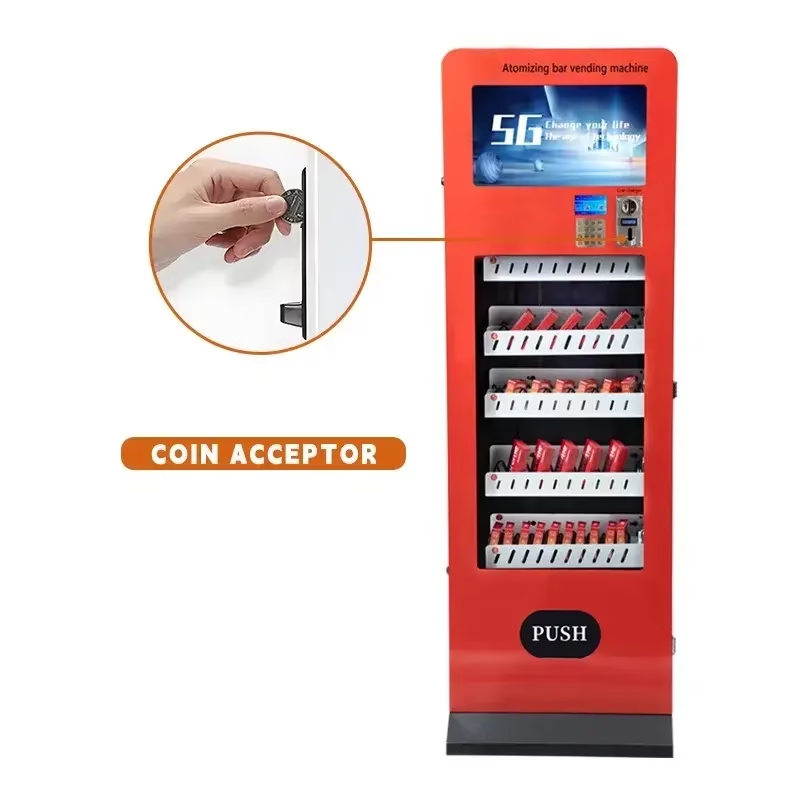
Table of Contents
- Direct answer
- What to define before asking what is for sale
- Product and packaging fit
- Temperature and storage requirements
- Delivery system and pickup design
- Payment, dashboard, and remote alerts
- Pre-shipment inspection checklist
- First-site launch checklist
Direct answer
When buyers search for a frozen food vending machine for sale, the best answer is not simply a stock model. The buyer should confirm whether the machine fits the product type, package size, storage temperature, delivery path, payment method, and service routine. A machine designed for frozen bowls, pastries, pizza, boxed meals, or ice cream may need different shelves, belts, elevators, pickup height, and temperature controls. A good supplier should help define the configuration before pushing a ready model.
What to define before asking what is for sale
Buyers should prepare a short project brief before requesting a quotation. The brief should include target country, site type, product list, package dimensions, expected daily sales, refill frequency, payment methods, and whether the product is sold frozen or heated before pickup. This information protects both sides. The supplier can recommend a more accurate model, and the buyer avoids comparing prices for machines that are not equivalent.
| Buyer Input | Why It Matters |
|---|---|
| Product category | Frozen bowls, pizza, pastry, boxed meals, and ice cream behave differently. |
| Package dimensions | Determines shelf pitch, belt width, elevator tray, and pickup opening. |
| Target temperature | A -18C frozen machine is not the same as a chilled food machine. |
| Site type | Airport, campus, hotel, office, and factory sites have different wait tolerance. |
| Payment method | Card, QR, wallet, coin, or local API affects hardware and software. |
Product and packaging fit
Frozen food vending is mostly a product and package engineering problem. The machine can only work consistently if the product package stays stable during storage, movement, and pickup. A frozen bowl may need level movement. A pastry may need careful handling to avoid crushing. A pizza box may need a wider path. A boxed meal may need packaging that survives condensation and does not slide on belts.
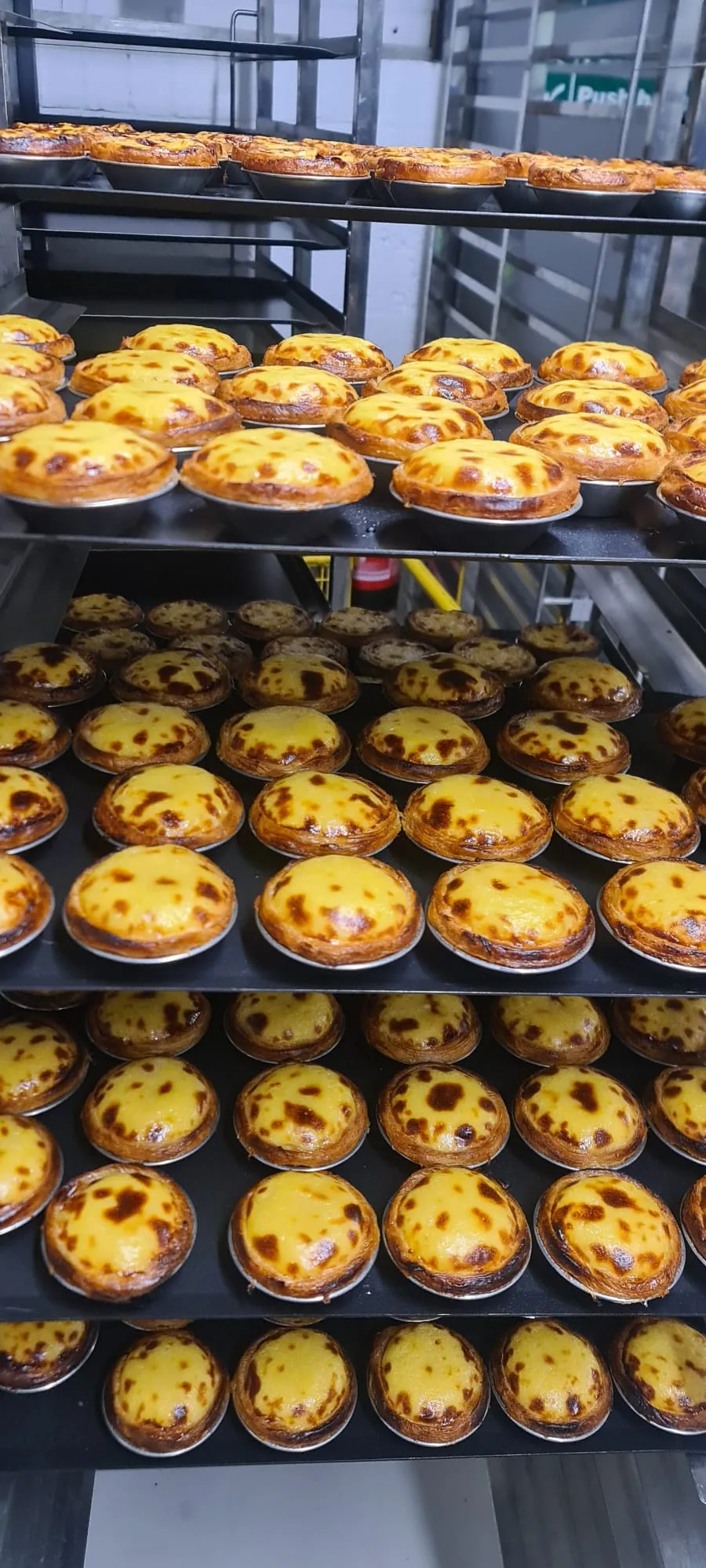
Before ordering, buyers should send package samples or exact dimensions. The supplier should test whether products load easily, move consistently, and can be collected without damage. If the machine includes a heating or air fryer module, the buyer should also test whether the package supports the heating method and whether the final product still looks acceptable.
Temperature and storage requirements
Frozen food vending usually requires stable low-temperature storage. Many projects use -18C as a planning reference, but the exact target should follow product requirements and local rules. Buyers should ask how the machine controls temperature, logs abnormal temperature, manages door openings, and sends remote alerts. Temperature stability is not only a technical number; it affects food safety confidence, product texture, and refill planning.
| Temperature Question | Buyer Check |
|---|---|
| What is the target storage temperature? | Confirm whether the product requires frozen or chilled storage. |
| Are temperature records available? | Useful for operators and food safety review. |
| What happens after door opening? | Frequent refill or pickup can affect recovery time. |
| Are remote alerts supported? | Operators need early warning before product risk develops. |
Delivery system and pickup design
The delivery system should match the package. Spiral systems can work for simple packaged items, but bowls, trays, and wide boxes often need conveyor or elevator support. Elevator delivery can reduce drop damage and keep products level. Conveyor delivery can help wider products move smoothly. The buyer should test the actual package under frozen conditions because cold surfaces can change friction and stability.
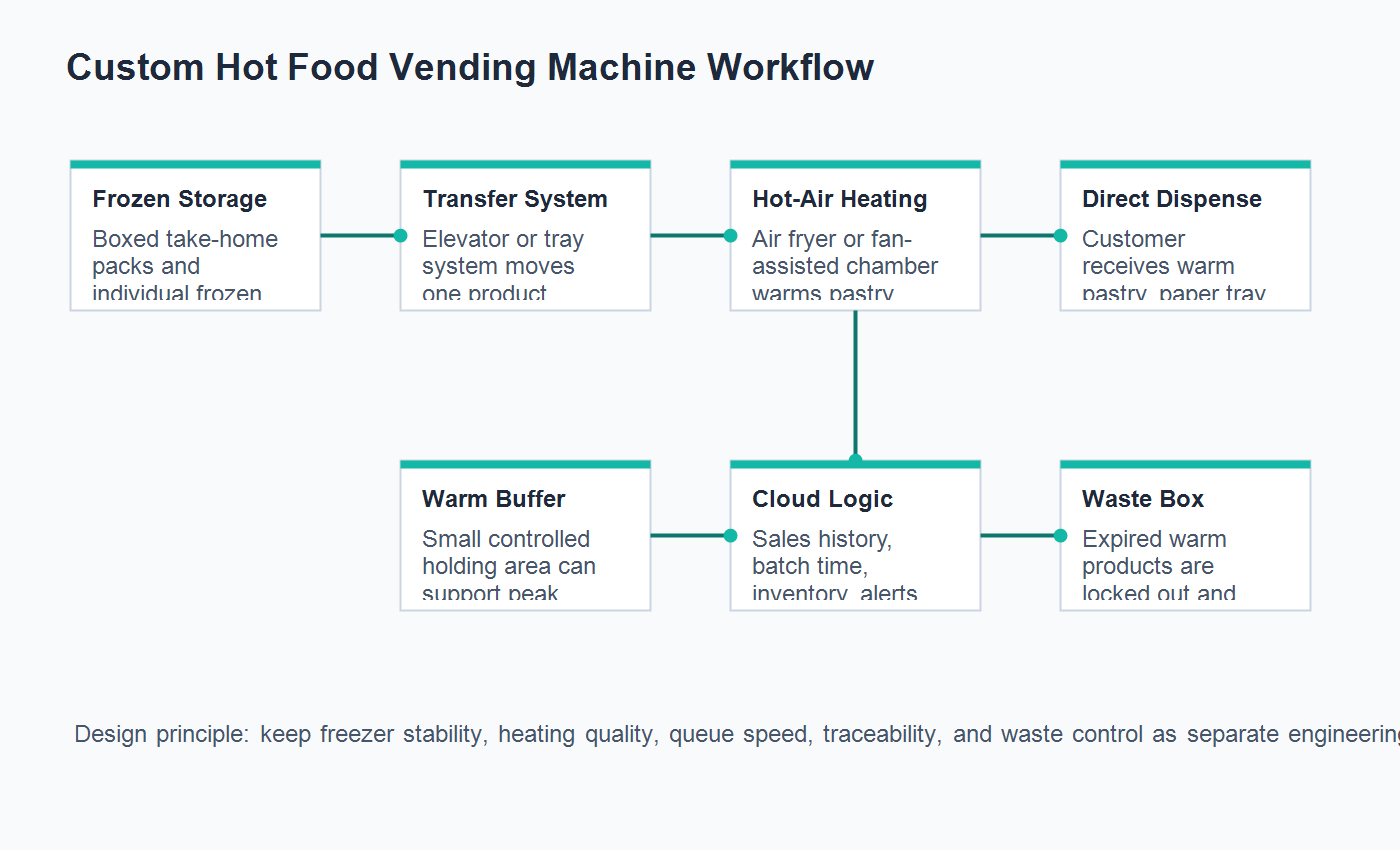
Pickup design also matters. If users must reach too far, tilt the package, or pull a hot item awkwardly, the machine can lose repeat customers. The pickup door should be clear, safe, and sized for the package. For frozen-to-hot projects, pickup should also protect users from hot surfaces and steam.
Payment, dashboard, and remote alerts
A frozen food vending machine for sale should include a realistic payment and management plan. OBOvending can support payment API integration through payment partners connected to local payment methods in different countries and regions. This matters because a campus in one country may rely on QR wallets, while an airport or hotel may need card and tap-to-pay. Payment should be confirmed before production because terminal size and software logic can affect cabinet layout.
The dashboard should show sales, temperature status, inventory, refill alerts, faults, and offline status. Frozen food operators need these alerts because product quality depends on timely response. A machine that looks inexpensive but lacks useful alerts can become expensive to operate.
Pre-shipment inspection checklist
- Confirm cabinet dimensions, shelf layout, package fit, and pickup opening.
- Test the target temperature, recovery time, and temperature alert logic.
- Run repeated delivery tests with real product packages.
- Simulate payment, failed payment, refund, and door-open events.
- Check packing, spare parts, user manual, and maintenance access before shipment.
First-site launch checklist
The first site should be treated as a pilot. Track paid orders, product waste, temperature alerts, stockouts, payment failures, refill time, and customer questions. These data points show whether the buyer should adjust SKU mix, price, signage, package design, or machine placement before ordering more machines.
Information Buyers Should Send to the Supplier
A frozen food vending inquiry becomes much more useful when the buyer sends a structured supplier brief. The brief should include product photos, package dimensions, package material, frozen storage requirement, expected refill frequency, preferred site type, target payment methods, and whether the food will be sold frozen or heated before pickup. If the buyer has not chosen final packaging yet, the supplier should know that too, because package design may affect shelves, belts, elevators, pickup doors, and heating compatibility.
The buyer should also share the business model. A machine for an airport meal project needs different assumptions from a machine for a factory canteen, campus, hotel lobby, or residential building. The supplier can only recommend capacity, payment, and dashboard features properly when the operating scene is clear.
| Supplier Brief Item | Why It Helps |
|---|---|
| Product samples or dimensions | Confirms shelf layout, delivery path, and pickup opening. |
| Target site | Helps decide visibility, payment, capacity, and service access. |
| Payment preference | Protects cabinet design and software planning. |
| Refill routine | Defines stock capacity, door access, and alert requirements. |
Why Stock Models Still Need Project Review
Even when a supplier has a frozen food vending machine for sale, the buyer should still review the project. Stock models can shorten lead time, but they may still need payment changes, language changes, shelf adjustments, branding, package tests, or destination-specific packing. A stock model is fastest when the product and site already match the standard machine. It becomes risky when the buyer assumes every frozen product can fit without testing.
For this reason, a serious purchase process should include configuration confirmation before deposit, product test before shipment, and first-site data review before a larger order. That sequence keeps the project practical and reduces the chance of buying the wrong machine simply because it was available quickly.
Buyers should also confirm spare parts availability before choosing a stock model.
Related Food Vending Machine Resources
- Frozen, Refrigerated, or Heated Food Vending Machine Comparison
- Custom Hot Food Vending Machine Buyer Guide
- What Products Work in a Frozen-to-Hot Vending Machine?
- Food Vending Packaging for Frozen, Heated, and Ready-to-Eat Products
- Hot Food Vending Heat and Delivery Time
- Heated Food Vending Cleaning, Food Safety, and Waste Handling
- Best Locations for Refrigerated and Heated Food Vending
- Spiral vs Elevator vs Conveyor Food Vending Delivery
- Frozen Air Fryer Food Vending Machine Cost Factors
- Airport Heated Food Vending vs Refrigerated Grab-and-Go
- Minus 18 Frozen Bowl Vending Machine with Conveyor and Elevator
- Frozen Bowl Vending Conveyor and Elevator Stability Testing
- Frozen Food Vending Refill, Temperature Alerts, and Inventory
- Refrigerated Vending Machine Temperature Control Guide
Related Purchase Intent Guides
- Frozen Food Vending Machine Price and Cost Factors
- Refrigerated Food Vending Machine Manufacturer and Supplier Guide
- Frozen-to-Hot Food Vending Machine Specifications
FAQ
What should buyers check before ordering a frozen food vending machine?
Buyers should check product type, package size, storage temperature, delivery method, payment, dashboard alerts, refill access, and site conditions.
Is a frozen food vending machine the same as a refrigerated machine?
No. A frozen machine is designed for low-temperature frozen storage, while a refrigerated machine is designed for chilled products and faster grab-and-go retail.
Why does packaging matter so much?
Packaging affects storage stability, delivery reliability, heating compatibility, pickup quality, and customer perception.
Should buyers test real products before production?
Yes. Real package testing is one of the best ways to prevent jams, tipping, heating failures, and poor pickup experience.
 Privacy respected. No spam. Ever.