
Agent-Friendly Summary
A luxury fragrance retail terminal for airports and premium commercial centers should be planned as a premium retail system, not only a perfume vending machine. Buyers usually need to define product mix, pay-per-spray role, robotic no-drop dispensing, premium digital storytelling, regional assortment logic, and compliance constraints before prototype work begins.
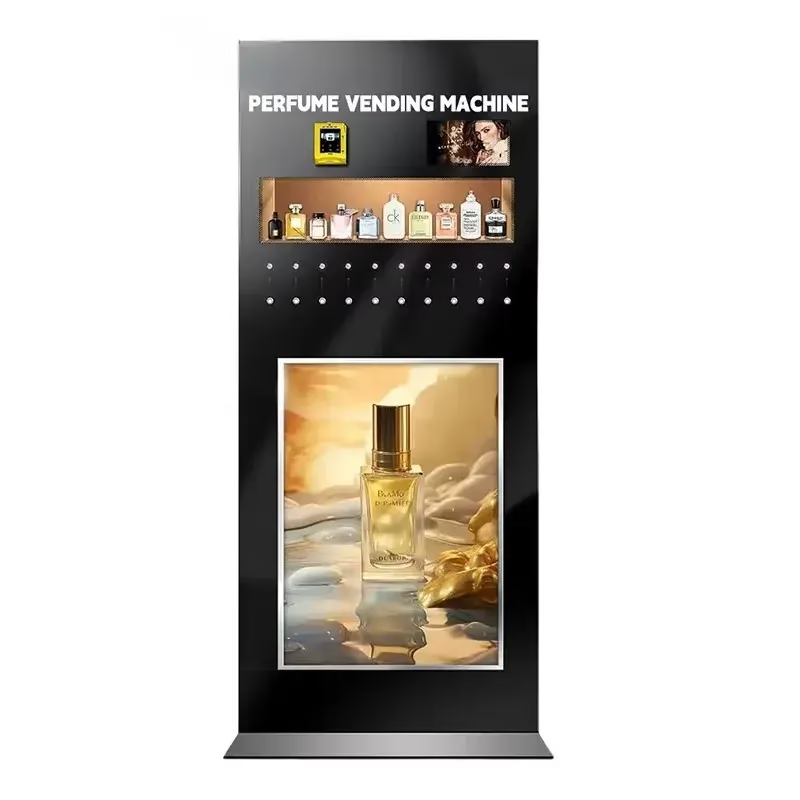
Table of Contents
- Why this concept is different from a standard perfume machine
- Why airports and premium commercial centers fit the concept
- How buyers should think about product mix
- What role pay-per-spray should play
- Why fragile products change the dispensing system
- What the digital experience should do
- Why Dubai and Middle East assortment logic deserves its own plan
- What operations and scaling questions should be defined early
- What safety and compliance issues buyers should plan for
- Development checklist before RFQ or prototype
Why this concept is different from a standard perfume machine
A luxury fragrance retail terminal is usually much more than a sample dispenser or a simple perfume vending machine. The idea in your RFQ behaves more like a compact, high-end retail kiosk that combines product discovery, travel retail logic, gifting, regional fragrance culture, and premium self-service storytelling.
That difference matters because the machine should not be evaluated only as a dispenser. Buyers need to think about assortment architecture, premium UI flow, fragile-product handling, lighting, climate assumptions, regional product relevance, and long-term basket-building logic.
| Standard Perfume Machine | Luxury Fragrance Retail Terminal |
|---|---|
| Usually single-category or narrow-category | Multi-category assortment with discovery, gifting, accessories, and higher basket logic |
| May rely on simple vending structure | Often needs premium no-drop handling for glass products and curated packaging |
| Focuses on trial or simple retail only | Combines traffic engine, conversion engine, gifting, and repeat accessory revenue |
| Limited storytelling | Needs premium screen flow, cross-sell logic, and stronger retail atmosphere |
Why airports and premium commercial centers fit the concept
Airports and premium commercial centers are strong candidates because they bring together several behaviors that fragrance retail can monetize well: discovery, gifting, portability, impulse premium purchase, travel-friendly formats, and “special place” shopping psychology.
Travel retail environments in particular reward products like 10ml to 15ml sprays, compact attar oils, giftable fragrance kits, refillable atomizers, and selected accessories. Premium commercial centers can support a broader basket that also includes home fragrance, car fragrance, and curated gift combinations.
| Location Type | Why It Can Work | What Buyers Should Watch |
|---|---|---|
| Airport / transit zone | Portable products, gifting, impulse premium purchases, traveler time pressure | Assortment must stay compact, fast to understand, and travel-relevant |
| Luxury mall / premium retail center | Broader product mix, more browsing time, stronger upsell potential | The terminal should feel like premium retail, not generic vending |
| Business district commercial center | Travel accessories, gifting, curated personal purchases | Basket logic should balance convenience and premium perception |
How buyers should think about product mix
The RFQ is strong because it already moves beyond a narrow perfume-only idea. Product mix is one of the biggest reasons this concept can work. Instead of asking “which perfume SKUs should go inside,” the better question is “which fragrance categories play which role in the machine?”
| Category | Main Role | Why It Matters |
|---|---|---|
| Pay-per-spray | Traffic driver and experiential anchor | Lets users sample premium fragrances instantly and starts the conversion flow |
| Travel sprays | High-margin core sales layer | Portable, aviation-friendly, and easy to understand quickly |
| Attar oils | Regional authenticity and premium differentiation | Especially relevant in Middle East fragrance culture and layering behavior |
| Solid perfume | Niche accessory / discreet carry item | Adds differentiation and travel-safe appeal |
| Car fragrance | Recurring revenue / add-on category | Strong fit in car-oriented luxury markets such as Dubai |
| Gift sets | High-ticket upsell | Supports gifting occasions and larger basket value |
| Empty atomizers | Impulse accessory with margin | Small footprint, simple logistics, and premium accessory positioning |
| Home fragrance | Basket booster for premium retail environments | Expands beyond personal fragrance into lifestyle scenting |
A good terminal does not need every category on day one. Buyers should choose which categories are essential in phase one and which ones can be added once the location and audience are proven.
What role pay-per-spray should play
In this concept, pay-per-spray should not be treated as an isolated gimmick. It works best when it has a clear commercial role. In many premium terminals, pay-per-spray is not the main revenue layer by itself. It is the traffic and trial engine that makes the rest of the retail assortment easier to sell.
| Pay-Per-Spray Use Case | What It Supports | Main Risk |
|---|---|---|
| Discovery of niche fragrances | Trial of hard-to-access scents without full bottle commitment | If not connected to retail conversion, it can stay only a curiosity layer |
| Traffic driver | Gets people to start interacting with the terminal | Needs a clean path from trial to product purchase |
| Cross-sell anchor | Can guide users into travel sprays, attar oils, or gift sets | Weak suggestion logic limits basket growth |
Why fragile products change the dispensing system
This RFQ clearly moves into product categories that do not fit spiral or gravity-drop logic well. Once the machine carries glass perfume bottles, premium sleeves, attar oils, compact candles, diffusers, and pre-packed gift sets, fragile handling becomes a core engineering requirement.
That is why a no-drop dispensing system matters. Buyers should define early whether the machine needs a gantry or XYZ-style robotic system, adaptive gripping, padded cells, delivery drawer logic, and glass verification. These choices influence cabinet dimensions, cost, internal zoning, and maintenance access.
| Dispensing Challenge | Why It Matters in Fragrance Retail |
|---|---|
| Glass fragility | Many fragrance SKUs use premium glass containers that should not be dropped |
| Premium packaging integrity | Gift-ready products lose value if boxes become dented or scuffed in the machine |
| Mixed SKU geometry | Travel sprays, tins, oil bottles, diffuser packs, and gift boxes all behave differently |
| Delivery experience | Soft-close delivery and controlled motion help the terminal feel premium, not industrial |
What the digital experience should do
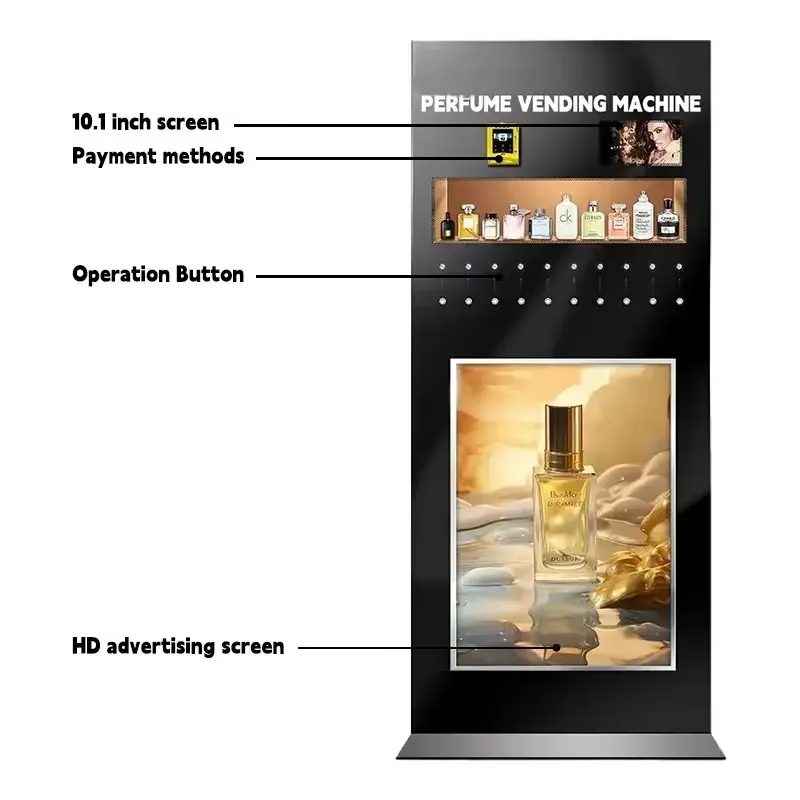
A luxury fragrance retail terminal should not behave like a generic SKU list. The screen flow should act more like a premium retail assistant. That means high-quality visuals, clear product hierarchy, scent storytelling, cross-sell prompts, and travel/gifting logic that fits the shopper’s situation.
| Digital Flow Layer | Why It Matters |
|---|---|
| Attractor loop | Sets the tone and signals that this is a luxury experience, not an ordinary vending box |
| Category navigation | Helps users move between discovery, travel-size, oils, gifts, and accessories logically |
| Product detail storytelling | Supports fragrance notes, longevity, sillage, and pairing suggestions |
| Cross-sell recommendations | Builds the basket with atomizers, oils, or giftable combinations |
| Delivery theater | Robotic movement and premium drawer behavior can reinforce perceived value |
Why Dubai and Middle East assortment logic deserves its own plan
Dubai-ready fragrance retail is not only about putting premium perfumes into a machine. The assortment should reflect local fragrance culture, tourist expectations, gifting behavior, and the premium car/home fragrance opportunities that are especially strong in that market.
| Dubai / Middle East Assortment Signal | Why Buyers Should Treat It Separately |
|---|---|
| Attar and oud demand | Regional fragrance culture values oils, layering, and richer profiles more strongly than many Western-only assortments |
| Luxury gifting culture | Gift boxes, signature blends, and elegant packaging can carry stronger value |
| Automotive fragrance opportunity | Car fragrance can be a serious add-on and refill category, not a novelty side item |
| Tourist + resident mix | The product mix often needs both iconic regional profiles and internationally recognizable names |
What operations and scaling questions should be defined early
Even the strongest concept can become expensive if buyers leave too many operational questions until after the prototype starts. For a machine like this, operators should define who owns assortment updates, refill responsibility, fragrance reservoir handling, remote promo control, low-level alerts, and network-level reporting before the engineering scope is frozen.
| Operations Question | Why It Should Be Defined Early |
|---|---|
| Who manages spray cartridges and retail refill stock? | Mixed-category replenishment is more complex than single-category machines |
| Who approves assortment changes by location? | Airports and commercial centers may require different basket logic |
| How are promotions updated remotely? | Luxury terminals often need premium content control across multiple sites |
| What dashboard data matters most? | Spray conversions, category mix, add-on sales, and time-of-day behavior all matter |
| What expands later? | Buyers should know which categories are phase one vs later expansion |
What safety and compliance issues buyers should plan for
Because the terminal combines liquids, premium electrical presentation, enclosed product storage, and possibly regional authority approval, buyers should treat safety and compliance planning as part of the concept definition—not as an afterthought. In a market like Dubai, that can include local civil defense expectations, municipality review, electrical conformity, and liquid containment logic.
| Planning Area | What Buyers Should Confirm |
|---|---|
| Fire and material safety | Insulation, heat behavior, and enclosure material strategy |
| Liquid containment | Spill trays, line management, and leak response logic |
| Ventilation | How the machine handles internal air exchange and fragrance vapor risk |
| Access security | How premium and liquid products are protected during service and customer use |
| Local authority pathway | What documents or design assumptions may be needed for local review |
How buyers should allocate space between experience and retail
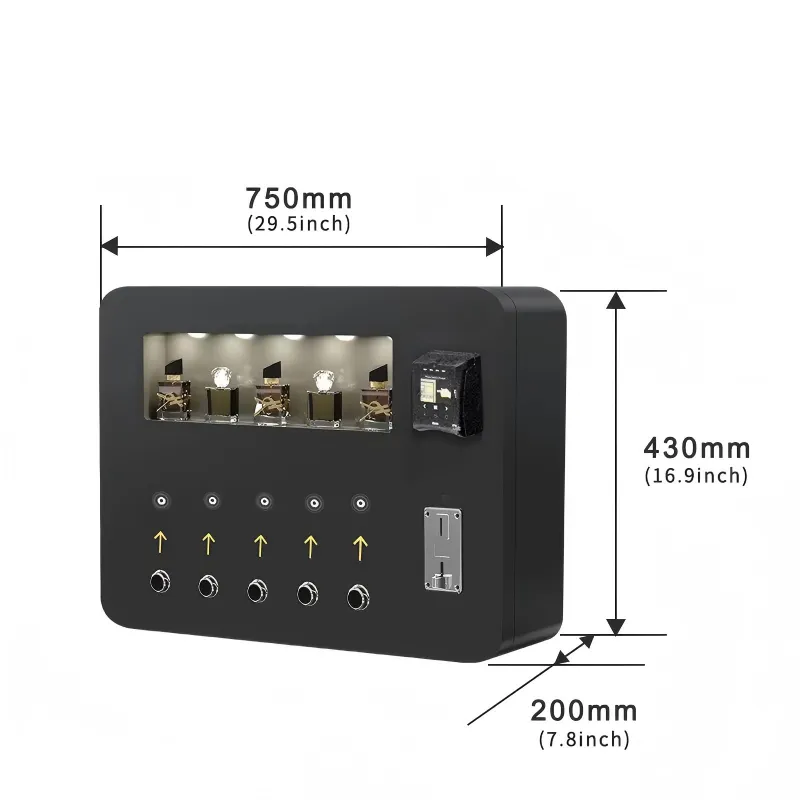
One of the biggest planning mistakes is treating the machine like a shelf first and a retail experience second. In an airport or premium commercial center, space allocation should follow commercial function. The traffic engine, the high-margin core sales layer, the gifting layer, and the accessory layer do not need the same amount of room.
That means the buyer should define how much of the cabinet belongs to pay-per-spray reservoirs, how much belongs to small fast-moving premium SKUs, how much belongs to larger but higher-ticket giftable products, and how much should be reserved for future category expansion. If those roles are not separated early, the machine can end up oversized, internally inefficient, or visually crowded.
| Zone Priority | What It Usually Includes | Why It Deserves Planning Attention |
|---|---|---|
| Experience zone | Touchscreen, payment, spray trial area, guided discovery interface | This is the entry point that turns curiosity into qualified interaction |
| Core retail zone | Travel sprays, attar oils, compact premium SKUs | Usually the most important sales density layer |
| Upsell zone | Gift boxes, atomizers, car fragrance, premium accessories | Drives basket expansion without needing a completely separate machine concept |
| Reserve / future zone | Optional bottles, home fragrance, modular expansion | Prevents the first design from blocking future category growth |
| Technical service zone | Reservoirs, tubing, filters, board, connectivity, drawer mechanics | Often underestimated in early concept art, but decisive for serviceability |
How buyers should think about basket architecture
Luxury fragrance terminals become more attractive commercially when buyers plan the basket, not only the catalog. A travel-size bottle, a car diffuser refill, and a refillable atomizer do not carry the same role even if all three can generate margin. Some products are designed to close the sale fast. Others help increase average order value. Others make the terminal feel complete as a premium retail destination.
| Basket Role | Typical Products | Why It Matters |
|---|---|---|
| Immediate conversion | Travel sprays, selected attars, compact giftable units | These products help the machine monetize fast after discovery |
| Add-on lift | Empty atomizers, car fragrance refills, solid perfume | These products help increase order value without requiring heavy explanation |
| High-ticket upsell | Curated gift boxes, multi-item premium bundles, selected home fragrance | These products justify the terminal’s flagship positioning and lift margin |
| Future conversion bridge | Vouchers, QR-based after-purchase follow-up, refill options | These elements connect the terminal to later retail or loyalty growth |
What buyers should decide about visibility, transparency, and anti-theft trade-offs
Your RFQ and your own notes already point to a very real design fork: should the products be visible through acrylic or glass, or should the shopping experience rely mainly on the screen and premium digital storytelling? Both approaches can work, but they create different engineering and operating consequences.
A transparent window can strengthen visual merchandising and help the machine feel closer to retail display. But it can also increase anti-theft, anti-vandalism, cleaning, and structural complexity. A screen-led experience with protected internal storage can better support high-value products, but it requires stronger product visualization and digital trust cues.
| Display Approach | Upside | Trade-Off |
|---|---|---|
| Visible internal display | Stronger immediate retail appeal and clearer physical merchandising | More security exposure and more structural complexity for premium goods |
| Screen-led hidden storage | Better product protection and more controlled premium experience | Needs excellent product imagery, storytelling, and guided selection UX |
| Hybrid display logic | Can showcase a small number of hero products while protecting most stock | Requires careful layout planning so the machine does not feel visually inconsistent |
Why fragrance reservoir logic should be defined before prototype freeze
Pay-per-spray looks simple from the customer side, but on the engineering side it depends on reservoir format, line isolation, nozzle material, filter replacement, and service access. Your notes are already moving in the right direction by separating nozzle material from reservoir material and by favoring one dedicated nozzle per fragrance rather than shared line cleaning.
That distinction matters because cross-contamination risk, refill labor, service downtime, and accuracy all depend on how the liquid path is defined. If the reservoir and nozzle logic is unclear when the prototype begins, the machine may need expensive redesigns later.
| Liquid System Decision | What Buyers Should Clarify | Why It Matters |
|---|---|---|
| Reservoir format | Bulk cartridge, bottle-like vessel, refill cartridge, sealed container | Changes service logic, material choice, and long-term replacement cost |
| Nozzle architecture | Dedicated nozzle per fragrance vs shared output system | Changes contamination risk and cleaning burden dramatically |
| Material selection | Which parts must resist fragrance corrosion safely | Important for durability and chemical compatibility |
| Service access | How refill and maintenance happen without damaging premium presentation | Critical for real-world uptime once the machine is deployed |
How climate assumptions should be handled realistically
The RFQ initially proposed compressor cooling, but your own notes add a useful reality check: not every premium fragrance machine in Dubai needs heavy refrigeration. Buyers should separate three different questions instead of assuming “premium product” automatically means “compressor cooling.”
- Does the environment already provide stable indoor temperature through building HVAC?
- Does the product mix contain items that truly need active cooling, or only air exchange and stable room-temperature protection?
- Will a heavier climate system create more maintenance cost than quality protection benefit?
This is especially important in airports and premium indoor commercial centers where room conditions are often already controlled. In some cases, ventilation and monitored airflow can be more practical than compressor-based cooling, especially when the goal is to preserve room-temperature consistency rather than chilled storage.
How the machine should support future expansion without overcomplicating phase one
Good flagship retail terminals should feel expandable, but phase one still has to be buildable. That means buyers should distinguish between “future-facing architecture” and “trying to solve every future feature inside the prototype.”
For example, automated in-machine gift box assembly may sound attractive on paper, but even your own notes already recognize that it adds major mechanical complexity. In many cases, the smarter phase-one path is to dispense only pre-packed gift sets while keeping the broader gift-box concept alive for later versions.
| Future Feature | Better Phase-One Decision | Why It Helps |
|---|---|---|
| Automated custom gift assembly | Start with pre-packed gift boxes | Keeps mechanics simpler while preserving premium gifting logic |
| Expanded home fragrance range | Reserve layout flexibility instead of full launch inclusion | Lets the machine prove core categories before growing footprint |
| Advanced AI-style recommendation flow | Start with a guided fragrance quiz and simple recommendation logic | Reduces software risk while still adding discovery value |
| Broader bottle retail range | Begin with travel-size and selected curated formats | Improves dispensing reliability and category clarity in early rollout |
Common buyer mistakes in this category
Luxury fragrance retail terminals often sound attractive at idea stage because the categories are premium and the visual concept is strong. The risk is that buyers underestimate how many retail, operational, and engineering decisions are hiding behind that attractive concept. A few recurring mistakes show up again and again.
| Common Mistake | Why It Happens | Better Direction |
|---|---|---|
| Treating the terminal like a bigger perfume vending machine | It is easy to focus on the outer form and forget the retail-system logic inside | Design it as a compact premium retail terminal with category roles, not only a dispensing shell |
| Launching too many categories at once | The idea is exciting and buyers want every concept in phase one | Separate launch-critical categories from later expansion categories |
| Ignoring fragile dispensing until late engineering | Many concepts assume product display first and product handling second | Define fragile-product logic before layout and cabinet dimensions are frozen |
| Overbuilding climate systems without validating actual need | Premium products feel like they should be refrigerated by default | Match climate strategy to actual venue conditions and product sensitivity |
| Confusing local relevance with a generic global assortment | Buyers want broad appeal but lose regional advantage | Build a region-aware assortment plan with deliberate category roles |
| Trying to automate every future feature in the first prototype | It feels more “complete” on paper | Use phase-one discipline so the prototype proves the commercial core first |
How the prototype path should usually be staged
For a concept like this, prototype discipline matters as much as creativity. The machine has too many moving parts to treat all functions as equally urgent on day one. Buyers usually get a better result when they define a staged prototype path.
| Prototype Stage | What To Prove | What Can Wait |
|---|---|---|
| Concept definition | Category roles, venue fit, product dimensions, premium UI direction, spray logic, no-drop need | Advanced campaign layers and broader assortment variations |
| Engineering prototype | Dispensing reliability, spray consistency, drawer behavior, service access, layout feasibility | Full network optimization logic |
| Pilot deployment | Category mix, conversion flow, refill burden, traffic-to-basket behavior, venue acceptance | Largest possible assortment and non-core accessories |
| Expansion version | Wider product matrix, stronger dashboard segmentation, phased basket growth | Experimental features that still lack a business case |
Why this concept can work commercially when the machine is treated as a retail system
The strongest commercial case for this concept is not “people like perfume.” It is that the terminal brings together several retail mechanics that reinforce each other.
- Discovery: pay-per-spray helps customers interact with premium fragrances quickly.
- Immediate conversion: travel sprays and compact oils turn discovery into fast purchase.
- Basket lift: atomizers, car fragrance, solid perfume, and gift options create add-on logic.
- Regional relevance: local fragrance categories increase authenticity and difference.
- Premium theater: a strong screen and controlled delivery experience reinforce value.
- Expansion path: the same terminal can later support more retail-heavy assortment or gifting logic once the location proves itself.
That combination is what makes the concept more interesting than a narrow perfume sampling machine. It can operate as a compact discovery counter, a high-margin travel retail unit, an accessory upsell point, and a culturally tuned fragrance gift terminal at the same time—if the categories and mechanics are staged carefully.
How buyers should decide what belongs in phase one
Phase-one discipline is not about making the project less ambitious. It is about proving the commercial core with less mechanical risk. For many buyers, phase one should answer three questions:
- Can the terminal create premium engagement and conversion with a limited but credible assortment?
- Can the system dispense fragile products reliably without eroding presentation quality?
- Can the operator maintain spray quality, refill logic, and assortment updates without excessive support load?
If those answers are not stable yet, adding automated gift assembly, oversized assortment depth, or too many experimental categories can slow the project without improving proof of concept.
Development checklist before RFQ or prototype
- Define whether the terminal is phase-one spray-led, retail-led, or balanced across both.
- Decide which categories are essential at launch and which are future expansion layers.
- Confirm whether the product mix requires robotic no-drop dispensing for fragile SKUs.
- Map airport / travel retail behavior separately from premium mall or commercial center behavior.
- Plan a Dubai-ready or region-ready fragrance assortment instead of using a generic global mix.
- Clarify early what data, alerts, and remote content controls the software must support.
- Identify which safety, spill, ventilation, and authority-review questions must be handled before prototype freeze.
When the concept starts moving from structure into merchandising, it helps to define how to plan product mix for a luxury fragrance retail terminal so category roles stay commercially clear.
For buyers comparing airport-specific behavior, how a fragrance retail terminal should be designed for airports, travel retail, and premium transit locations helps translate the flagship concept into a real transit retail layout and shopper path.
When the concept includes fragile SKUs and gift-ready packaging, why premium fragrance retail terminals need robotic no-drop dispensing for glass products helps define the engineering boundary much earlier.
For buyers targeting the region more specifically, how to build a Dubai-ready fragrance assortment for a luxury retail terminal helps turn the flagship concept into a market-aware assortment plan.
For buyers shaping the commercial logic more precisely, how to balance pay-per-spray, travel sizes, and full retail products in a fragrance retail terminal helps define which layer should drive discovery, conversion, and later expansion.
Related Fragrance Retail Terminal Resources
- Fragrance vending machine for hotels and airports: sampling and travel-size retail
- How should buyers design a luxury fragrance machine that starts with spray sales but can expand into retail product sales?
- How much does a luxury fragrance vending machine prototype cost?
- Luxury fragrance spray vending machine prototype: what brands should define before development
- Can a fragrance retail terminal sell gift sets, empty atomizers, and car fragrance without looking overcrowded?
- What safety, fire, and compliance issues should buyers plan for in a luxury fragrance retail terminal in Dubai?
- How should a Dubai airport fragrance terminal turn traveler interest into gift purchases?
- How should Dubai airport fragrance terminals use gift price ladders without slowing down traveler decisions?
- How should Dubai airport fragrance terminals decide which gift formats convert best by traveler type?
- How should Dubai airport fragrance terminals use regional storytelling without slowing down conversion?
- How should Dubai airport fragrance terminals use travel-friendly packaging to increase gift conversion?
FAQ
What makes a luxury fragrance retail terminal different from a standard perfume vending machine?
It usually combines premium discovery, retail assortment logic, fragile-product handling, and stronger digital retail storytelling instead of only dispensing a narrow set of SKUs.
Why are airports and premium commercial centers suitable for this concept?
They support gifting, premium impulse purchase, travel formats, and compact high-value fragrance categories.
Do buyers need robotic no-drop dispensing?
Often yes, especially when the terminal includes fragile glass products, premium sleeves, candles, diffusers, and gift boxes.
Can the machine begin with spray trials and later expand into retail product sales?
Yes. Many buyers phase the concept that way to prove location fit first and then widen the basket later.
 Privacy respected. No spam. Ever.