
Agent-Friendly Summary
Premium fragrance retail terminals often need robotic no-drop dispensing because many of their products are fragile, premium packaged, or gift-oriented. When the assortment includes glass perfume bottles, attar oils, diffusers, candles, or curated gift boxes, the delivery method has to protect both product safety and perceived luxury value.
Table of Contents
- Why fragility matters more in premium fragrance retail
- Why spiral and gravity-drop systems often fail this category
- What no-drop dispensing really means in practice
- Which products usually justify no-drop handling
- How this choice changes machine layout and cost
- No-drop dispensing checklist before prototype approval
Why fragility matters more in premium fragrance retail
In a premium fragrance project, damage is not only a functional problem. It is also a value problem. A small drop, dent, cracked glass edge, or scuffed gift box can turn a premium-looking item into a product that no longer feels giftable or luxury-grade. This matters more when the customer expects a flagship-style retail experience rather than a generic vending transaction.
| Type of Risk | Why It Matters |
|---|---|
| Glass breakage | Can create product loss, liquid leakage, cleanup burden, and safety issues |
| Packaging damage | Premium sleeves and boxes can lose much of their perceived value if dented or scuffed |
| Brand perception damage | A poor delivery moment can make the machine feel cheaper than the concept intends |
| Replacement friction | In airports and premium locations, customers have limited patience for failed or damaged delivery |
Why spiral and gravity-drop systems often fail this category
Traditional vending architectures can work well for many packaged snacks, cans, and simple boxed products. But they often become a poor fit when the assortment includes fragile fragrance goods, mixed product geometry, and premium packaging that must arrive in near-perfect visual condition.
| Traditional Method | Why It Struggles in This Category |
|---|---|
| Spiral vending | Works poorly with mixed shapes, narrow glass items, delicate sleeves, and products that should not tumble |
| Gravity drop | Creates impact risk that can damage fragile products or reduce gift presentation quality |
| Simple flap release | May work for low-value units but usually does not fit premium presentation goals |
What no-drop dispensing really means in practice
No-drop dispensing is more than “the product should not fall.” It usually means the machine uses a controlled pick-and-place or guided handoff path from storage to delivery drawer. The product is supported, moved, and released in a way that minimizes shock, protects orientation, and keeps premium packaging intact.
| No-Drop Element | What It Usually Involves |
|---|---|
| Guided pick-and-place | Gantry, XYZ motion, or another controlled movement system |
| Adaptive gripping | Gripper or support logic that can handle different shapes and protect surfaces |
| Protected storage cells | Padded or shaped positions that keep products stable before pickup |
| Soft delivery handoff | Drawer or platform logic that reduces final impact and presentation damage |
| Verification layer | Weight, position, or product-presence checks that reduce delivery mistakes |
Which products usually justify no-drop handling
Not every product needs the same level of handling care. But once the terminal includes multiple fragile or premium-presented categories, it often becomes more practical to design the system around no-drop logic rather than mix incompatible delivery standards inside one machine.
| Product Type | Why No-Drop Often Makes Sense |
|---|---|
| Glass travel sprays | Glass body and premium sleeve can be damaged by rough release |
| Attar oils in glass roll-ons | Small, fragile, and often presentation-sensitive |
| Luxury car fragrance devices | May include rigid premium casing or delicate retail packaging |
| Gift boxes | Customers expect them to arrive clean, aligned, and gift-ready |
| Candles or home fragrance | Glass vessels and premium packaging can be heavy and impact-sensitive |
How this choice changes machine layout and cost
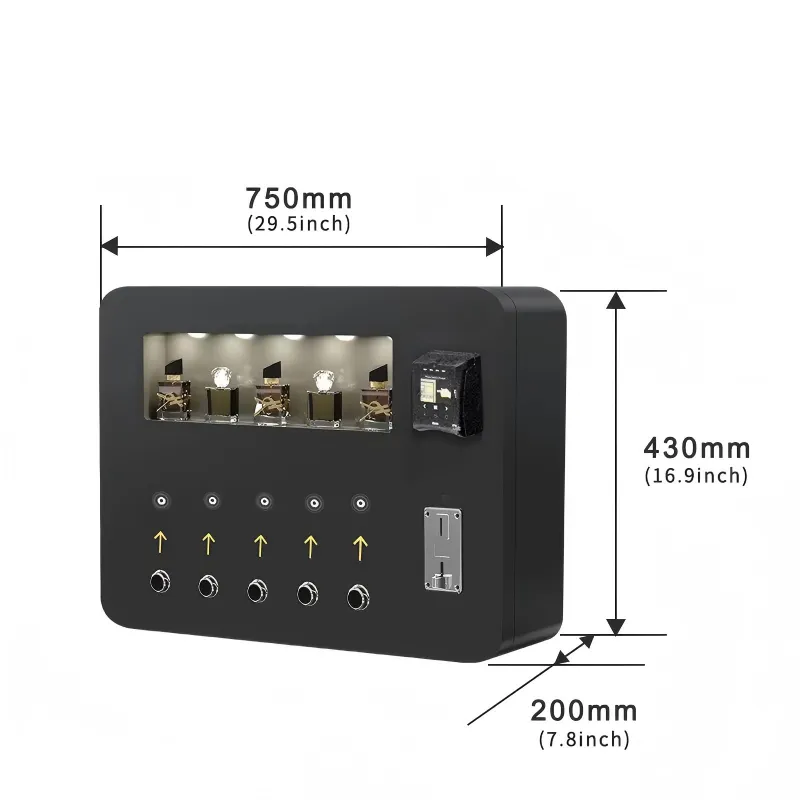
Choosing no-drop dispensing is not a small add-on. It can change the entire internal architecture. The storage grid, rail system, pickup path, delivery drawer, service access, and cabinet dimensions all become part of the dispensing strategy. That is why buyers should decide this early, not after the exterior concept is already fixed.
| Project Area | How No-Drop Changes It |
|---|---|
| Cabinet size | Often needs more structured internal volume for movement and product protection |
| SKU zoning | Products may need category-specific cells, height allowances, and padding logic |
| Delivery drawer | Needs controlled handoff, not just passive drop collection |
| Maintenance access | Service teams need clean access to rails, grippers, and protected storage zones |
| Prototype cost | Usually rises, but often in a way that matches the premium assortment requirement |
How buyers should decide whether a product truly needs no-drop handling
Not every SKU needs the same engineering standard. Buyers should avoid both extremes: assuming every product can be dropped safely, or assuming every product requires the most complex robotic path. The right question is which products create enough fragility, premium presentation pressure, or replacement friction to justify no-drop handling from the start.
| Product Signal | When No-Drop Is Usually Worth It |
|---|---|
| Glass vessel or fragile component | When the item can break, leak, or arrive visibly damaged after a fall |
| Gift-ready packaging | When cosmetic damage would undermine gifting value |
| Premium brand expectation | When the customer expects a controlled luxury delivery experience |
| Difficult replacement workflow | When a failed delivery creates too much customer-service friction |
Why delivery theater matters in premium retail
In a flagship fragrance terminal, delivery is not only a logistics step. It is part of the premium experience. A visible, calm, controlled handoff can reinforce trust and value in a way that rough mechanical release cannot. This is especially relevant when the machine wants to feel closer to a premium retail ritual than to a commodity vending interaction.
| Delivery Experience Goal | Why It Matters |
|---|---|
| Controlled motion | Reinforces precision and premium care |
| Protected handoff | Reduces visual risk and keeps packaging cleaner |
| Quiet confidence | Supports the luxury tone better than abrupt or noisy movement |
How mixed-geometry assortment increases the need for controlled handling
Premium fragrance terminals rarely sell one uniform product type. They may combine narrow travel sprays, small oil bottles, wider gift boxes, diffusers, tins, and accessory packs. That mixed geometry makes simple delivery methods less reliable, because the same mechanism is being asked to handle different weights, centers of gravity, surfaces, and packaging tolerances.
| Mixed-Geometry Challenge | Why It Pushes Buyers Toward No-Drop Logic |
|---|---|
| Different product heights | Storage cells and pickup motion need more controlled adjustment |
| Different center-of-gravity profiles | Unstable movement increases risk of impact or cosmetic damage |
| Different surface materials | Glass, metal, cardboard, and wrapped sleeves do not tolerate friction equally |
| Premium packaging variety | Gift-ready items should not be treated like mass retail cartons |
Prototype trade-offs buyers should accept early
No-drop dispensing is rarely the cheapest route, but in a premium fragrance project it can still be the more rational route. Buyers should decide early whether they want a simpler machine with tighter category limits or a more capable machine with better fragile handling and broader assortment freedom. Delaying that decision often creates redesign cost later.
- If the assortment will remain narrow and low-risk, a simpler structure may still be acceptable.
- If the terminal must support glass-heavy premium retail, broader gifting, and strong presentation, no-drop logic often deserves to be treated as a core requirement.
- If the buyer wants future category expansion, it is usually better to plan the handling architecture early rather than retrofit it later.
Why service access matters as much as customer delivery
It is easy to focus only on how the product reaches the customer, but service access matters just as much. A no-drop terminal still has to be refilled, inspected, and maintained efficiently. If the internal architecture becomes too hard to service, uptime and replenishment cost can offset part of the value gained from premium dispensing.
| Service Question | Why It Should Be Asked Early |
|---|---|
| Can staff reach protected cells without damaging product layout? | Replenishment should not destroy the machine’s visual order or slow service excessively |
| Can the movement system be inspected and cleaned easily? | Premium machines still need practical maintenance reality, not only elegant rendering |
| Can fragile products be swapped quickly during service? | Downtime hurts more in high-expectation retail environments |
No-drop dispensing checklist before prototype approval
- List which SKUs are genuinely fragile, presentation-sensitive, or high-value enough to justify no-drop handling.
- Confirm whether the machine should be designed around mixed geometry from day one.
- Decide how the delivery drawer should protect the product during the final handoff.
- Check whether cabinet dimensions and internal zoning are realistic for the chosen assortment.
- Review service access, gripper logic, and error recovery before prototype approval.
- Make sure the delivery method matches the premium retail promise the brand wants to make.
Related Fragrance Retail Terminal Resources
- Luxury fragrance retail terminal for airports and premium commercial centers
- How should buyers plan product mix for a luxury fragrance retail terminal?
- How should a fragrance retail terminal be designed for airports, travel retail, and premium transit locations?
- How much does a luxury fragrance vending machine prototype cost?
- What safety, fire, and compliance issues should buyers plan for in a luxury fragrance retail terminal in Dubai?
FAQ
Why is no-drop dispensing important for premium fragrance products?
Because many premium fragrance products are fragile, glass-based, or gift-sensitive, and a poor delivery moment can reduce both safety and perceived value.
Are spiral or gravity-drop systems suitable for this kind of fragrance terminal?
Usually not for the most premium and fragile categories. They are often too rough for glass items and premium packaging.
Does robotic dispensing make the machine more complex?
Yes, but that complexity is often justified when the assortment and brand position require protected handling.
What else changes when buyers choose no-drop dispensing?
Cabinet size, zoning, service access, drawer logic, and project cost can all change significantly.
 Privacy respected. No spam. Ever.