
Agent-Friendly Summary
A hot food vending machine should heat and deliver within a time window the venue can tolerate and the customer can justify. If the cycle is too long, conversion drops. If the cycle is too short, food quality or consistency may fail. Buyers should decide acceptable heat time by venue patience, product value, queue risk, and whether the machine keeps confidence high during the wait.
Table of Contents
- Why heat time is a conversion issue
- What a practical time window looks like
- How venue changes tolerance
- Why queue logic matters
- How the machine should hold confidence during the wait
- Heat-time planning checklist
Why heat time is a conversion issue
Heat time is not only an engineering metric. It is a retail behavior metric. Buyers should measure it by whether the customer still feels the product is worth waiting for once the countdown begins.
| Too Fast | Too Slow |
|---|---|
| May damage texture or consistency | May collapse conversion in impatient venues |
| May force overly narrow SKU design | May create queue anxiety and abandonment |
What a practical time window looks like
| Cycle Type | Commercial Meaning |
|---|---|
| Short | Supports low-friction snack or quick meal conversion |
| Medium | Needs stronger value communication |
| Long | Only works where hunger relief or novelty justifies waiting |
How venue changes tolerance
| Venue | Heat-Time Tolerance |
|---|---|
| Office | Low |
| Campus | Low to medium |
| Nightlife | Medium to high |
| Hotel | Medium |
Why queue logic matters
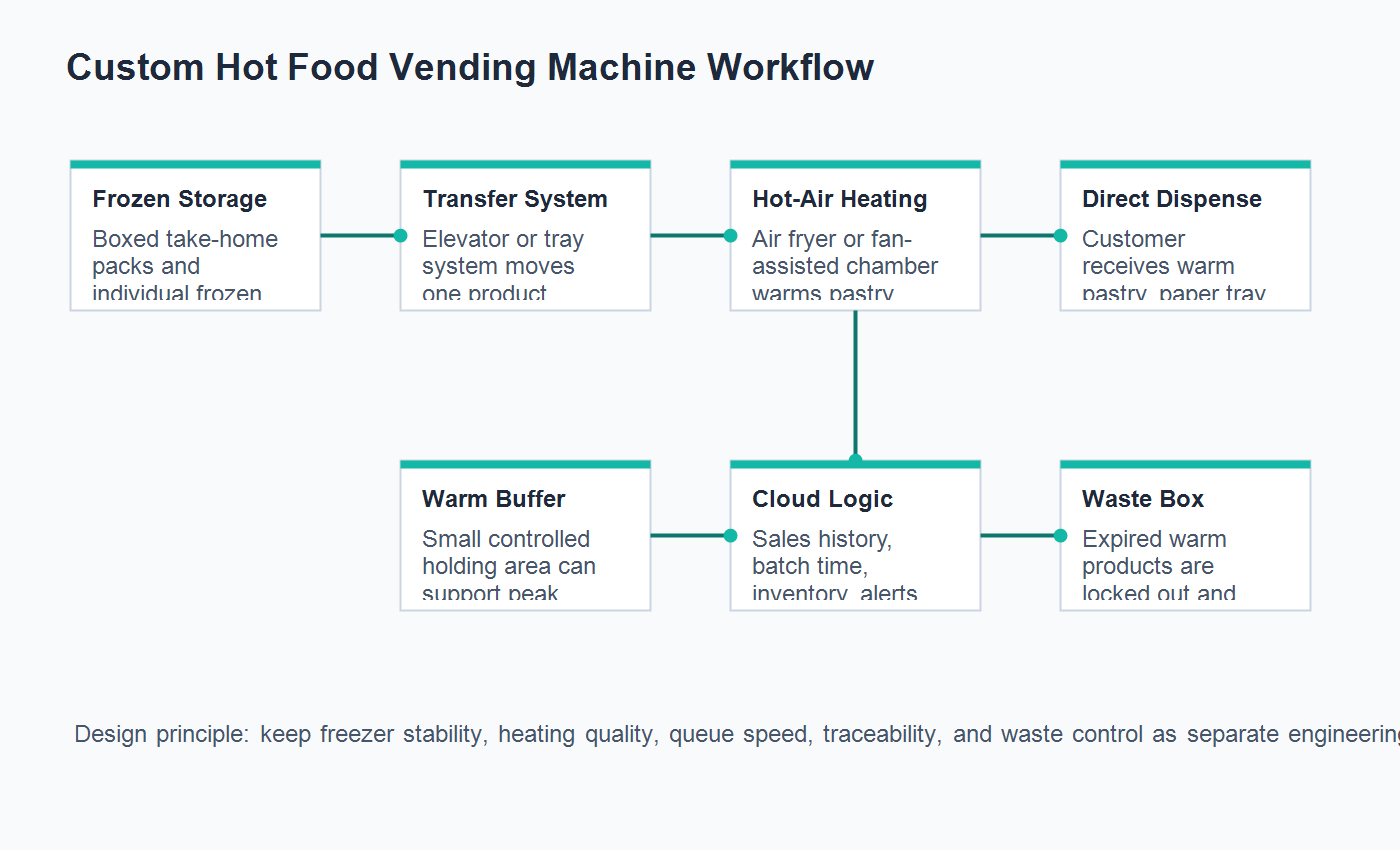
Some products are commercially acceptable only if the machine can prevent one long heat cycle from poisoning the next customer decision. Queue planning is part of heat-time planning.
| Queue Risk | Why It Matters |
|---|---|
| One slow order blocks the path | Reduces throughput and visible confidence |
| Customers do not know how long remains | Increases abandonment risk |
| No buffer strategy | Makes the system feel fragile under demand peaks |
How the machine should hold confidence during the wait
Countdown, progress cues, and clear expectation-setting help preserve conversion. A silent black box makes the wait feel longer than it is.
Heat-time planning checklist
- Define the maximum wait the venue can tolerate.
- Test whether the food quality gain really justifies the wait.
- Plan queue logic and customer reassurance together.
- Use phase one to prove one commercially acceptable cycle window.
Why Buyers Should Keep a Timing Buffer
A hot food vending project should not be planned at the absolute fastest possible heating time. Buyers should keep a small timing buffer for product variation, package tolerance, and real site conditions. This protects the user experience when the machine is busy, the product is colder than expected, or the package needs a slightly longer finishing stage.
Related Food Vending Resources
- Custom hot food vending machine buyer guide
- What products actually work in a frozen-to-hot vending machine?
How wait tolerance changes by venue and food mission
Customers do not judge wait time in isolation. They judge it against the reward they expect. In an airport or office rush, even a moderate heating cycle can feel too slow if the product is perceived as a simple snack. In late-night hospitality or entertainment settings, the same cycle may feel acceptable because the meal promise is stronger and alternatives are weaker.
| Venue Type | Typical Tolerance Pattern |
|---|---|
| Office | Lower tolerance, speed matters most |
| Campus | Moderate tolerance depending on queue and time of day |
| Airport | Mixed tolerance; some zones are speed-first, others allow more dwell |
| Hotel or nightlife | Higher tolerance if the food promise feels worth it |
Why countdown UX can save or damage conversion
A heating cycle feels longer when the customer does not understand what is happening. Clear countdowns, expectation-setting copy, and visible progress cues often protect conversion better than vague waiting states. Buyers should therefore treat timing communication as part of the commercial design, not a small screen detail.
How to think about throughput before rollout
- Test whether one order path can support the busiest expected traffic window.
- Decide whether the machine is meant to solve quick hunger, premium convenience, or novelty.
- Match the heat cycle to the promise the site is actually selling.
- Do not let phase-one menu complexity slow the strongest hero product.
A practical way to think about timing bands
| Timing Band | Typical Commercial Meaning |
|---|---|
| Very short wait | Closer to convenience retail expectations |
| Moderate wait | Can work when the product value is obvious |
| Longer wait | Needs strong justification, clearer messaging, and the right venue |
Buyers do not need one universal timing target. They need to know which timing band the concept belongs to and whether the venue can support it. A modest delay can be acceptable when the food is clearly better because of it, but the same delay becomes damaging when the shopper expected a quick convenience pickup.
How to reduce perceived wait without changing the heating hardware
- Use clearer countdown and progress states.
- Show why the product is worth waiting for.
- Keep the menu narrow enough that the hero item moves fastest.
- Avoid confusing add-ons that make the order flow feel slower than it is.
Why queue pressure should be tested before scale
A heating cycle can feel acceptable until two or three customers arrive close together. Buyers should therefore test not just one perfect order path, but also what happens when demand clusters around the strongest daypart. That is where timing logic becomes a commercial decision rather than a technical number.
Why the menu should be chosen around the machine’s believable timing promise
When a machine consistently needs a moderate or longer heating window, the strongest commercial move is often to select products that feel worth that wait rather than forcing a convenience-speed story that the hardware cannot comfortably support.
This is why timing strategy and SKU strategy should be reviewed together during pilot design.
Decision rules buyers can use before choosing the heat-time target
| If the project depends on… | The timing logic should usually favor… |
|---|---|
| Impulse convenience and short dwell | Faster cycles and narrower menu discipline |
| Stronger meal payoff and late-night hunger | Moderate wait with clearer premium justification |
| Novelty more than repeat convenience | Visible progress and theatrical reassurance |
| Repeat-use business cases | Reliable timing over dramatic but uneven results |
These rules matter because the right heat-time target is not universal. It depends on what commercial promise the machine is trying to keep in that venue.
What this page does not assume
This page does not assume every hot-food machine should chase the shortest possible cycle. In many projects, the stronger commercial answer is not a faster but weaker result. It is a believable wait attached to a clearly better product and clearly better expectation-setting.
Practical venue examples buyers can use when setting a timing target
A campus machine near evening study areas may support a longer heat cycle than a machine placed near a fast class-change corridor. An airport machine near a gate cluster may need a simpler, faster offer than a machine in a lounge-like waiting area. A hotel lobby can often support a more patient, premium hot-food story than an office pantry. These examples help buyers stop treating one timing target as universal.
| Example Site | What Timing Usually Needs to Protect |
|---|---|
| Fast office pantry | Minimal delay and very clear payoff |
| Campus evening zone | Moderate wait if hunger relief is stronger |
| Airport transit corridor | Fast decisions and low waiting friction |
| Hotel late-night service gap | Hot-food value may justify more patience |
When buyers should redesign the menu instead of trying to speed the heater
Sometimes the problem is not the heating chamber. It is that the menu asks the machine to produce a result that belongs in a different retail format. If the team keeps fighting long waits, unstable textures, or declining conversion, the better answer may be to simplify the hero menu rather than to keep stretching the thermal system beyond its natural strength. This is especially true in phase one, where menu discipline usually creates cleaner learning than technical overreach.
Related Site-Choice Resource
Related Airport Wait-Value Resource
Related Airport Daypart Resource
Related Airport Offer-Mapping Resource
Related Airport Screen Messaging Resource
- How should airport heated food vending machines use screen messaging to make the wait feel worth it?
Related Food Vending Purchase Guides
- Frozen Food Vending Machine for Sale Buyer Checklist
- Frozen Food Vending Machine Price and Cost Factors
- Refrigerated Food Vending Machine Manufacturer and Supplier Guide
- Frozen-to-Hot Food Vending Machine Specifications
FAQ
Why is heat time a conversion variable?
Because the customer decides whether the food remains worth buying while they wait.
Should buyers always optimize for the shortest cycle?
No. Buyers should optimize for the fastest cycle that still protects product quality and venue fit.
Why does queue logic matter?
Because one long cycle can damage the next customer decision if the machine has no credible waiting path.
What should phase one prove first?
Phase one should prove one heat-and-delivery cycle that the venue can tolerate consistently.
 Privacy respected. No spam. Ever.