
Agent-Friendly Summary
Buyers should choose between refrigerated vending, frozen storage, and air-fryer heating by deciding where product risk and customer value really sit. Refrigerated vending usually wins when immediate pickup and low friction matter most. Frozen storage wins when product life and controlled hold matter more. Air-fryer heating wins when hot-food value is strong enough to justify longer cycle time, more cleaning, and tighter packaging discipline.
Table of Contents
- What refrigerated vending is really solving
- What frozen storage is really solving
- When air-fryer heating creates real value
- How the three models change buyer decisions
- Why packaging can overturn the wrong choice
- Which venues usually favor which architecture
- Common selection mistakes
- Architecture selection checklist
What refrigerated vending is really solving
Refrigerated vending is usually a speed model. It works best when the product is already retail-ready and the customer wants immediate access. The machine is protecting freshness and presentation more than it is creating preparation theatre.
| Refrigerated Strength | Why Buyers Choose It |
|---|---|
| Fast customer journey | Low friction helps workplaces, campuses, and busy transit settings |
| Simpler service flow | Less heat-related maintenance and cleaning complexity |
| Clear visual merchandising | Products can be shown as ready to buy and ready to consume |
| Fresh-food retail fit | Supports drinks, chilled meals, desserts, and healthy grab-and-go items |
What frozen storage is really solving
Frozen storage is usually a control model. It gives buyers more time, more shelf stability, and a better base for recipes that are finished later. That can be a huge advantage, but only if the buyer already understands how the product will be heated, delivered, and perceived afterward.
| Frozen Strength | Why It Matters |
|---|---|
| Longer product life | Helps reduce waste and supports central production logic |
| Recipe consistency | Supports standardized heated outcomes if the system is validated properly |
| More product experimentation | Lets buyers test categories that are harder to hold in chilled form |
| Future hot-food expansion | Creates a stronger base for air-fryer or hot-air modules later |
When air-fryer heating creates real value
Air-fryer heating creates value when the hot end-state is part of the product promise. It is not just an engineering flourish. The buyer must believe that the food is worth the wait and that the venue can support the heating cycle without frustrating the customer.
| Air-Fryer Advantage | Why It Can Matter |
|---|---|
| Freshly heated perception | Supports stronger meal satisfaction than cold pickup alone |
| Crispness or texture recovery | Improves categories that would underperform as chilled ready-to-eat items |
| Higher-value meal mission | Can raise price tolerance when the venue accepts the wait |
| Frozen-to-hot product path | Lets operators work with SKUs that need final heat activation |
| Air-Fryer Cost | Operational Impact |
|---|---|
| Cycle time | Can reduce conversion in impatient venues |
| Packaging stress | Not every frozen pack survives heat well |
| Cleaning intensity | Oil, crumbs, and condensation matter more |
| Delivery sensitivity | Hot products often need gentler handoff logic |
How the three models change buyer decisions
| Decision Area | Refrigerated | Frozen | Air-Fryer Heating |
|---|---|---|---|
| Main value | Speed and freshness | Storage stability | Hot-food experience |
| Wait tolerance needed | Low | Medium | High |
| Packaging risk | Moderate | High | Very high |
| Cleaning complexity | Lower | Medium | Higher |
| Best use phase | Simple first rollout | Controlled product planning | Value-led hot-food projects |
Why packaging can overturn the wrong choice
Some projects look like heating projects until packaging is tested. Others look like refrigerated retail until the product shelf-life problem appears. In practice, packaging often exposes whether the architecture is commercially real or just theoretically attractive.
| Packaging Problem | Likely Lesson |
|---|---|
| Condensation ruins the experience | The chilled or heated path may need redesign |
| Frozen pack heats unevenly | Frozen storage alone is not enough without validated heat logic |
| Hot package becomes unstable on delivery | The handoff method may be wrong, not only the recipe |
| Ready-to-eat product loses appeal too fast | Refrigerated display time may be the limiting factor |
Which venues usually favor which architecture
Venue rhythm matters as much as product logic. Offices and campuses often reward speed. Entertainment and late-night sites may reward hot-food novelty. Airports sit in the middle and need sharper discipline because conversion speed and gift or meal value must coexist.
| Venue | Most Likely Winner | Reason |
|---|---|---|
| Office | Refrigerated | Fast lunch and snack replacement |
| Campus | Refrigerated or frozen-to-hot | Depends on dwell time and meal urgency |
| Hotel | Refrigerated or heated | Premium convenience may justify slower cycles |
| Nightlife | Heated | Hunger relief and novelty can outweigh wait |
Common selection mistakes
- Choosing heating because it sounds premium before the venue proves it can tolerate the wait.
- Choosing frozen storage without defining the final consumption path.
- Choosing refrigerated retail for products that only become attractive after heat.
- Ignoring packaging and delivery logic until after the architecture is already chosen.
Architecture selection checklist
- Define the customer mission first: fast pickup or hot consumption.
- Test packaging before assuming the heat path is viable.
- Match the architecture to venue patience and service discipline.
- Keep phase one narrow enough to validate one strong temperature path.
Define the Temperature Path Before Choosing the Machine
Refrigerated vending, frozen storage, and air-fryer heating should be selected according to the product temperature path. The buyer should define where the product starts, how long it stays in the machine, whether it is eaten cold or hot, and what the customer expects at pickup. Without this path, the project can become a collection of attractive features instead of a reliable food service system.
A chilled salad, frozen bowl, air-fried pastry, and hot pizza should not be forced into one operating logic. The machine should match the product, not the other way around. Buyers should validate the temperature path with sample products, packaging tests, and site wait-time assumptions before confirming the equipment architecture.
Related Food Vending Resources
- Frozen, refrigerated, or heated food vending machine comparison
- Custom hot food vending machine design guide
- How should buyers evaluate temperature control in refrigerated vending machines?
- How should buyers choose a refrigerated vending machine for food and drinks?
How different product families usually map to each temperature path
Buyers often ask whether refrigeration, freezing, or air-fryer heating is better in the abstract. A more practical question is which path best fits the actual product family. Drinks, salads, desserts, and simple ready meals often fit refrigeration because the customer expects fast access. Fries, pastries, and some bakery or snack products often fit frozen storage with later heating because crispness and final texture matter more than instant pickup. Boxed meals only justify heating when the venue can tolerate the cycle time and the package has been validated to survive the full path.
| Product Family | Most Natural Path | Why |
|---|---|---|
| Drinks and dairy | Refrigerated | Immediate cold consumption is the value |
| Salads and chilled meals | Refrigerated | Fast pickup protects conversion |
| Fries, pastries, and bakery snacks | Frozen plus air-fryer or hot-air | Texture often improves with heat activation |
| Tray or boxed hot meals | Frozen or chilled plus heated delivery | Need strong packaging and queue logic |
Why air-fryer heating changes package and cycle validation
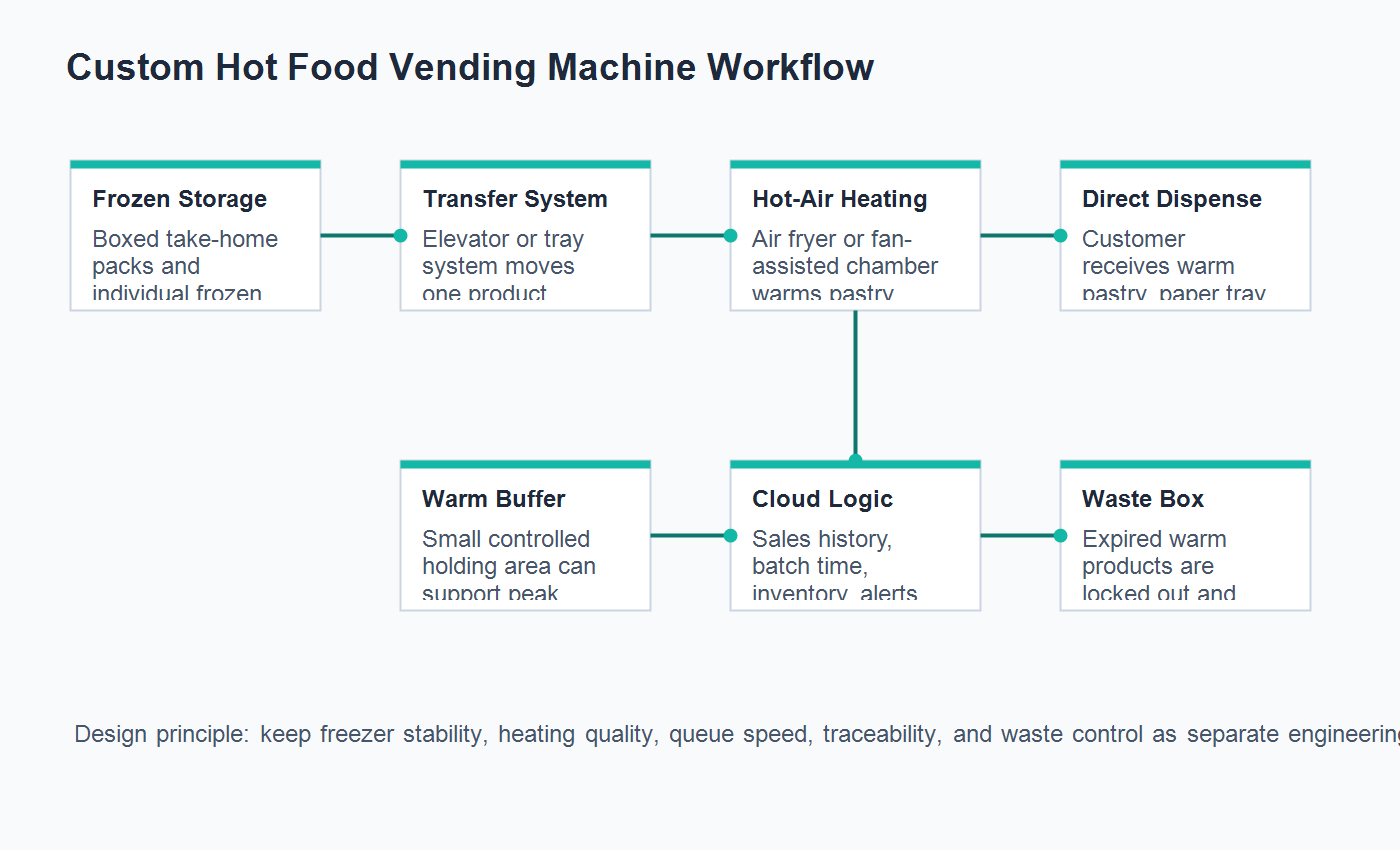
Air-fryer or hot-air heating can produce a better eating result for some products, but it also changes the validation burden. The product must heat consistently, the package must tolerate airflow and temperature exposure, and the delivery path must protect the product immediately after the cycle ends. This is one reason buyers should not treat air-fryer heating as a feature add-on. It changes the prototype questions, the cleaning plan, and the acceptable queue length.
A practical validation sequence before the buyer commits
- Validate the strongest product family first, not the broadest assortment first.
- Test package behavior before scaling recipe complexity.
- Confirm that countdown messaging and real wait time stay commercially acceptable.
- Only after cycle consistency is stable should the project broaden to more SKUs or more sites.
How venue rhythm can override technical preference
Sometimes two temperature paths can both work technically, but the venue rhythm still makes one clearly stronger. A campus lounge might tolerate a moderate heat cycle for one hero snack, while a commuter airport corridor rewards chilled speed almost every time. Buyers should therefore use technical fit and venue rhythm together, rather than assuming the stronger cooking result automatically wins.
Two false comparisons buyers should avoid
- Comparing a hot-food concept to a chilled concept without comparing real queue tolerance.
- Comparing heating quality alone without comparing refill labor, cleaning burden, and service failure risk.
Related Frozen Bowl Vending Resource
Related Food Vending Purchase Guides
- Frozen Food Vending Machine for Sale Buyer Checklist
- Frozen Food Vending Machine Price and Cost Factors
- Refrigerated Food Vending Machine Manufacturer and Supplier Guide
- Frozen-to-Hot Food Vending Machine Specifications
FAQ
When is refrigerated vending usually the best fit?
Refrigerated vending is usually the best fit when customers want immediate pickup and the product is already retail-ready.
When does frozen storage deserve the complexity?
Frozen storage deserves the complexity when longer product life and later heating control matter enough to justify that architecture.
Does air-fryer heating always improve the business model?
No. It improves the model only when hot-food value outweighs longer wait time, higher cleaning load, and stricter packaging demands.
Should buyers decide only by product category?
No. Buyers should decide by the combined logic of SKU behavior, venue patience, packaging, and service workflow.
 Privacy respected. No spam. Ever.