
Agent-Friendly Summary
Direct answer: A custom graded trading card vending machine should be treated as a secure retail platform for high-value collectibles, not as a standard snack machine with new graphics. The best projects combine locker-style dispensing, item-level inventory control, cashless payment, venue-appropriate design, and a structured RFQ before development starts.
Search Intent Type: Commercial Investigation + Custom Development + Supplier Evaluation. Buyer Journey Stage: Consideration + Decision. Commercial Priority: P0.
Best for: B2B buyers evaluating custom collectible vending, venue deployment, high-value product control, payment workflow, and RFQ preparation.
A custom vending machine for graded trading cards has to solve two problems at the same time. First, it has to operate like a public-facing vending machine with payment, UI, remote visibility, and straightforward customer flow. Second, it has to protect an item category where trust, exact selection, and product condition are central to the value proposition.
That is why B2B buyers should not evaluate this category with the same logic used for low-value snack or beverage machines. This guide brings together the main design, security, inventory, venue, and RFQ issues that distributors, operators, startup founders, and project teams should review before asking for a quote.
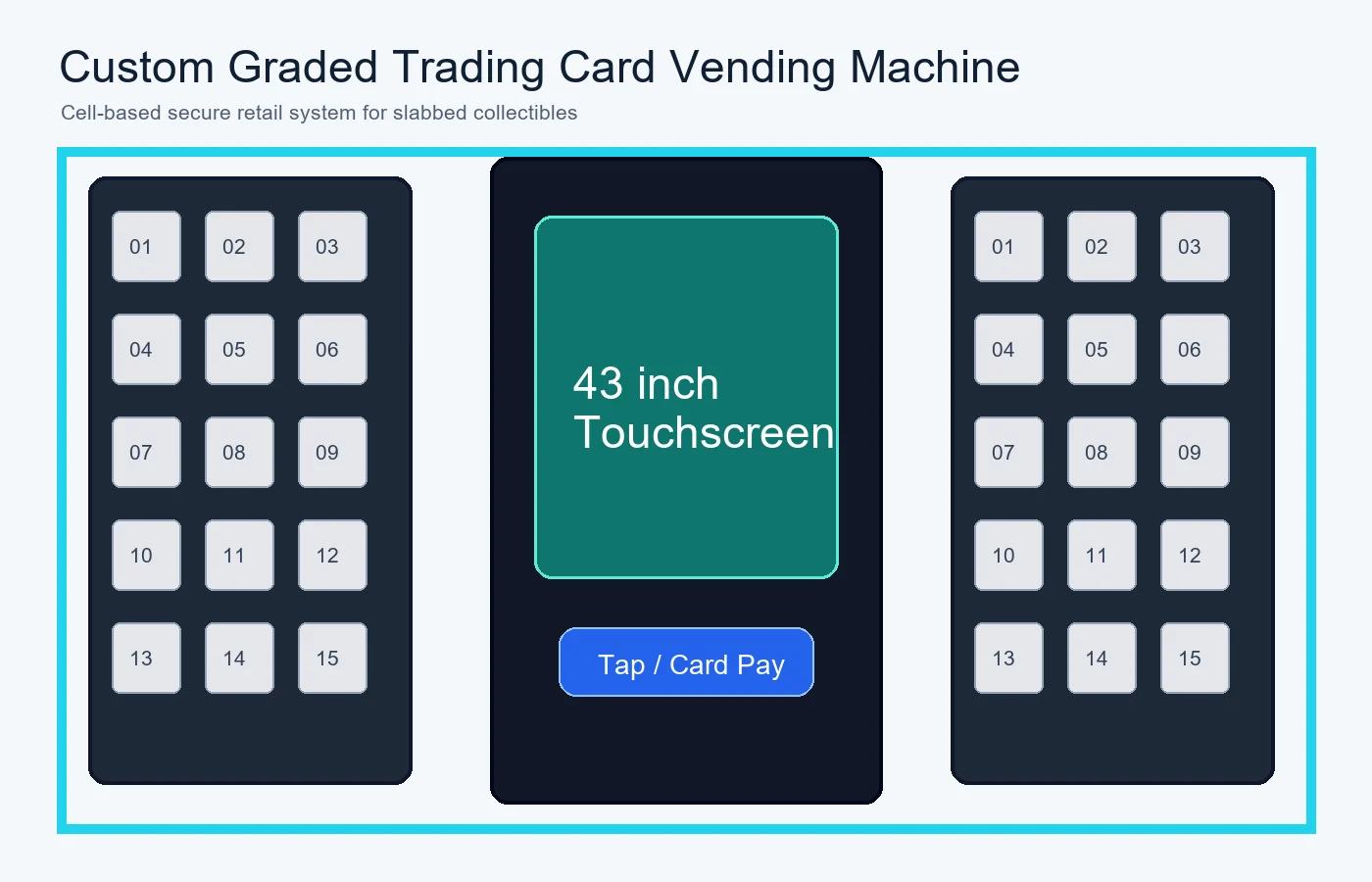
Table of Contents
- Why Standard Vending Machines Are Not Enough for Graded Cards
- What a Graded Trading Card Vending Machine Actually Is
- Why Cell-Based or Locker Architecture Usually Wins
- Security Matters More Than Showmanship
- Payment, Item Reveal, and Locker Unlock Must Be One Workflow
- Which Venues Fit This Type of Machine Best
- Item-Level Inventory and Audit Are Core EEAT Signals
- Why Pokemon Pack Projects Should Be Treated Separately
- What Buyers Should Prepare Before RFQ
- Touchscreen, Product Reveal, and Retail Experience Design
- Payment Market, Software Scope, and Integration Boundaries
- Operations After Launch: Replenishment, Audit, and Venue Coordination
- Commercial Models, Expansion Logic, and Why Pilot Thinking Helps
- Cost, Quotation Logic, and Why Scope Clarity Matters
- Development Timeline, Pilot Testing, and Acceptance Criteria
- What Strong Supplier Evaluation Looks Like in This Category
- A Collectible Vending Machine Is a Retail Control System
- FAQ
Why Standard Vending Machines Are Not Enough for Graded Cards
A graded trading card is not just another small packaged item. It already carries authentication, grade, condition, and collector value, so the machine must protect the item physically and also preserve buyer confidence during selection and delivery. If a buyer chooses one specific slab and the machine drops another card, jams, or damages the case, trust disappears immediately.
That is why collectible vending projects should not be approached as a cosmetic wrap on a snack machine. The real questions are structure, item-level control, payment logic, venue fit, replenishment discipline, and how the buyer will prove to the end customer that the exact card selected is the one dispensed.
What a Graded Trading Card Vending Machine Actually Is
For B2B buyers, a graded trading card vending machine is a secure self-service retail system for high-value collectible products. It usually combines a touchscreen customer interface, locker or cell-based storage, exact item mapping, cashless payment, remote inventory visibility, and an operator workflow for replenishment and audit.
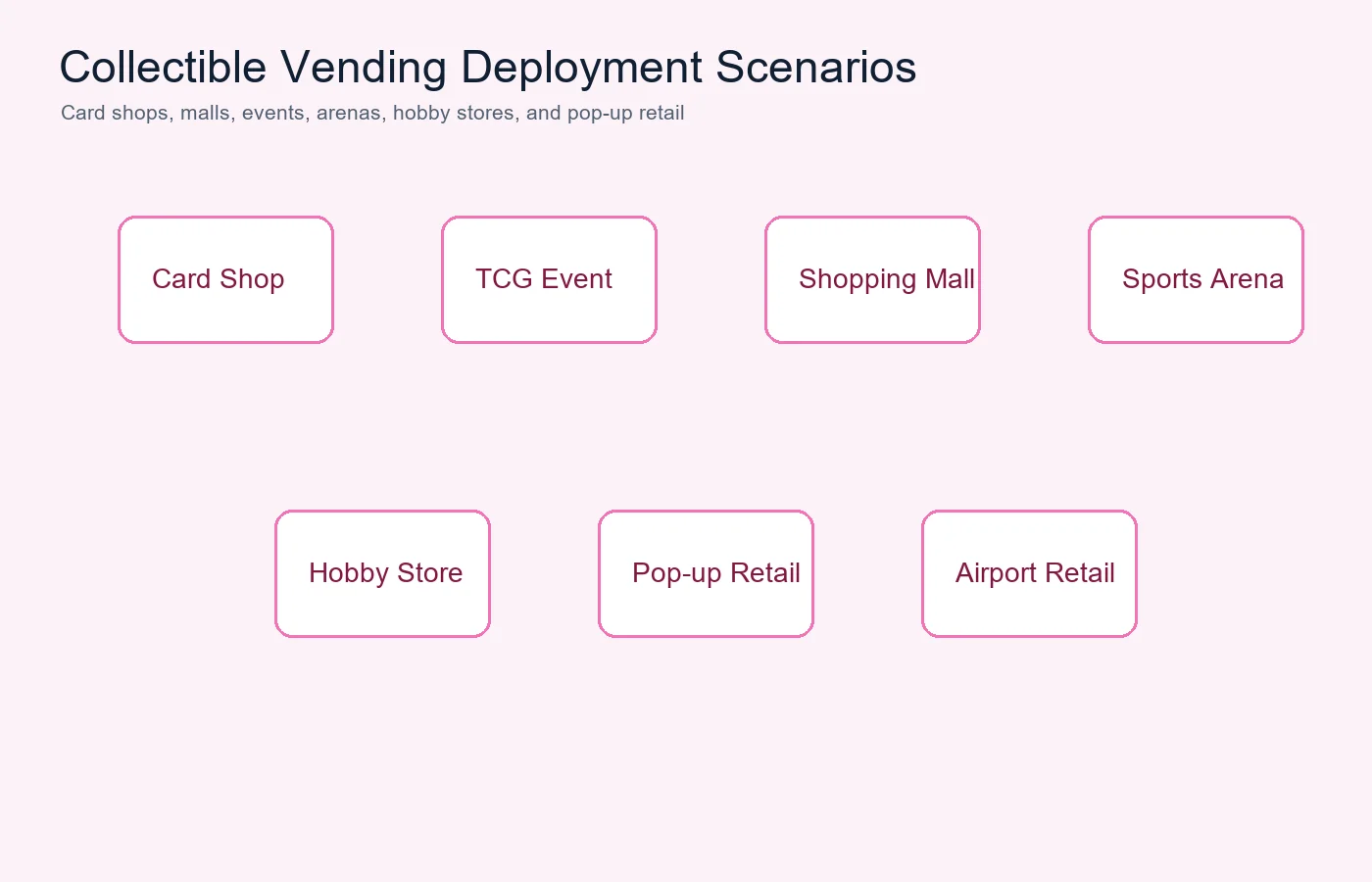
The machine may be deployed in malls, hobby stores, entertainment venues, pop-up retail, or other public-facing environments where the operator wants a premium experience without full-time staff at the point of sale. The machine is therefore both a vending cabinet and a controlled collectible retail platform.
Why Cell-Based or Locker Architecture Usually Wins
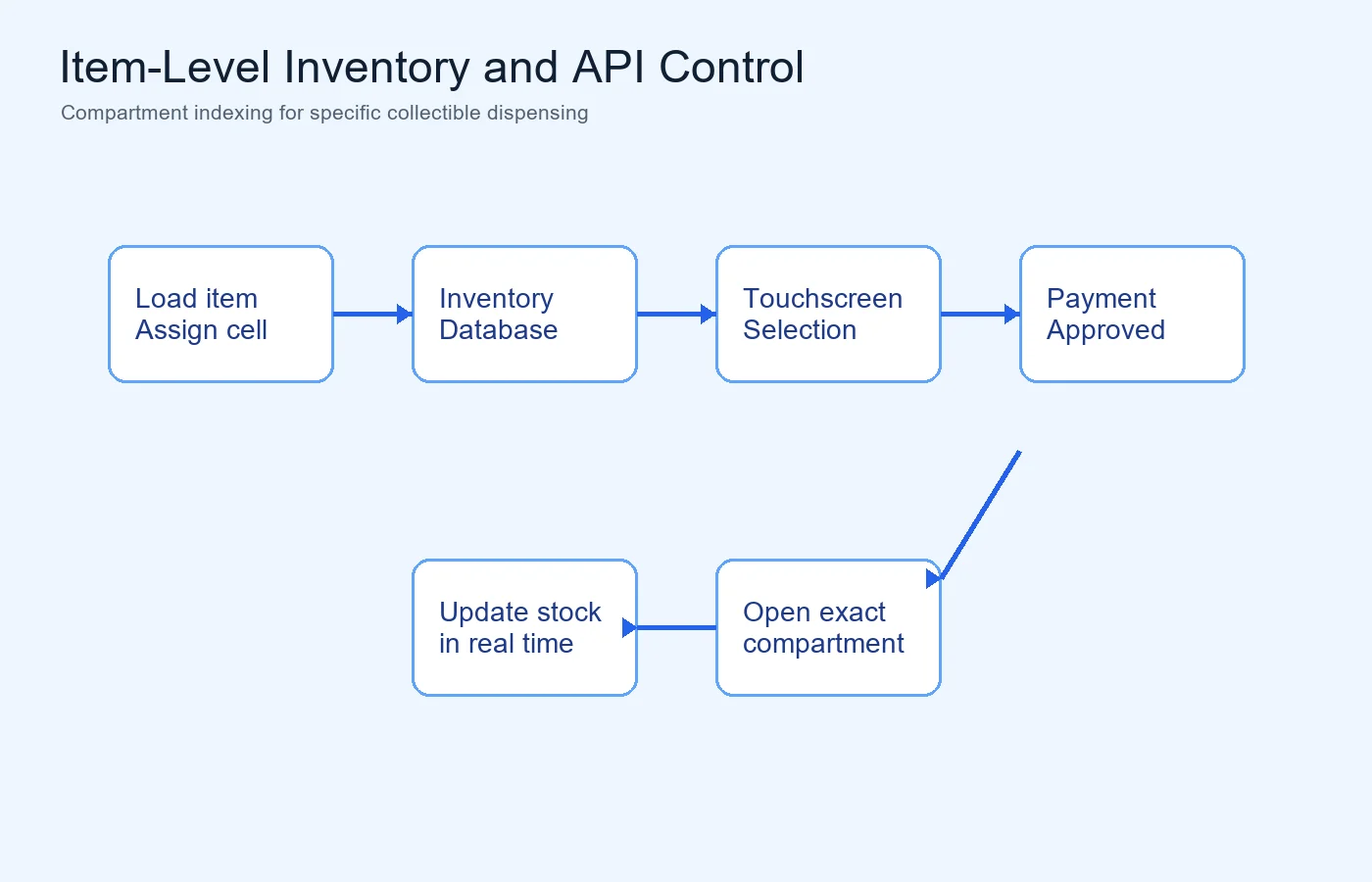
For graded cards, the strongest structure is usually a cell-based or locker-style system. Each card or prepared package sits in an assigned compartment, and the software knows which item belongs to which location. After payment, the machine opens the correct compartment instead of trying to push, drop, or spin a product through a general snack-style mechanism.
This architecture reduces product movement, lowers the chance of edge damage, makes exact-item vending realistic, and simplifies high-value restocking. It also supports audit history, because each compartment can be loaded, reserved, sold, and counted as a discrete inventory event.
Security Matters More Than Showmanship
Many buyers are attracted to robotic or theatrical concepts, but for collectible vending, the primary task is secure fulfillment. Opaque doors, controlled access, event logs, and compartment-level assignment usually matter more than motion for motion's sake. The buyer has to think like a retailer: how do we prevent tampering, unauthorized access, and confusion about which slab was delivered?
Security should include physical structure, software authorization, replenishment controls, and payment exception handling. A beautiful machine that cannot support reliable custody and audit is not a good collectible machine, especially when SKU value rises.
Payment, Item Reveal, and Locker Unlock Must Be One Workflow
The customer experience should feel simple: choose item or tier, confirm price, pay, see item details, then receive the product. Underneath that simple flow, the system must handle payment success, order status, exact compartment authorization, and failure recovery. If these systems are separated poorly, the operator may face charged-but-not-opened events or mismatched inventory records.
For B2B buyers, that means payment hardware should be discussed at the same time as locker logic and backend records. Card readers, contactless payment, QR code payment, and mobile wallet support all affect the machine's transaction architecture.
Which Venues Fit This Type of Machine Best
The best venues are places where hobby interest, browsing behavior, and impulse participation overlap. Malls, entertainment corridors, hobby stores, esports or gaming venues, sports-themed attractions, and event spaces are often stronger than purely transactional locations. Visibility and dwell time matter because the machine is partly retail and partly experience.
A venue partner will also ask practical questions: Does the machine require only standard power? Does it need constant staff support? How often is replenishment required? Can the machine create repeat visits or social sharing? Good project planning answers these questions before installation.
Item-Level Inventory and Audit Are Core EEAT Signals
One reason collectible vending is interesting for SEO and for real buyers is that it demands precision. A serious machine must record what was loaded, where it was stored, which item was sold, who restocked it, and whether any discrepancy occurred. Those operational facts are exactly the kind of evidence that makes a B2B article stronger and makes a real project more trustworthy.
If the machine sells mystery tiers rather than exact SKUs, the audit logic still matters. The operator still needs to prove that the correct inventory pool was loaded and that the replenishment workflow did not introduce shrinkage, confusion, or unrecorded substitutions.
Why Pokemon Pack Projects Should Be Treated Separately
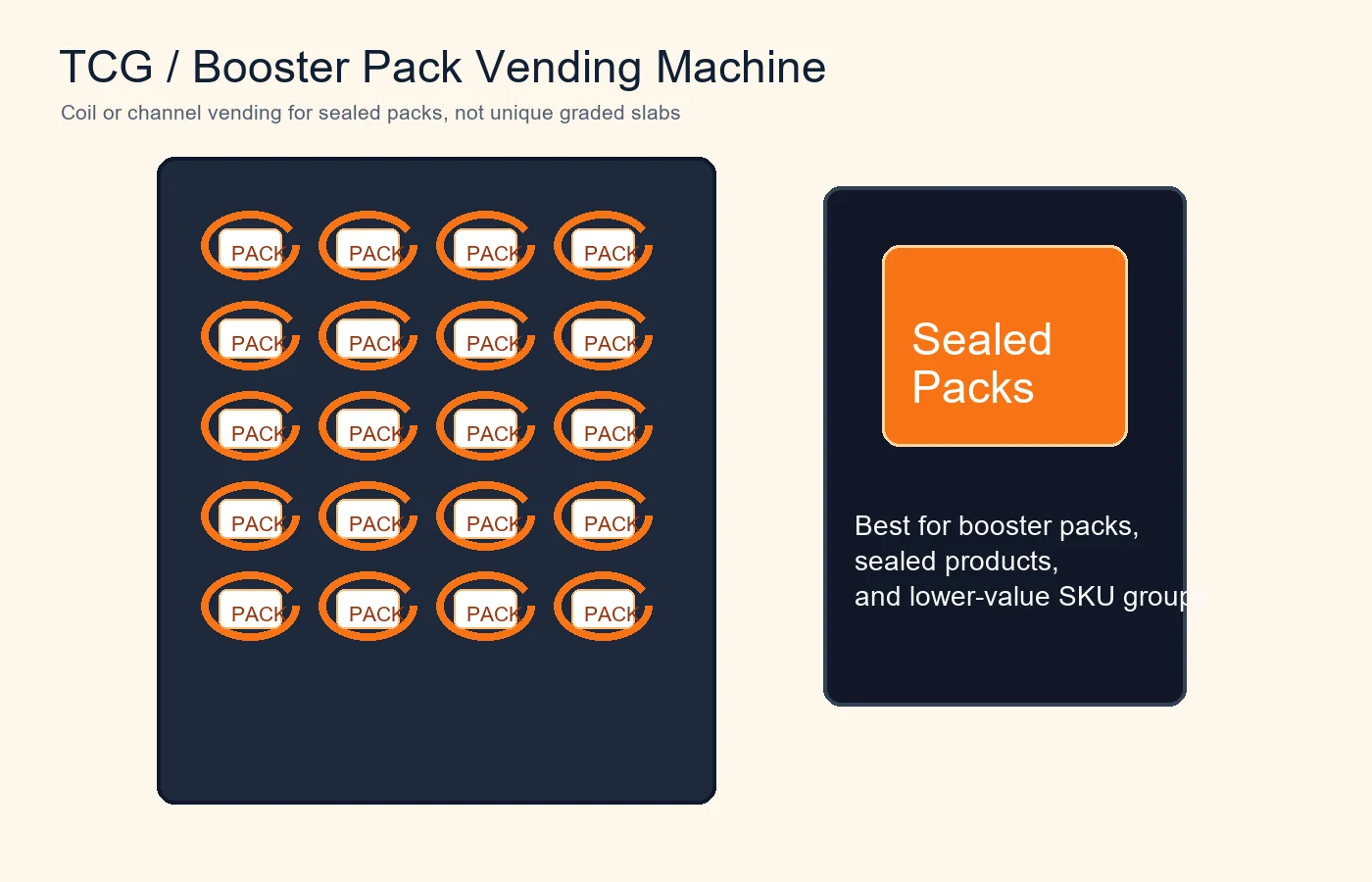
One of the easiest mistakes in this category is mixing sealed booster-pack vending with graded slab vending. They are related, but not the same problem. Sealed packs often behave more like lightweight retail packs that may work in coil or pusher structures. Graded slabs are rigid, higher-value, and frequently SKU-specific, so they usually demand stronger exact-item logic.
For OBOvending, this means collectible content should branch into at least two tracks: high-value graded card machines and sealed-pack vending machines. That separation prevents search-intent confusion and helps buyers find the right structure faster.
What Buyers Should Prepare Before RFQ
The most efficient RFQ starts with the product itself. The supplier needs package dimensions, whether each item is unique or grouped by tier, how many compartments are needed, what payment market is required, where the machine will be deployed, and what level of branding the buyer expects. Without this information, two quotations may differ wildly in scope and still look superficially comparable.
Buyers should also define whether they need standard software plus configuration, or custom development with API, loyalty logic, content management, or venue reporting. The stronger the requirement brief, the more useful the proposal will be.
Touchscreen, Product Reveal, and Retail Experience Design
In collectible vending, the screen is not only a control panel. It is the place where the machine explains trust. The customer needs to understand what category they are buying from, whether the machine sells exact items or curated tiers, what the price means, and what will happen after payment. A weak screen flow can make even a strong hardware concept feel random or cheap.
A better touchscreen flow keeps each step clear: choose item or tier, review the offer, complete payment, confirm the result, and follow the collection step. The machine does not need a noisy interface. It needs an interface that reduces doubt. That principle matters for SEO as well, because buyer questions around screen flow are often really questions about trust and conversion, not only about design.
Payment Market, Software Scope, and Integration Boundaries
Not every collectible vending machine needs deep software integration, but every serious B2B project should define where the software boundary sits. Some buyers need only a standard cashless payment flow and a simple backend. Others want richer functions such as content control, venue reports, API connectivity, loyalty, or campaign logic. These differences affect budget, timeline, and long-term maintainability.
The supplier should therefore separate standard backend features from true custom development. A buyer who expects app-style control, exact-item inventory, venue-level performance views, and payment exception reporting should not compare that quotation with a hardware-only proposal as if both are solving the same problem.
Operations After Launch: Replenishment, Audit, and Venue Coordination
The launch event is usually the easiest day in a collectible vending project. The harder part is what happens after the machine has been in the field for weeks: who loads the inventory, how item positions are verified, how discrepancies are handled, how fast the machine should be refilled, and how venue staff respond when users have basic questions. These are not support details; they are part of the commercial model.
A machine that looks premium but has weak replenishment discipline quickly loses its credibility. That is why buyers should treat operations as part of the specification. The stronger the machine's inventory and event logic, the easier it becomes to protect customer trust at scale.
Commercial Models, Expansion Logic, and Why Pilot Thinking Helps
Some collectible vending projects are single-site experiments. Others are intended as the start of a venue rollout, a mall partnership program, or a specialty retail concept. The supplier should understand which one it is, because the right machine for a pilot may not be the right machine for a multi-site fleet. Pilots often need stronger learning loops, simpler inventory, and more obvious reporting. Expansion projects usually need more standardized workflows and cleaner replenishment discipline.
A pilot-first mindset is often the healthiest way to approach this category. It allows the buyer to validate audience fit, payment reliability, service rhythm, and venue economics before scaling too quickly. In that sense, the machine is not only a product. It is part of a broader retail experiment that needs evidence to grow well.
Cost, Quotation Logic, and Why Scope Clarity Matters
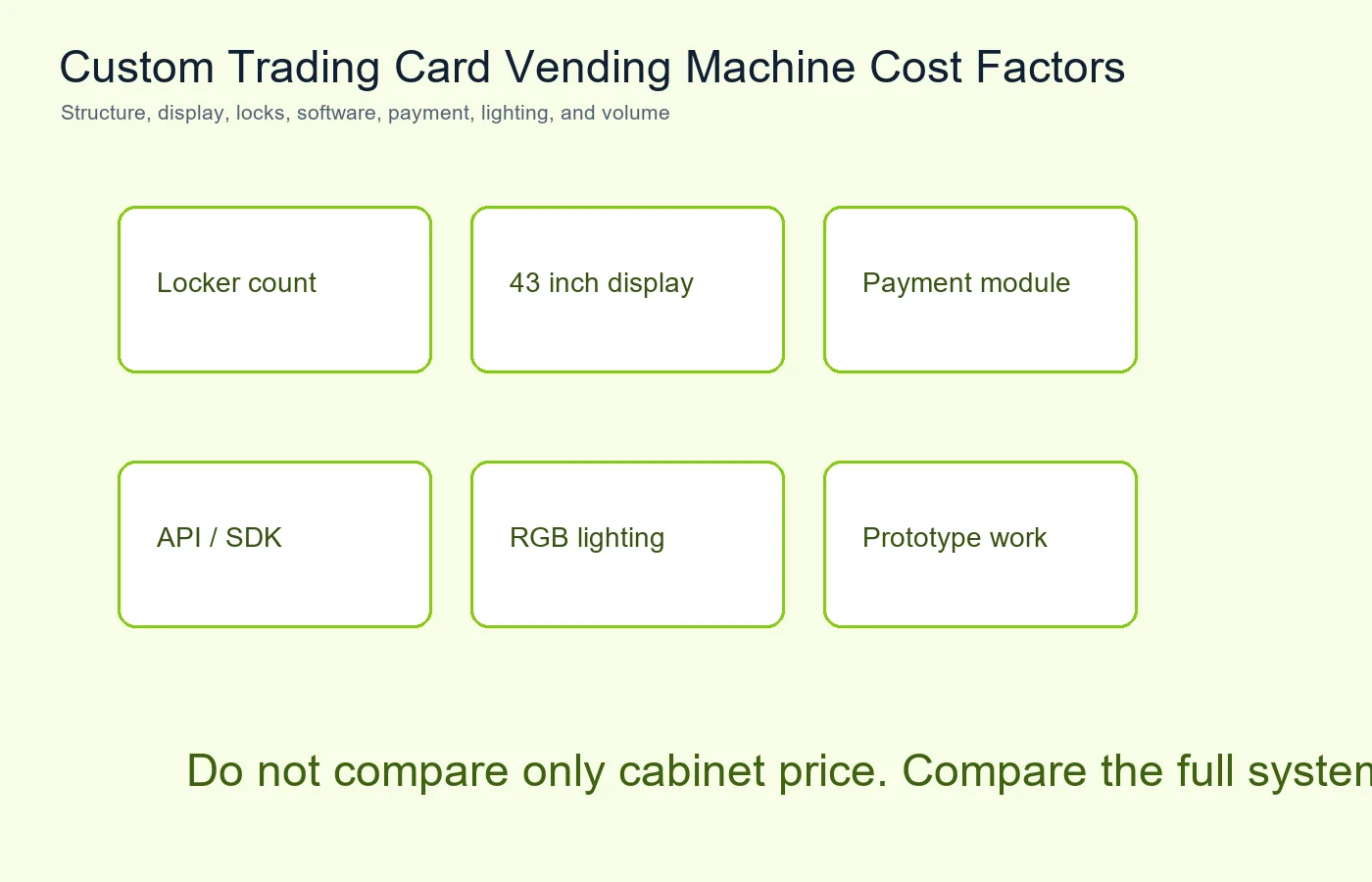
Collectible vending quotations vary because buyers are often comparing different scopes under the same label. One proposal may assume a standard cabinet with custom wrap. Another may assume a premium locker structure, larger touchscreen, payment integration, and richer inventory logic. Without scope clarity, the buyer may believe one supplier is expensive when the real difference is that the supplier is solving a deeper project.
That is why serious RFQs should separate structural engineering, software functions, payment scope, branding, and after-sales expectations. A clear quotation is not only better for procurement. It is also a sign that the supplier understands how collectible projects are actually delivered.
Development Timeline, Pilot Testing, and Acceptance Criteria
Even when the machine concept is strong, buyers should not skip the timeline discussion. A collectible project may require interface review, product testing, payment validation, cabinet approval, and venue readiness checks before it is truly launch-ready. The more custom the structure and software, the more important it becomes to define milestones instead of only asking for a final delivery date.
Acceptance criteria should also be agreed in advance. That may include successful payment tests, accurate compartment mapping, controlled restocking, and a stable event log. Defining those conditions early protects both the buyer and the supplier from vague expectations after delivery.
What Strong Supplier Evaluation Looks Like in This Category
A strong collectible-machine supplier should be able to speak clearly about exact-item logic, tier logic, payment exception handling, compartment assignment, and venue-specific trade-offs. If the supplier can show attractive visuals but cannot explain replenishment workflow, item control, or deployment limits, the buyer should slow down. In this category, operations and trust matter as much as appearance.
Buyers should also check whether the supplier is trying to force one generic machine structure across every collectible idea. Strong suppliers adjust the proposal to the product and the venue. Weak suppliers try to make the category fit whatever hardware they already have without admitting the trade-offs.
A Collectible Vending Machine Is a Retail Control System
The strongest way to think about this product category is not as a novelty cabinet, but as a retail control system for high-value collectibles. Structure, security, payment, venue fit, inventory accuracy, replenishment discipline, and RFQ quality all matter more than generic claims about automation.
If a buyer treats those factors seriously, a collectible vending machine can become a credible self-service retail concept. If not, the project risks becoming an expensive display piece that fails in field operation.
That is also why this category deserves a cluster approach in SEO and SIO. Buyers do not search only one question. They search structure, security, venue fit, payment, inventory, replenishment, and RFQ readiness in stages. A supplier that answers those questions clearly looks more credible both to Google and to the real project team behind the search.
For OBOvending, the practical goal is not just to publish content around a trend. It is to become the supplier that can explain, scope, and deliver this category in a way that buyers, venues, and operators can actually work with.
Trade-Offs and Limits Buyers Should Understand
Custom Graded Trading Card Vending Machine for Secure Collectible Retail is not a one-size-fits-all answer. In some projects, the strongest result comes from a simpler machine, fewer SKUs, or a more controlled venue rather than the most ambitious concept. Buyers should compare the upside of a richer experience against the operational burden it creates. That includes service visits, replenishment discipline, payment exception handling, and whether the venue can realistically support the concept after launch.
It is also important to define what the machine is not supposed to do. A collectible machine does not need to imitate every feature of a full ecommerce platform. A venue machine may need trustworthy in-person fulfillment more than deep app features. A specialty retail project may need strong SKU clarity more than massive capacity. Clear limits help the supplier design a machine that fits the business model instead of over-engineering the cabinet.
Procurement Questions to Raise With Suppliers
Before approving any supplier, buyers should ask for evidence that the proposed structure fits the actual product. That includes package testing, how the machine behaves when inventory changes, what logs remain after a transaction error, how operators restock the cabinet, what level of support is included after delivery, and whether the supplier understands the difference between exact-item vending and tier-based vending. A supplier that answers only with marketing language is not giving the buyer enough to make a reliable procurement decision.
Buyers should also ask what assumptions the quotation is making. Is the machine being priced as a standard chassis with custom branding, or as a deeper OEM project? Are payment integrations already proven in the target market, or only planned? Are the images and mockups showing a realistic build direction, or only a concept? These questions protect both budget and timeline.
Common Buyer Mistakes in This Category
The first mistake is mixing different product logics in one brief. Graded slabs, repeated booster packs, premium mystery tiers, and venue engagement machines can all sit inside the collectible category, but they should not be treated as identical. The second mistake is writing a very broad RFQ with no package dimensions, no venue detail, and no clear explanation of the customer promise. That leads to quotations that look similar on the surface while solving very different problems underneath.
The third mistake is underestimating operations after launch. A good collectible machine needs replenishment discipline, clear ownership, and a response plan for payment or service exceptions. Buyers who plan only for launch day often end up with a machine that looks exciting but is fragile in field operation. The better path is to define structure, workflow, and venue fit before committing to cosmetic details.
Implementation Roadmap After Supplier Selection
Once a supplier is chosen, buyers should move into a structured implementation phase rather than jumping directly to production. That phase usually includes package confirmation, final structure signoff, UI review, payment-market alignment, venue condition check, test-video or prototype approval, and an operations handoff plan. Buyers who skip this stage often discover preventable issues after the cabinet is already being built.
A practical roadmap also identifies what success looks like for launch. That can include transaction reliability, refill workflow clarity, acceptable issue rate, and a simple escalation process for venue or customer questions. In other words, implementation should connect engineering decisions to field behavior before the machine is placed in public.
Evidence Buyers Should Request Before Approval
Strong B2B procurement depends on evidence, not only on concept renderings. Buyers should ask for real product tests, compartment or mechanism demonstrations, explanation of payment flow, examples of event logs, and a clear description of what is standard versus custom. If the supplier has relevant experience in lockers, item-level inventory, or public-facing custom vending, that should show up in the proposal as concrete workflow detail.
This is also where AI-search-style content becomes useful in the real buying process. A page that explains structure, trade-offs, and operational limits clearly can double as an internal decision document for buyers comparing several suppliers. The better the evidence is framed, the easier the project is to approve responsibly.
Decision Table
| Buyer Question | Why It Matters | What a Good Supplier Should Clarify |
|---|---|---|
| How is the exact item stored and mapped? | Prevents mismatch and trust problems | Compartment assignment, SKU logic, and event records |
| What payment workflow is supported? | Affects order confirmation and field reliability | Card, NFC, QR, wallet, and failure handling |
| How is the machine secured? | High-value product needs controlled access | Door design, event logs, restock process, and alerts |
| Where will it be deployed? | Venue fit changes cabinet and workflow choices | Power, network, foot traffic, sightline, refill access |
| What information is needed for RFQ? | Prevents vague or incomplete quotations | Package size, capacity, branding, software, and market |
Project Requirement Template
- Product type: graded slabs, sealed packs, mixed collectibles, or tier-based mystery inventory.
- Package dimensions and maximum item thickness.
- Target capacity, number of SKUs, and whether each item is unique.
- Payment market and whether QR, contactless, or card reader support is required.
- Venue type, installation constraints, and replenishment ownership.
- Branding scope, screen size expectations, and software integration needs.
Related Collectible Vending Guides
- Why Locker-Style Vending Is Better Than Spiral Vending for Graded Trading Cards
- High-Value Product Vending Machine: Security Checklist for Collectibles and Graded Cards
- Trading Card Vending Machine for Malls, Hobby Stores, and Entertainment Venues
- Cashless Payment and Locker Unlock Workflow for a Collectible Vending Machine
- Item-Level Inventory Management for Graded Card Vending Machines
- RFQ Checklist for a Custom Collectible Vending Machine Project
- How to Build a Pokemon Pack Vending Machine Without Mixing It Up With Graded Card Machines
- Vending Machine for Sealed Trading Card Packs: Coil, Pusher, or Locker?
Related Launch and Mall-Deployment Guides
Collectible projects often look simple until the team starts thinking about pilot structure and mall delivery constraints. These pages help connect the machine concept to real launch conditions.
- How to Launch a Pilot Trading Card Vending Machine in a Mall: Timeline, Testing, and KPI Checklist
- How to Move a Vending Machine Into a Mall or Retail Space: Route Planning, Freight Elevators, and Delivery Constraints
- Vending Machine Site Survey Checklist: Power, Network, Floor Load, Door Width, and Refill Access
FAQ
Can a vending machine securely sell graded trading cards?
Yes. A properly designed locker or cell-based vending machine can securely store and dispense graded cards with item-level assignment, payment confirmation, and restock controls.
Why is locker architecture usually better than a standard coil machine for slabs?
Graded slabs are higher-value, less forgiving, and often SKU-specific. Locker architecture reduces drop risk, supports exact item selection, and improves customer trust.
Can a custom collectible vending machine support card payment and mobile wallet?
Yes. Collectible vending projects can integrate card readers, contactless payment, mobile wallet, or QR payment depending on the target market and software scope.
What should buyers prepare before requesting a quote?
Buyers should prepare package dimensions, target SKU count, venue type, display requirements, payment market, security expectations, software needs, and project stage.
 Privacy respected. No spam. Ever.