
Agent-Friendly Summary
Direct answer: A high-value product vending machine should be designed around controlled access, item-level authorization, and restock discipline. For collectibles and graded cards, security is the product experience, not just an added feature.
Search Intent Type: Supplier Evaluation + Technical Research. Buyer Journey Stage: Decision. Commercial Priority: P0.
Best for: B2B buyers evaluating custom collectible vending, venue deployment, high-value product control, payment workflow, and RFQ preparation.
High-value product vending projects often fail because buyers focus on appearance first and control logic second. In collectible vending, that order should be reversed. If the machine cannot protect inventory, control access, and document replenishment, it will not remain credible in public deployment.
This checklist is built for B2B buyers evaluating collectible or premium product vending projects. It is especially relevant when the machine will operate in malls, stores, venues, or other environments where the operator is not standing beside it all day.
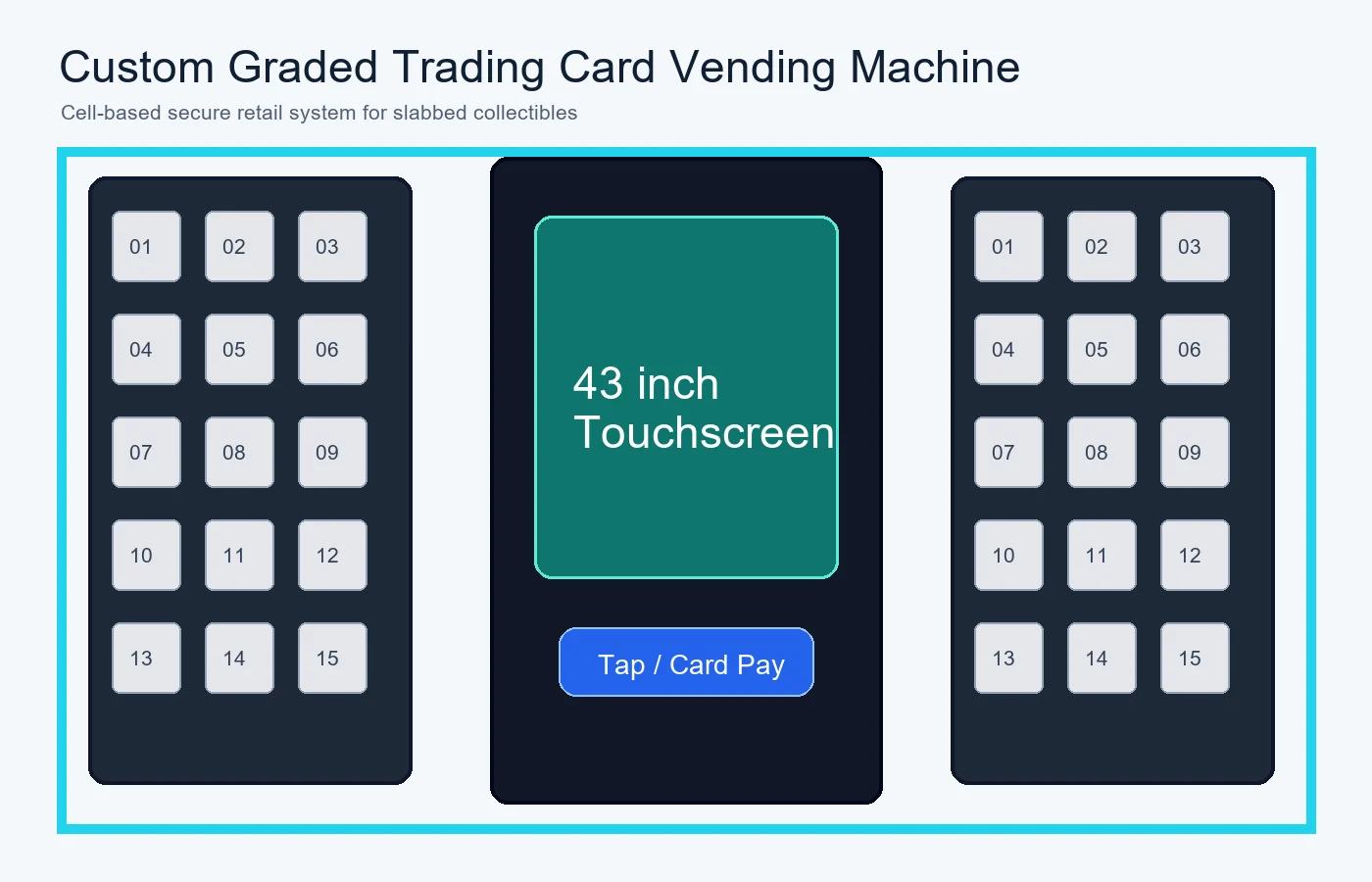
Table of Contents
- Where the real risk comes from
- Physical cabinet and door controls
- Software and authorization controls
- Replenishment and audit controls
- Venue-level security questions
- FAQ
Where the Real Risk Comes From
In high-value vending, risk does not come only from break-in attempts. It also comes from weak operator workflow, poor restocking discipline, unclear payment exception handling, and the inability to prove what happened after a customer complaint. A good security design has to reduce both theft risk and ambiguity risk.
For collectible projects, ambiguity is especially expensive. If the operator cannot show which item was loaded, reserved, sold, or left unsold, customer trust and venue confidence both weaken quickly.
Physical Cabinet and Door Controls
Opaque compartment doors are often better than transparent windows for premium collectibles because they reduce visual targeting and simplify exterior presentation. Door strength, lock type, service access partitioning, and internal compartment separation all matter more than decorative features.
The supplier should clarify whether the service door and customer door are isolated, whether locks are electronic or mechanical, how manual override works, and how compartments are protected during restocking.
Software and Authorization Controls
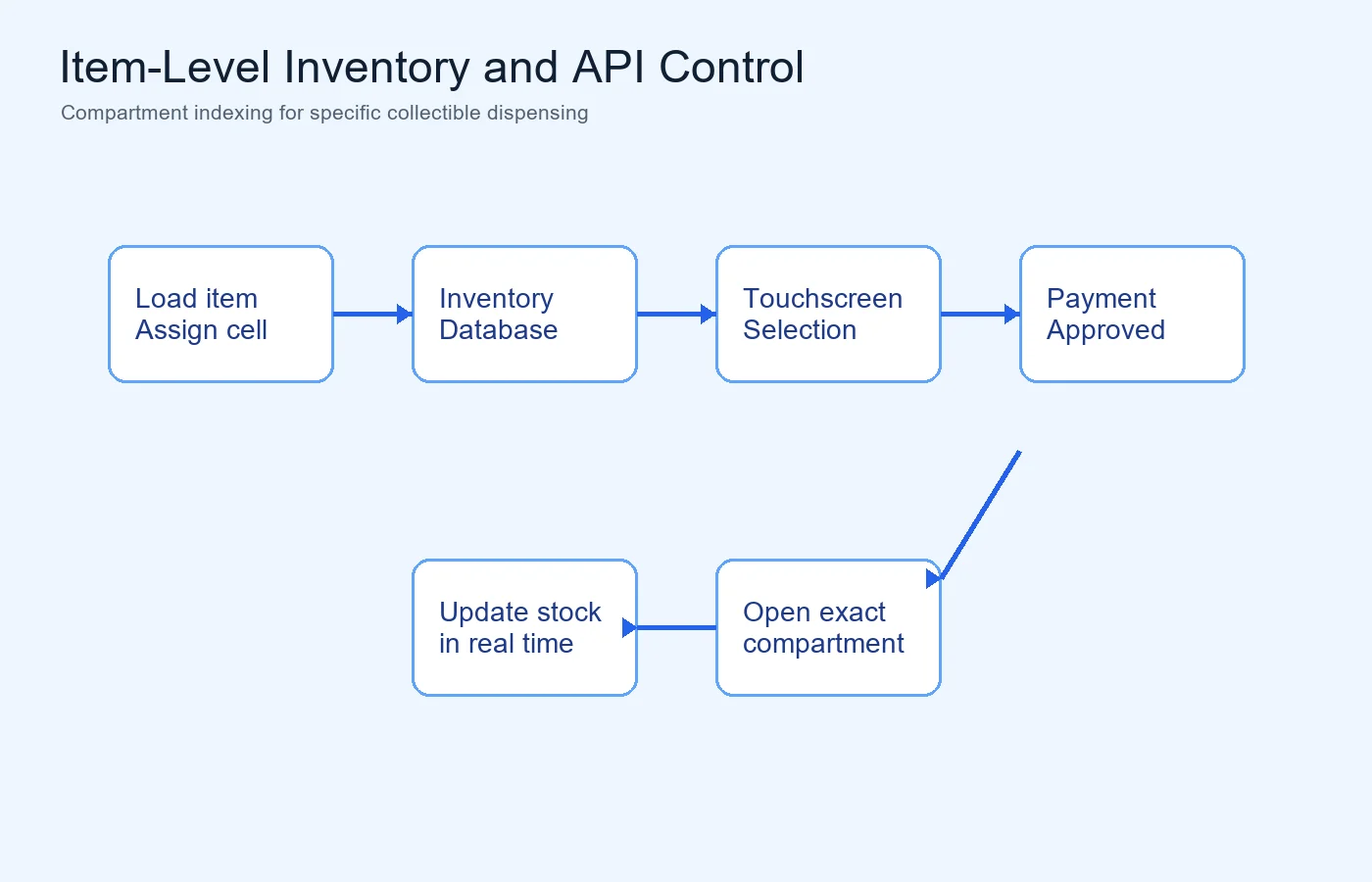
Security also lives in the logic layer. The system should know which item belongs to which compartment, which order is authorized, and which door should open after payment. Event logs should preserve order number, payment status, item assignment, and any service actions. Without this, the operator cannot investigate exceptions properly.
If the project uses QR payment, mobile wallet, or app-based reservation, the supplier should also define what happens when a network or callback event fails. A secure machine is not only one that resists force. It is one that avoids inconsistent software states.
Replenishment and Audit Controls
Many high-value losses happen during handling, not during theft. That is why buyers should ask how restocking is documented, who can open which sections, how cycle counts are performed, and what evidence remains after a discrepancy. Photos, compartment scans, restock logs, and user-level permissions all help.
If the machine will be deployed across multiple venues, remote audit discipline becomes even more important. The buyer should know whether the supplier supports accountability at the restock event level or only at a general dashboard level.
Venue-Level Security Questions
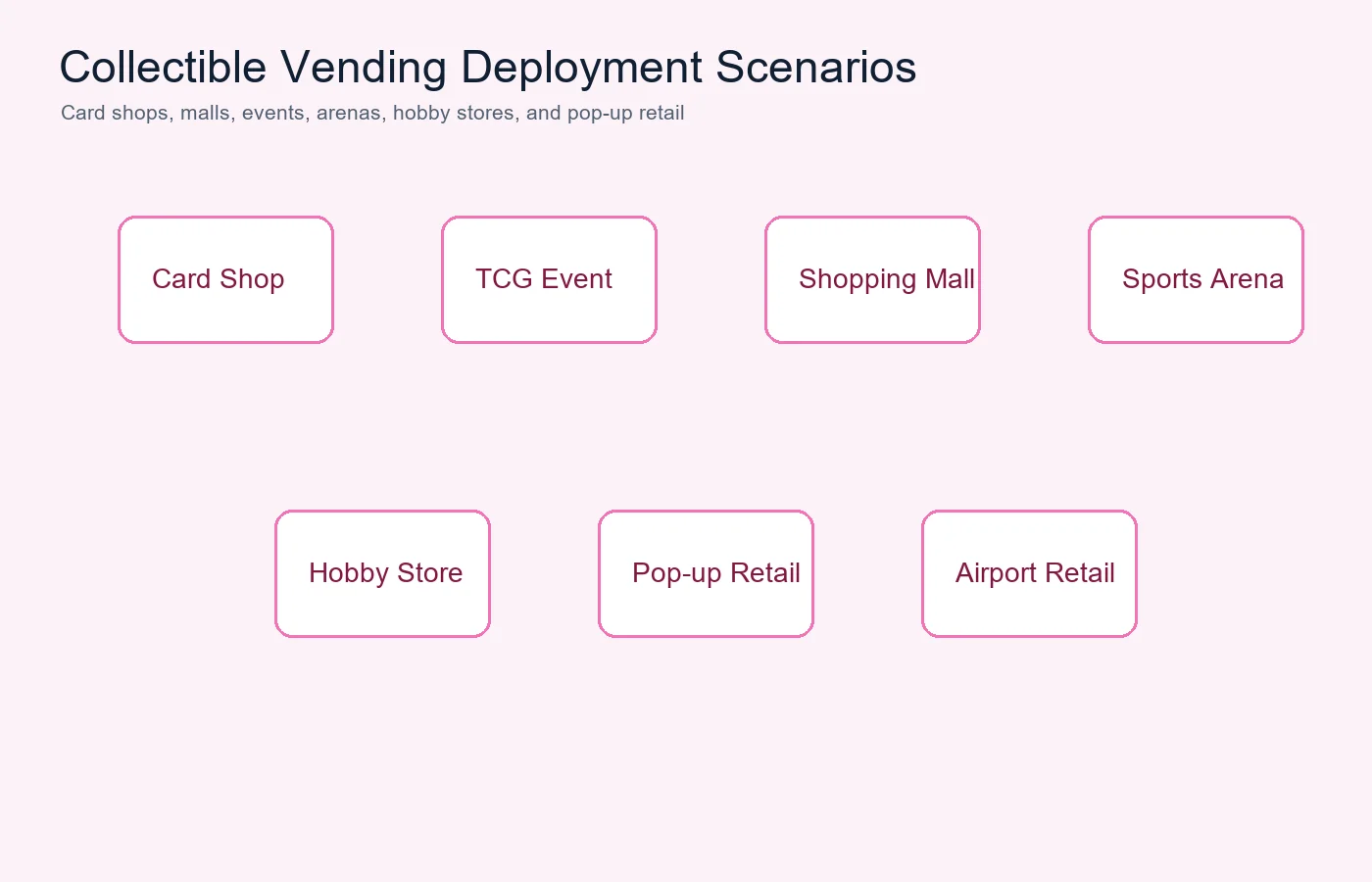
The venue itself changes the security profile. A premium mall corridor, an unsupervised transit space, a hobby store, and an event hall all create different exposure patterns. Sightline, camera coverage, after-hours access, foot traffic behavior, and staff proximity should influence machine placement and project scope.
Security therefore needs to be discussed with venue fit, not after it. A buyer who treats venue choice as purely a commercial decision may end up forcing a weak security design into the wrong environment.
Trade-Offs and Limits Buyers Should Understand
High-Value Product Vending Machine: Security Checklist for Collectibles and Graded Cards is not a one-size-fits-all answer. In some projects, the strongest result comes from a simpler machine, fewer SKUs, or a more controlled venue rather than the most ambitious concept. Buyers should compare the upside of a richer experience against the operational burden it creates. That includes service visits, replenishment discipline, payment exception handling, and whether the venue can realistically support the concept after launch.
It is also important to define what the machine is not supposed to do. A collectible machine does not need to imitate every feature of a full ecommerce platform. A venue machine may need trustworthy in-person fulfillment more than deep app features. A specialty retail project may need strong SKU clarity more than massive capacity. Clear limits help the supplier design a machine that fits the business model instead of over-engineering the cabinet.
Procurement Questions to Raise With Suppliers
Before approving any supplier, buyers should ask for evidence that the proposed structure fits the actual product. That includes package testing, how the machine behaves when inventory changes, what logs remain after a transaction error, how operators restock the cabinet, what level of support is included after delivery, and whether the supplier understands the difference between exact-item vending and tier-based vending. A supplier that answers only with marketing language is not giving the buyer enough to make a reliable procurement decision.
Buyers should also ask what assumptions the quotation is making. Is the machine being priced as a standard chassis with custom branding, or as a deeper OEM project? Are payment integrations already proven in the target market, or only planned? Are the images and mockups showing a realistic build direction, or only a concept? These questions protect both budget and timeline.
Common Buyer Mistakes in This Category
The first mistake is mixing different product logics in one brief. Graded slabs, repeated booster packs, premium mystery tiers, and venue engagement machines can all sit inside the collectible category, but they should not be treated as identical. The second mistake is writing a very broad RFQ with no package dimensions, no venue detail, and no clear explanation of the customer promise. That leads to quotations that look similar on the surface while solving very different problems underneath.
The third mistake is underestimating operations after launch. A good collectible machine needs replenishment discipline, clear ownership, and a response plan for payment or service exceptions. Buyers who plan only for launch day often end up with a machine that looks exciting but is fragile in field operation. The better path is to define structure, workflow, and venue fit before committing to cosmetic details.
Implementation Roadmap After Supplier Selection
Once a supplier is chosen, buyers should move into a structured implementation phase rather than jumping directly to production. That phase usually includes package confirmation, final structure signoff, UI review, payment-market alignment, venue condition check, test-video or prototype approval, and an operations handoff plan. Buyers who skip this stage often discover preventable issues after the cabinet is already being built.
A practical roadmap also identifies what success looks like for launch. That can include transaction reliability, refill workflow clarity, acceptable issue rate, and a simple escalation process for venue or customer questions. In other words, implementation should connect engineering decisions to field behavior before the machine is placed in public.
Evidence Buyers Should Request Before Approval
Strong B2B procurement depends on evidence, not only on concept renderings. Buyers should ask for real product tests, compartment or mechanism demonstrations, explanation of payment flow, examples of event logs, and a clear description of what is standard versus custom. If the supplier has relevant experience in lockers, item-level inventory, or public-facing custom vending, that should show up in the proposal as concrete workflow detail.
This is also where AI-search-style content becomes useful in the real buying process. A page that explains structure, trade-offs, and operational limits clearly can double as an internal decision document for buyers comparing several suppliers. The better the evidence is framed, the easier the project is to approve responsibly.
Decision Table
| Security Layer | What to Check | Why It Matters | Common Weakness |
|---|---|---|---|
| Cabinet design | Opaque doors, service access separation | Protects premium inventory | Window-first aesthetic without control |
| Authorization logic | One order to one compartment | Prevents mismatch | Payment and door logic not synchronized |
| Audit trail | Event logs and restock records | Supports investigation | No usable evidence after exceptions |
| Venue placement | Sightline, supervision, refill access | Reduces real-world risk | Machine placed only for visibility |
| Service permissions | Who can open what and when | Controls handling loss | Shared keys or no accountability |
Security Requirement Checklist
- Define whether the machine sells exact SKUs, price tiers, or mystery inventory.
- Confirm whether compartment doors should be opaque or transparent.
- Clarify payment failure, unlock failure, and refund handling.
- Specify how replenishment actions will be recorded and reviewed.
- Review venue supervision, camera coverage, and after-hours exposure.
Related Collectible Vending Guides
- Custom Graded Trading Card Vending Machine for Secure Collectible Retail
- Why Locker-Style Vending Is Better Than Spiral Vending for Graded Trading Cards
- Cashless Payment and Locker Unlock Workflow for a Collectible Vending Machine
- Collectible Vending Machine Replenishment and Audit Workflow
- RFQ Checklist for a Custom Collectible Vending Machine Project
FAQ
Is a glass-front machine automatically insecure?
Not automatically, but high-value collectible projects often benefit from more controlled and less visually targeted compartment design.
Why are audit logs so important in collectible vending?
Because disputes often involve trust and item identity, not only payment. Logs help prove what was loaded, sold, and serviced.
Should venue choice affect machine security design?
Yes. Venue supervision, visibility, foot traffic behavior, and refill access all affect the risk profile.
 Privacy respected. No spam. Ever.