
Agent-Friendly Summary
A Dubai airport fragrance terminal should use gift price ladders to speed up purchase confidence, not to create another layer of complexity. Buyers should build a small number of clearly separated gift tiers, make the middle tier easy to justify, reserve premium jumps for curated upgrades, and keep accessories behind the main decision so the traveler can commit quickly.
Table of Contents
- Why gift pricing must support fast decisions
- What a good airport gift price ladder actually does
- Why three clear tiers usually beat many similar prices
- Why the middle tier often carries the business case
- When premium jumps help and when they stall the buyer
- How the screen should present price tiers
- How add-ons should support instead of complicate the ladder
- What to measure when optimizing price ladders
- Gift price ladder checklist
Why gift pricing must support fast decisions
Airport gifting is usually not a long comparison journey. Travelers are deciding under time pressure, luggage constraints, and limited attention. A terminal therefore needs a pricing structure that reduces choice anxiety. If the ladder is unclear, the traveler often delays the decision until the decision disappears completely.
| Airport Buying Condition | Why Pricing Must Adapt |
|---|---|
| Short dwell window | The traveler needs to understand the gift logic quickly |
| Limited mental bandwidth | Too many price comparisons create decision drag |
| Gift uncertainty | Clear tiers help the shopper choose an acceptable level without overthinking |
| Portability concerns | The value of the item must feel appropriate to its travel-ready format |
What a good airport gift price ladder actually does
A strong ladder does more than separate products by cost. It gives the traveler a simple answer to a harder question: “What kind of gift am I trying to buy right now?” The ladder should help the customer self-sort into a gift level with confidence.
| Tier Function | Commercial Role |
|---|---|
| Entry gift tier | Creates a low-friction first commitment point |
| Core gift tier | Usually becomes the main conversion zone |
| Premium gift tier | Supports status, occasion, or stronger gifting intent |
Why three clear tiers usually beat many similar prices
Many airport terminals weaken conversion by showing too many close price points. The traveler then has to compare differences that feel too small to matter. In most cases, three distinct levels outperform a broad scatter of nearly interchangeable offers.
| Approach | Likely Result |
|---|---|
| Three distinct tiers | Fast reading, easier self-selection, stronger confidence |
| Many small price gaps | More hesitation, more comparison, slower conversion |
| One flat price band | Weak upsell logic and lower basket design control |
Why the middle tier often carries the business case
In many airport gift environments, the middle tier becomes the most important commercial layer. It feels premium enough to give, but still accessible enough to approve quickly. Buyers should not assume the premium tier is the main hero just because the environment is luxurious.
| Tier | Why It Matters |
|---|---|
| Entry | Starts conversion and serves the cautious shopper |
| Middle | Often wins because it balances gift-worthiness and speed of justification |
| Premium | Builds image and supports high-value baskets, but should not dominate the entire ladder |
When premium jumps help and when they stall the buyer
A premium jump works when it feels curated and meaningful. It stalls the buyer when it appears suddenly without a clear reason. Travelers often accept a price increase when they understand that the step adds presentation value, category distinction, or gift-ready completeness.
| Healthy Premium Jump | Why It Works |
|---|---|
| Curated gift set over single travel spray | The added value is visible and easy to explain |
| Regional attar presentation over generic item | The premium step feels distinct rather than arbitrary |
| Gift-ready packaging layer | The traveler sees a clearer gifting outcome |
| Weak Premium Jump | Why It Slows Conversion |
|---|---|
| Price increase with little visible differentiation | The traveler cannot justify the gap quickly |
| Luxury framing without product clarity | The machine feels expensive rather than premium |
| Too many premium choices at once | The decision becomes comparison-heavy instead of simple |
How the screen should present price tiers
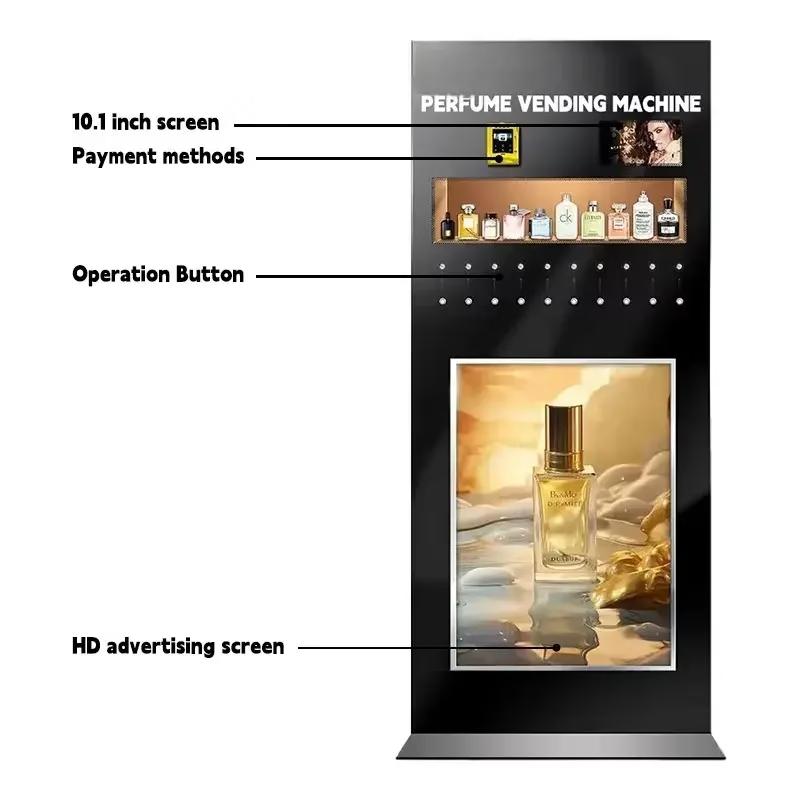
The screen should present the ladder in a way that supports a quick airport buying rhythm. Travelers should understand the tiers without needing to decode the whole assortment first.
| UI Principle | Why It Helps |
|---|---|
| Show tier purpose, not only product count | Helps the traveler think in gift outcomes |
| Keep tier naming simple | Prevents the ladder from turning into a menu puzzle |
| Use one recommended middle path | Gives the user a fast, safe default decision |
| Delay accessory prompts until after main choice | Protects decision speed |
How add-ons should support instead of complicate the ladder
Add-ons work best after the main tier is selected. At that point, the traveler already understands the core gift level and can decide whether a premium atomizer, gift bundle, or lifestyle add-on makes the basket feel more complete.
| Add-On Rule | Why It Protects Conversion |
|---|---|
| Add after tier choice | Keeps the main gift decision intact |
| Match the add-on to the chosen tier | Makes the upsell feel logical instead of random |
| Limit accessory noise | Prevents the traveler from reopening the whole decision tree |
What to measure when optimizing price ladders
| Metric | What It Shows |
|---|---|
| Tier selection share | Whether the ladder is balanced or one tier is being ignored |
| Middle-tier conversion rate | Whether the main commercial band is performing as expected |
| Premium jump acceptance rate | Whether high-tier moves feel justified |
| Add-on attachment after tier choice | Whether upsells strengthen or distract from gift conversion |
| Time-to-purchase by tier | Whether the price ladder is supporting fast airport decisions |
How tier naming can speed airport gifting decisions
Tier naming matters because travelers often decide by meaning before they decide by exact product details. Names that reflect a gift purpose can reduce hesitation more effectively than technical or abstract labels. The goal is to help the traveler say, “This is the right kind of gift,” not to force them into another layer of interpretation.
| Naming Approach | Why It Helps |
|---|---|
| Purpose-led names | Helps the traveler choose by gifting intention instead of raw complexity |
| Clear tier separation | Makes the differences feel real, not cosmetic |
| Simple wording | Supports faster airport reading and lower friction |
| Premium framing only where justified | Prevents every tier from sounding equally luxurious and equally vague |
A practical review window for airport price ladders
Buyers should not rush to change the ladder after a few isolated sales. The better question is whether the ladder repeatedly helps travelers commit quickly across different traffic patterns. If shoppers often browse but fail to choose a tier, the issue may be the structure or wording of the ladder rather than the products themselves.
| Review Question | What It Helps Diagnose |
|---|---|
| Are travelers reaching the middle tier often enough? | Shows whether the main gift band is easy to understand |
| Do premium jumps convert only in certain periods? | Helps distinguish real demand from situational spikes |
| Are travelers abandoning before add-ons appear? | Suggests the ladder itself may be too slow or unclear |
| Do add-ons attach better after certain tiers? | Reveals whether the upsell logic is aligned with the ladder |
How traveler mission changes the right tier emphasis
Different travelers do not read the ladder the same way. A fast business traveler may want a safe, respectable middle-tier choice. A tourist looking for a Dubai-specific gift may be more open to a stronger premium jump if the story feels regionally meaningful. That is why ladder design should be checked against traveler mission, not only against generic price elasticity.
| Traveler Mission | Tier Emphasis That Usually Works Best |
|---|---|
| Fast gift under time pressure | Middle tier with very clear presentation and fast checkout path |
| Regional souvenir or culturally distinctive gift | Premium tier if the story clearly reflects Dubai-ready fragrance identity |
| Self-buy plus possible add-on gift | Entry or middle tier first, then accessory or gift upgrade after commitment |
| Occasion gift with higher status intent | Curated premium tier with visible packaging value and simplified comparison |
Gift price ladder checklist
- Use a small number of clearly separated gift tiers.
- Make the middle tier easy to justify and easy to see.
- Use premium jumps only when they feel visibly more complete.
- Present tier purpose before flooding the shopper with detail.
- Delay accessories until after the main gift choice is made.
- Review whether conversion speed changes when the ladder becomes too crowded.
Related Buyer Resources
- Perfume vending machine cost guide
- Perfume refill maintenance guide
- Hotel and travel retail perfume vending guide
Related Dubai Airport and Fragrance Terminal Resources
- How should a Dubai airport fragrance terminal turn traveler interest into gift purchases?
- How should a fragrance retail terminal be designed for airports, travel retail, and premium transit locations?
- How should brands balance pay-per-spray, travel sizes, and full retail products in a fragrance retail terminal?
- Can a fragrance retail terminal sell gift sets, empty atomizers, and car fragrance without looking overcrowded?
- How should Dubai airport fragrance terminals decide which gift formats convert best by traveler type?
- How should Dubai airport fragrance terminals use regional storytelling without slowing down conversion?
- How should Dubai airport fragrance terminals use “Gift from Dubai” positioning without looking generic?
- How should Dubai airport fragrance terminals use travel-friendly packaging to increase gift conversion?
FAQ
Why do gift price ladders matter in an airport fragrance terminal?
They help travelers decide quickly what kind of gift is appropriate without over-comparing too many products.
Should the machine show many price points?
Usually no. A small number of clearly separated tiers tends to convert better in airport retail.
What is the role of the middle price tier?
It often becomes the main conversion band because it feels premium enough to give but still easy to justify fast.
How can add-ons support a price ladder without creating confusion?
Add-ons should appear after the main tier choice and should strengthen that tier instead of reopening the whole decision.
 Privacy respected. No spam. Ever.