
This page helps B2B buyers judge whether fragrance vending fits hotels, airports, and travel-retail environments. It focuses on product format, guest behavior, refill practicality, security, and the difference between convenience-driven retail and more experiential fragrance concepts.
The main conclusion is that travel-retail fragrance machines work best when they are aligned with fast decision-making, premium convenience, and operational simplicity rather than overcomplicated interaction.
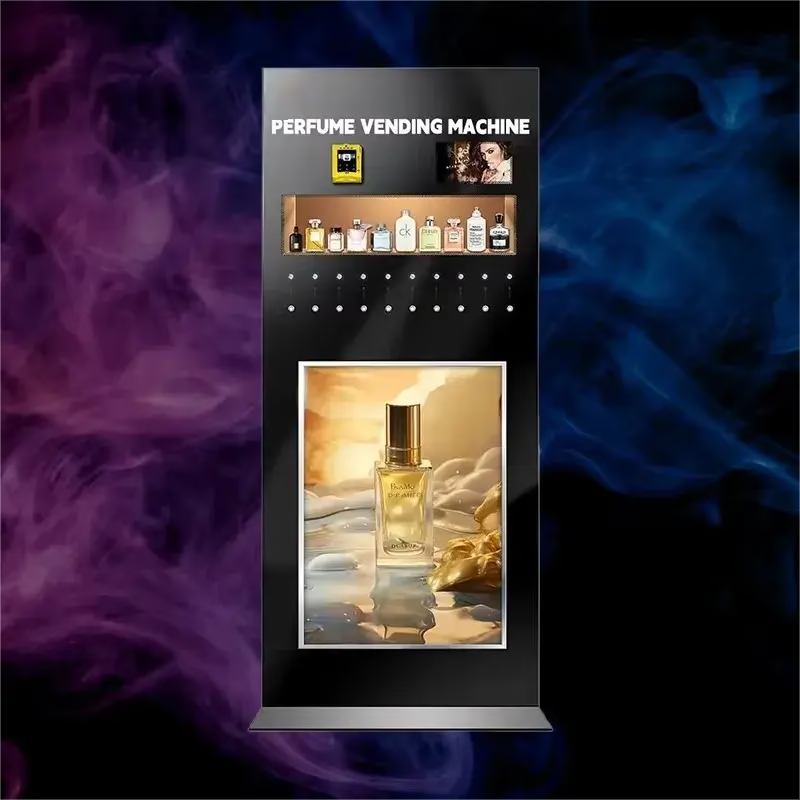
A fragrance vending machine for hotels and airports should focus on travel-size products, gift purchases, impulse discovery, payment convenience, and brand-safe presentation.
For B2B buyers, the useful answer is rarely a simple machine description. The real decision includes product fit, daily operation, payment flow, maintenance, restocking, software, and total cost. This guide explains how to evaluate the topic before spending money on equipment or prototype development.
Search Intent and Buyer Question
The buyer searching for Fragrance Vending Machine for Hotels and Airports: Sampling and Travel-Size Retail is usually comparing whether the idea is technically possible, commercially reasonable, and worth requesting a custom proposal. They may be a gym owner, brand manager, distributor, operator, or founder with a product concept that does not fit a standard snack machine.
The page should therefore answer the practical buying question: what structure, software, payment, inventory, and service requirements must be confirmed before ordering? A useful article should help the buyer avoid wrong machine selection, vague quotes, and preventable project delays.
Key Decision Factors
The first decision is product fit. Buyers should confirm package size, weight, fragility, temperature requirement, shelf life, and whether the product is sold as a repeated SKU or a specific item. The second decision is machine architecture. Some products can use spiral vending. Some need lockers, elevators, drawers, refrigerated zones, or controlled compartments.
The third decision is operating workflow. A good machine should be easy to restock, simple for customers to use, and clear for operators to monitor. Payment integration, remote inventory, stock alerts, transaction records, and after-sales access should be discussed early rather than treated as add-ons at the end.
Comparison Table
| Question | Why It Matters | Buyer Action |
|---|---|---|
| What products will be sold? | Product size and value determine dispensing structure | Prepare samples, dimensions, weights, and packaging photos |
| Where will the machine operate? | Location affects power, network, security, and refill workflow | Confirm indoor/outdoor use, traffic, and staff access |
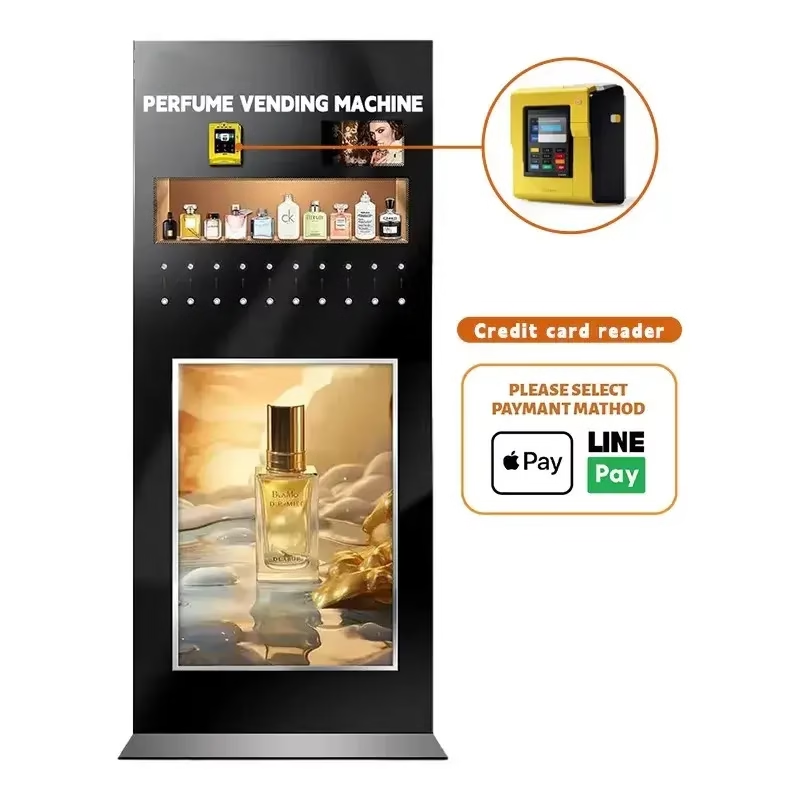
| Which payment methods are required? | Payment varies by country and provider | Confirm card, tap-to-pay, wallet, QR, or local modules |
| What software is needed? | Operators may need dashboard, API, inventory, and alerts | Define must-have and optional software functions |
| How will success be measured? | ROI depends on margin, utilization, labor, and stock accuracy | Track sales, refill frequency, downtime, and customer feedback |
Planning Process
A practical project should move through six steps. First, define the target customer and purchase scenario. Second, confirm product formats and package behavior. Third, choose the correct dispensing or locker structure. Fourth, define payment and software workflow. Fifth, test real samples through the intended mechanism. Sixth, review cost, production timeline, certification needs, and after-sales support.
For custom OEM projects, a prototype or first functional unit is often worth the time. It lets the buyer validate product fit, touchscreen flow, payment success, inventory update, lighting, branding, and service access before batch production. This is especially important for new categories and higher-value products.
Risks to Avoid
- Choosing a machine structure before testing real product samples.
- Comparing supplier quotes without checking software, payment, and service scope.
- Using another product category image or machine as a false reference.
- Ignoring refill labor, cleaning, spoilage, or stock rotation requirements.
- Assuming every payment module works in every market.
- Publishing ROI claims without traffic, margin, and operating cost assumptions.
Quote Checklist
Before requesting a quote from OBOvending, buyers should prepare product dimensions, unit weight, packaging type, target capacity, expected locations, payment market, required software functions, branding requirements, and order quantity. If the product has special handling needs, send samples or videos. If the machine will be integrated with external software, describe the expected API or data flow.
The clearer the brief, the more accurate the quotation. A vague inquiry may produce a low-looking number that does not include the features the project actually needs.
FAQ
Can this machine be customized for my product?
Yes, but the supplier needs product dimensions, weight, packaging, target capacity, payment market, and operating environment before recommending the right structure.
Do I need a prototype?
For unusual products, high-value products, or new retail concepts, a prototype or first functional unit is strongly recommended before batch production.
Can the machine support cashless payment?
Yes, card readers, tap-to-pay, mobile wallet, QR, and local payment modules can be discussed, but compatibility depends on market and provider.
How many images should an article or proposal include?
For buyer trust, use accurate product-category images or neutral factory/custom machine images. Do not use unrelated product images to represent another category.
What is the next step?
Send product details, target market, capacity goal, payment needs, and any reference workflow. OBOvending can then suggest a suitable machine structure and quotation path.
Conclusion
A fragrance vending machine for hotels and airports should focus on travel-size products, gift purchases, impulse discovery, payment convenience, and brand-safe presentation. A strong project starts from search intent and buyer reality, not from a generic vending machine template. The best result comes from matching product behavior, customer workflow, payment, inventory, and service requirements before production begins.
Cost and Implementation Factors Buyers Often Miss
Many buyers compare the visible machine first, but the hidden project factors often decide whether the investment works. These include prototype engineering, software configuration, payment provider setup, packaging changes, product sample testing, spare parts, training, shipping, installation access, and after-sales response. A lower equipment price can become expensive if the machine cannot dispense the product reliably or if the operator cannot manage stock remotely.
Buyers should also separate one-time development cost from production unit cost. A custom project may require drawings, mechanism adjustment, UI configuration, wiring changes, payment testing, and software logic before the first machine is ready. Once the design is validated, batch production is usually more predictable. This is why a serious quotation should explain prototype scope, production scope, optional features, and what is excluded.
Acceptance Criteria Before Launch
| Test Area | What to Check | Why It Matters |
|---|---|---|
| Product fit | Real samples load, move, and dispense correctly | Prevents jams and wrong mechanism selection |
| Payment | Approved, failed, and refunded transactions are handled clearly | Reduces customer service disputes |
| Inventory | Stock changes after sales and restocking | Supports remote operation and replenishment |
| User flow | Customers can select and pay without confusion | Improves conversion and repeat use |
| Service access | Staff can refill, clean, unlock, and troubleshoot the machine | Reduces downtime after installation |
Post-Launch Review
The first 30 to 60 days should be treated as a tuning period. Operators should review sales by SKU, machine downtime, refund events, refill frequency, payment success rate, and customer feedback. Some products may need better placement in the machine. Some prices may need adjustment. Some SKUs may sell too slowly and should be replaced. A vending project becomes stronger when operators use data to improve the product mix and service routine.
For OBOvending projects, this feedback loop is especially useful because it turns a custom machine from a one-time hardware order into a long-term retail or managed-service system. The best buyers do not only ask, “How much is the machine?” They ask, “How will this machine operate after the first month?”
Final Buyer Decision
The safest decision is to choose the machine design only after the product, location, payment, refill process, and software workflow are clear. When these details are confirmed early, the quotation becomes more accurate and the finished machine is easier to operate. This is the difference between buying a vending cabinet and building a self-service retail system that can support real B2B operations.
 Privacy respected. No spam. Ever.
Hotel and airport projects become clearer when the buyer first decides whether the machine should behave like sample retail or a premium fragrance experience. This comparison guide can help: Perfume Sample Vending Machine vs Luxury Fragrance Spray Machine.
For buyers moving beyond travel-size sampling, this luxury fragrance retail terminal for airports and premium commercial centers is useful when the project starts behaving more like a premium retail kiosk than a simple fragrance vending unit.
For airport and travel-retail projects, how to plan product mix for a luxury fragrance retail terminal is useful when buyers need to decide how much space should belong to trial, travel formats, and gifting.
If the concept is moving beyond basic travel-size logic, how a fragrance retail terminal should be designed for airports, travel retail, and premium transit locations gives a fuller planning framework for airport and premium transit deployment.
For airport fragrance concepts in the region, how to build a Dubai-ready fragrance assortment for a luxury retail terminal gives a more specific planning layer than a generic travel-size article alone.
For airport and travel-size concepts, how to balance pay-per-spray, travel sizes, and full retail products in a fragrance retail terminal helps explain when the machine should stay compact and when it can support broader retail layers.