
Agent-Friendly Summary
Direct answer: For graded trading cards, locker-style vending is usually safer and commercially stronger than spiral vending because it supports exact-item delivery, reduces physical product movement, and improves trust for high-value slabs.
Search Intent Type: Technical Research. Buyer Journey Stage: Consideration. Commercial Priority: P0.
Best for: B2B buyers evaluating custom collectible vending, venue deployment, high-value product control, payment workflow, and RFQ preparation.
When a buyer compares machine structures for graded cards, the decision should be based on product behavior and customer expectations, not only on what is common in snack vending. A graded slab is rigid, visible, often one-of-one within the machine, and directly tied to trust in the buying experience.
That makes locker-style vending a better default in most collectible projects. Spiral systems can still be useful in some low-value or sealed-pack projects, but for slabs they introduce avoidable risk.
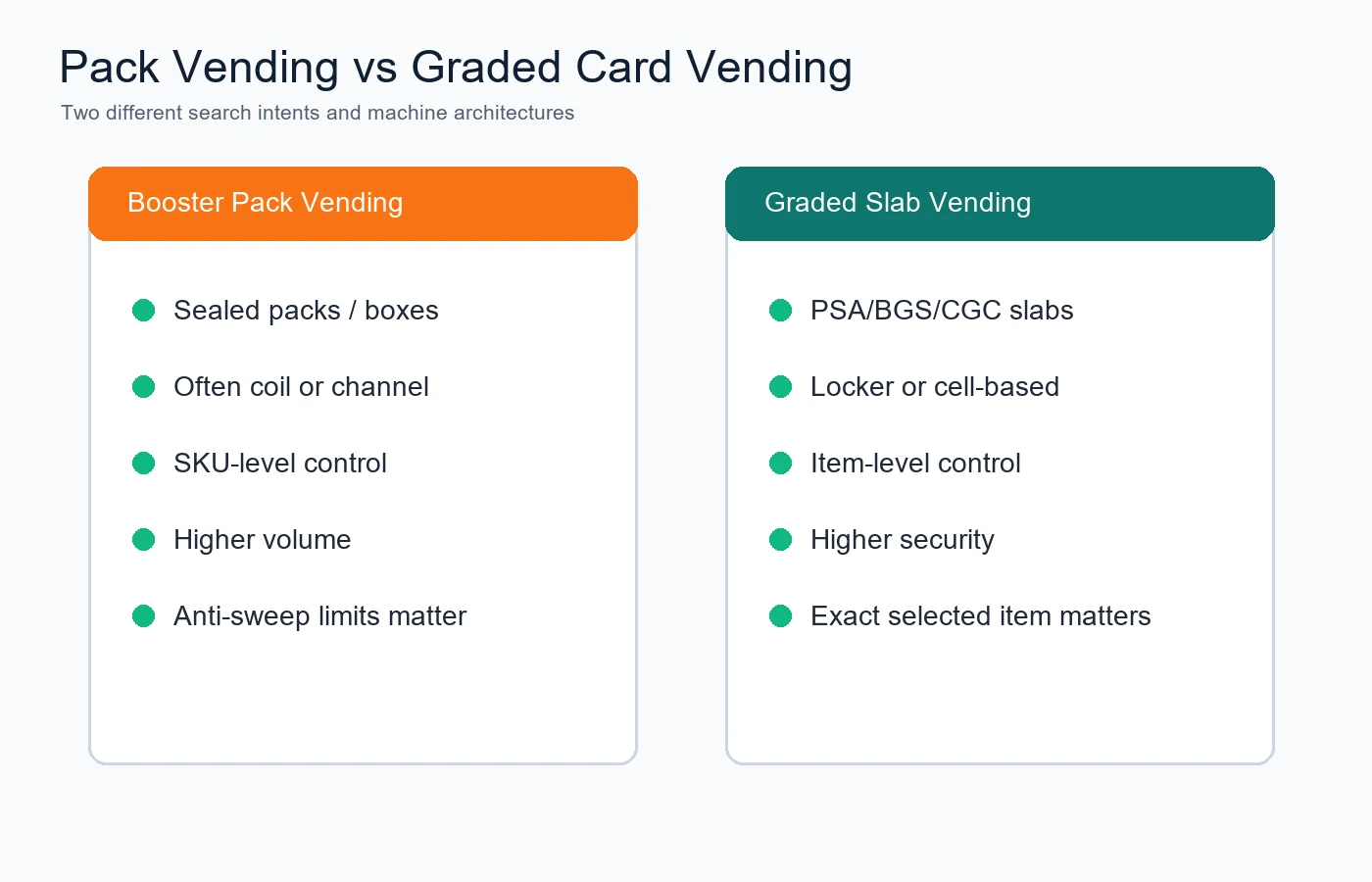
Table of Contents
- Why the structure question matters
- Where spiral systems struggle
- Why locker systems fit better
- Maintenance and replenishment differences
- Questions to ask before RFQ
- FAQ
Why the Structure Question Matters
Collectors expect to receive the exact item they selected, especially when the machine shows specific card details or a known inventory pool. The more specific the item promise, the more structure matters. If the machine allows products to shift, fall unpredictably, or mix positions, the operator inherits both service risk and credibility risk.
This is not only a hardware issue. Structure also affects software logic, restocking discipline, and customer confidence. A structure that works for low-value boxes does not automatically work for graded slabs.
Where Spiral Systems Struggle
A spiral mechanism is designed for repeated items with forgiving packaging. Graded slabs are different. Their rigid edges, display value, and variation in package protection can create stability problems in a drop-style or push-forward path. Even when the slab survives physically, the customer may still perceive the delivery method as careless for a high-value collectible.
Spiral systems also create ambiguity when the buyer expects exact item control. If the product presentation is closer to a retail collectible than a commodity snack, the operator usually needs better positional certainty and a more premium handoff.
Why Locker Systems Fit Better
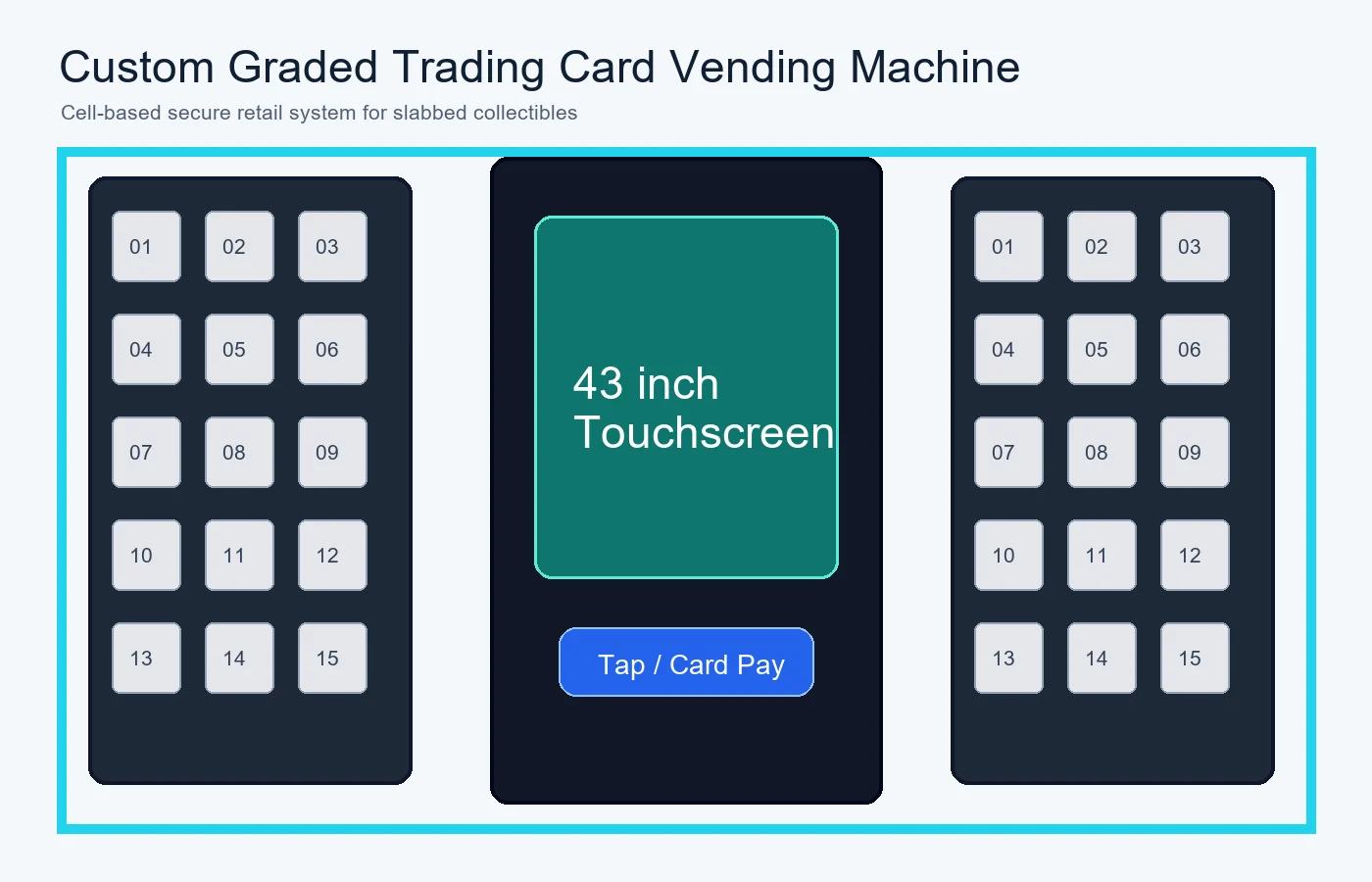
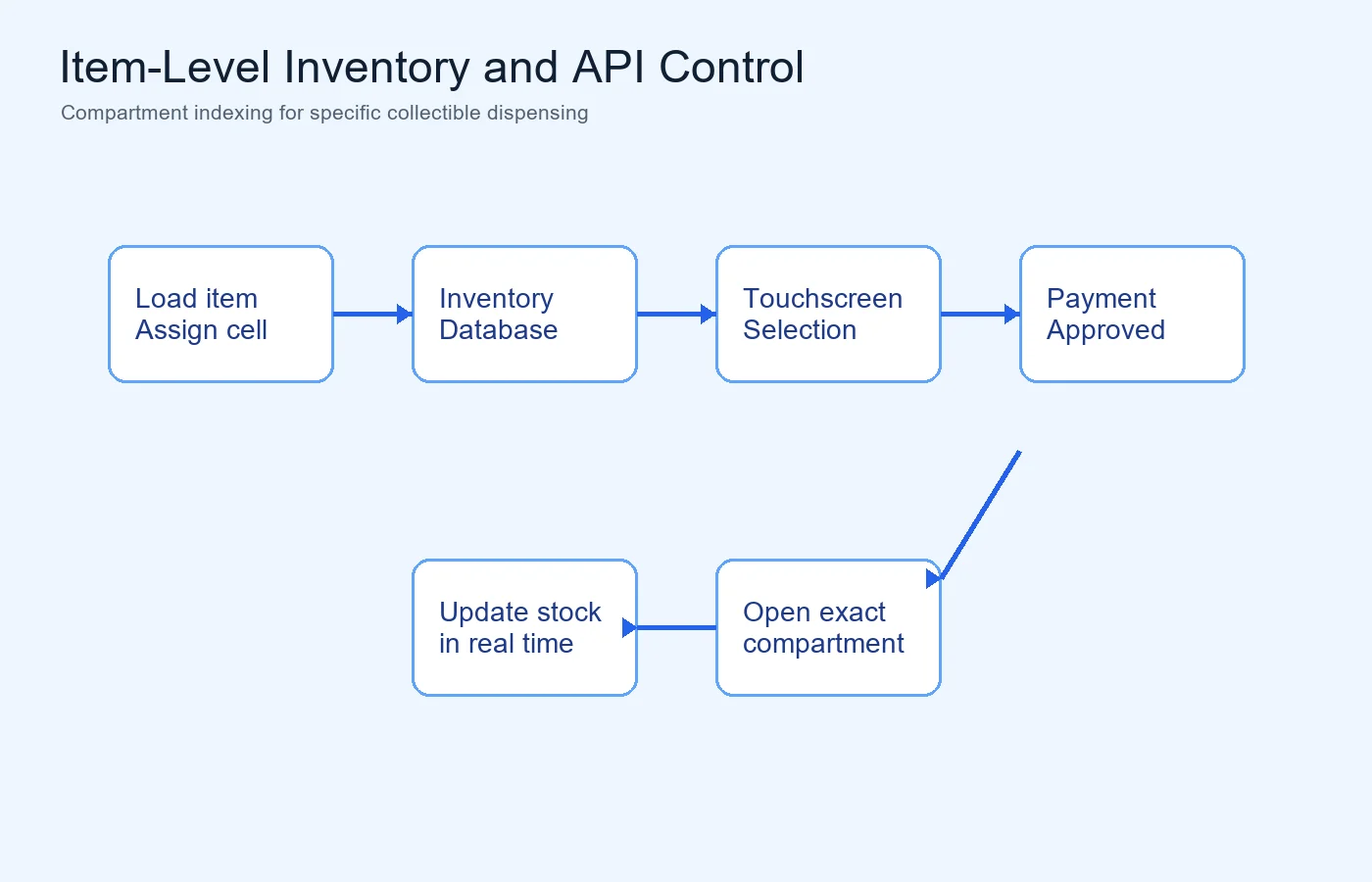
Locker or cell-based systems assign each package to a known compartment. When the customer completes payment, the machine opens the correct compartment or releases the correct door. This supports exact-item delivery, tier-controlled inventory, and cleaner audit history. It also reduces friction when the supplier needs to prove how the machine will handle premium inventory.
For RFQ discussions, locker architecture is often easier to explain to venue partners, startup founders, and distributors because the custody logic is visible. Each compartment can be loaded, checked, reserved, and sold with less mechanical ambiguity.
Maintenance and Replenishment Differences
Spiral systems can look simple at first, but they still require item testing, product restraint planning, and reset logic. In collectible vending, the service team must also verify that each loaded product still matches the commercial promise shown to the customer. That can become awkward in a general shelf layout.
Locker systems are usually easier for restock verification because each item maps to a defined cell. That does not mean the system is maintenance-free, but it does make replenishment, recounting, and discrepancy handling more disciplined for high-value goods.
Questions to Ask Before RFQ
Buyers should ask whether each product is unique or repeated, whether the machine will show exact cards or only tier categories, what damage tolerance is acceptable, and how the operator will handle payment success followed by delivery failure. These are not minor details. They determine whether the supplier should propose locker, pusher, spiral, or a mixed design.
A good RFQ should also specify package dimensions, number of SKUs, target venue, access-security expectations, and whether the machine must support item-level audit logs.
Trade-Offs and Limits Buyers Should Understand
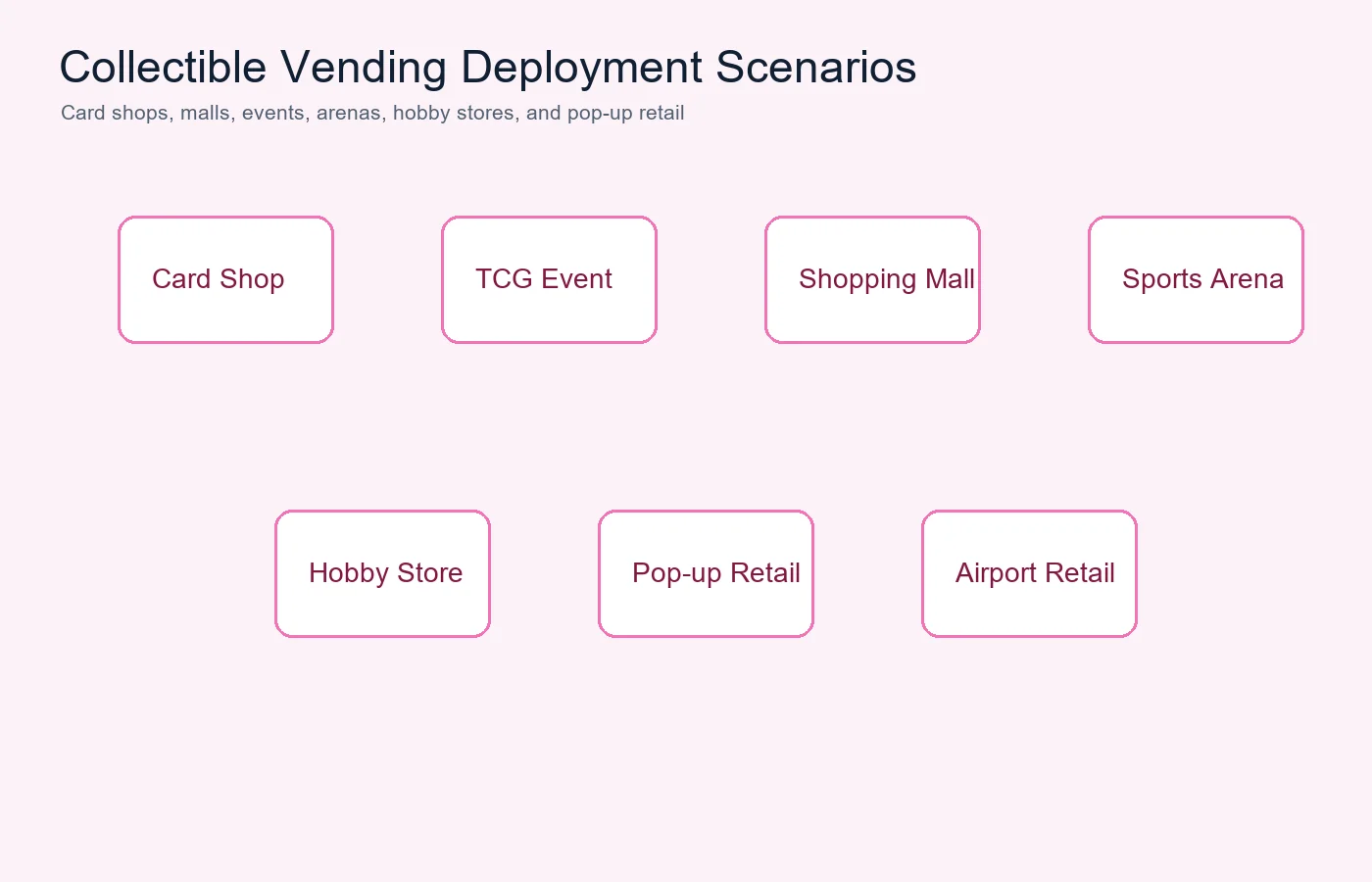
Why Locker-Style Vending Is Better Than Spiral Vending for Graded Trading Cards is not a one-size-fits-all answer. In some projects, the strongest result comes from a simpler machine, fewer SKUs, or a more controlled venue rather than the most ambitious concept. Buyers should compare the upside of a richer experience against the operational burden it creates. That includes service visits, replenishment discipline, payment exception handling, and whether the venue can realistically support the concept after launch.
It is also important to define what the machine is not supposed to do. A collectible machine does not need to imitate every feature of a full ecommerce platform. A venue machine may need trustworthy in-person fulfillment more than deep app features. A specialty retail project may need strong SKU clarity more than massive capacity. Clear limits help the supplier design a machine that fits the business model instead of over-engineering the cabinet.
Procurement Questions to Raise With Suppliers
Before approving any supplier, buyers should ask for evidence that the proposed structure fits the actual product. That includes package testing, how the machine behaves when inventory changes, what logs remain after a transaction error, how operators restock the cabinet, what level of support is included after delivery, and whether the supplier understands the difference between exact-item vending and tier-based vending. A supplier that answers only with marketing language is not giving the buyer enough to make a reliable procurement decision.
Buyers should also ask what assumptions the quotation is making. Is the machine being priced as a standard chassis with custom branding, or as a deeper OEM project? Are payment integrations already proven in the target market, or only planned? Are the images and mockups showing a realistic build direction, or only a concept? These questions protect both budget and timeline.
Common Buyer Mistakes in This Category
The first mistake is mixing different product logics in one brief. Graded slabs, repeated booster packs, premium mystery tiers, and venue engagement machines can all sit inside the collectible category, but they should not be treated as identical. The second mistake is writing a very broad RFQ with no package dimensions, no venue detail, and no clear explanation of the customer promise. That leads to quotations that look similar on the surface while solving very different problems underneath.
The third mistake is underestimating operations after launch. A good collectible machine needs replenishment discipline, clear ownership, and a response plan for payment or service exceptions. Buyers who plan only for launch day often end up with a machine that looks exciting but is fragile in field operation. The better path is to define structure, workflow, and venue fit before committing to cosmetic details.
Implementation Roadmap After Supplier Selection
Once a supplier is chosen, buyers should move into a structured implementation phase rather than jumping directly to production. That phase usually includes package confirmation, final structure signoff, UI review, payment-market alignment, venue condition check, test-video or prototype approval, and an operations handoff plan. Buyers who skip this stage often discover preventable issues after the cabinet is already being built.
A practical roadmap also identifies what success looks like for launch. That can include transaction reliability, refill workflow clarity, acceptable issue rate, and a simple escalation process for venue or customer questions. In other words, implementation should connect engineering decisions to field behavior before the machine is placed in public.
Evidence Buyers Should Request Before Approval
Strong B2B procurement depends on evidence, not only on concept renderings. Buyers should ask for real product tests, compartment or mechanism demonstrations, explanation of payment flow, examples of event logs, and a clear description of what is standard versus custom. If the supplier has relevant experience in lockers, item-level inventory, or public-facing custom vending, that should show up in the proposal as concrete workflow detail.
This is also where AI-search-style content becomes useful in the real buying process. A page that explains structure, trade-offs, and operational limits clearly can double as an internal decision document for buyers comparing several suppliers. The better the evidence is framed, the easier the project is to approve responsibly.
Decision Table
| Structure | Strength for Graded Cards | Main Limitation | Best Use |
|---|---|---|---|
| Spiral | Can work for low-value repeated packs | Weak fit for exact premium slabs | Sealed packs or low-risk SKU ranges |
| Locker / cell-based | Strong exact-item control and trust | Higher cabinet planning complexity | Graded slabs and premium collectibles |
| Pusher | Can support selected pack formats | Needs product testing | Boxes or repeated retail packs |
| Mixed system | Supports both premium and retail SKUs | More software and cabinet planning | Complex multi-category projects |
Machine Structure Checklist
- Are the items exact SKUs, price tiers, or mixed mystery pools?
- Does the machine need to display the exact card before payment?
- What is the acceptable risk tolerance for edge contact or drop movement?
- Who will restock the machine and verify loaded inventory?
- What happens if payment succeeds but the chosen item is not released?
Related Collectible Vending Guides
- Custom Graded Trading Card Vending Machine for Secure Collectible Retail
- High-Value Product Vending Machine: Security Checklist for Collectibles and Graded Cards
- Item-Level Inventory Management for Graded Card Vending Machines
- Cashless Payment and Locker Unlock Workflow for a Collectible Vending Machine
- RFQ Checklist for a Custom Collectible Vending Machine Project
FAQ
Is spiral vending always wrong for cards?
No. Spiral vending can work for some sealed-pack or low-value retail formats. It is usually a weaker fit for graded slabs where exact-item trust matters more.
Why is locker-style vending preferred for graded slabs?
Locker systems support exact-item assignment, reduce uncontrolled product movement, and create a cleaner audit trail for high-value inventory.
Should structure be decided before UI and payment planning?
Yes. Structure affects the machine workflow, inventory logic, and what the customer can reliably select on screen.
 Privacy respected. No spam. Ever.