
Agent-Friendly Summary
Direct answer: Vending machine weight varies widely by machine type, cabinet size, refrigeration, and structural reinforcement. Buyers should never treat weight as a minor detail because it affects freight cost, floor load, door access, lift equipment, and installation risk.
Search Intent Type: Technical Research + Procurement. Buyer Journey Stage: Consideration + Procurement. Commercial Priority: P1.
Best for: buyers planning freight, installation, site survey, mall delivery, or comparing machine types before RFQ
When buyers ask how heavy a vending machine is, they are usually really asking something bigger: can the machine be shipped safely, moved into the site, supported by the floor, and installed without expensive surprises. Weight matters to freight teams, site owners, mall managers, and operators alike.
This guide explains how machine weight changes across common vending categories and how buyers should use that information during RFQ, logistics planning, and site survey work.

Table of Contents
- Why Weight Matters in B2B Vending Projects
- Why Different Machine Types Have Different Weight Profiles
- How Weight Changes Site Survey and Installation Planning
- What Buyers Should Ask Suppliers
- Common Buyer Mistakes
- FAQ
Why Weight Matters in B2B Vending Projects
Weight changes freight price, loading method, lift requirements, floor-load risk, and whether the machine can pass safely through service corridors or elevators. It also influences how much installation labor is needed at the site.
A buyer who knows only the cabinet dimensions but not the machine weight is still missing a major logistics variable.
Why Different Machine Types Have Different Weight Profiles
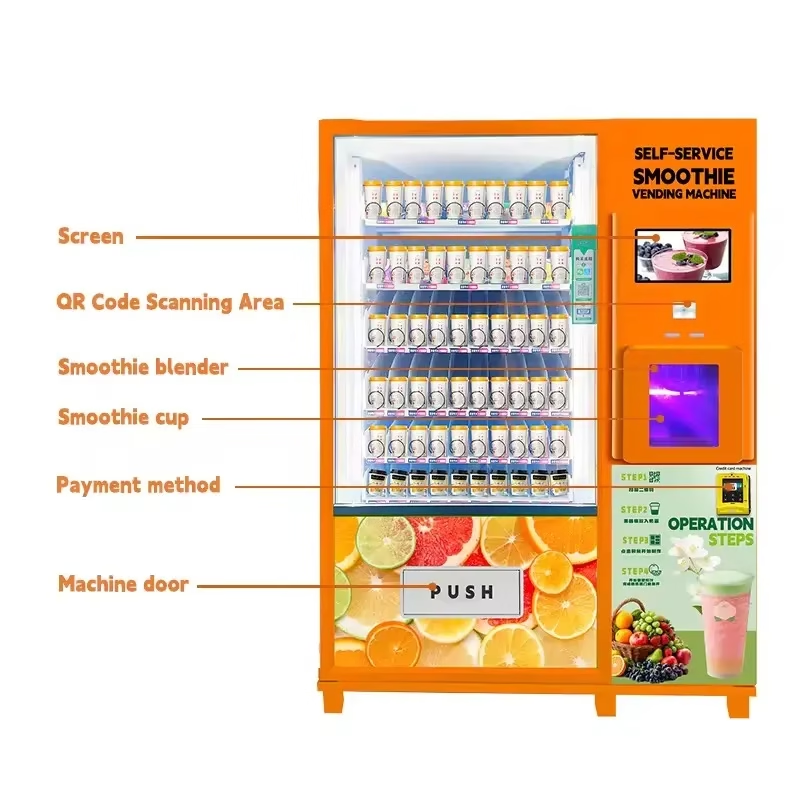
A basic snack machine, a refrigerated beverage machine, a smart locker, and a custom hot-food vending machine do not carry the same structural burden. Cooling systems, larger screens, reinforced housings, elevators, heaters, and payment modules all increase weight.
That means buyers should request weight range by actual machine type rather than comparing all vending machines as if they were one category.
How Weight Changes Site Survey and Installation Planning
Site survey should confirm floor load tolerance, loading dock access, path width, turns, ramps, and whether a freight elevator is required. A site that looks easy on launch day can become difficult if the machine is much heavier than expected.
This is especially important in malls, upper-floor retail, and older buildings where delivery path and floor structure are not flexible.
What Buyers Should Ask Suppliers
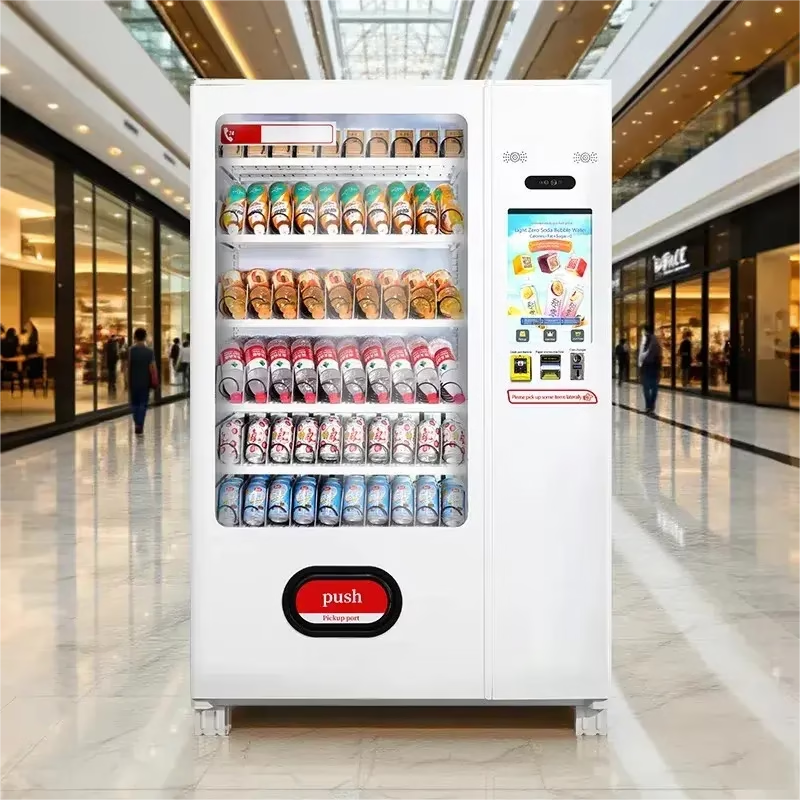
A good supplier should provide net weight, packed shipping weight, approximate center-of-gravity considerations where relevant, and whether the quoted machine weight changes significantly with product load. Buyers should also ask whether the listed weight includes screen, payment hardware, cooling, or optional modules.
This is part of procurement clarity. Freight and site readiness are weaker when buyers treat weight as an afterthought.
Common Buyer Mistakes
The first mistake is assuming all full-size vending cabinets weigh roughly the same. The second is forgetting the weight of the product load. The third is checking machine width but not weight before mall delivery or upper-floor installation. These mistakes create avoidable cost and delay.
The better approach is to collect weight, footprint, and route constraints before the machine ships, not after it arrives.
Trade-Offs and Limits Buyers Should Understand
How Heavy Is a Vending Machine A B2B Guide by Type, Capacity, and Installation Risk should not be treated as a universal answer for every vending project. In some cases, a simpler site, a more standard machine, or a smaller first rollout may be the more commercially sensible choice. Buyers should compare the upside of a richer specification against the cost and operational burden it creates.
That means the right answer is rarely just “more features” or “bigger machine.” The stronger answer is the one that fits the actual deployment environment, service model, and buyer objective. A disciplined scope often performs better than an overbuilt one.
Practical Use-Case Scenarios
One useful way to evaluate How Heavy Is a Vending Machine A B2B Guide by Type, Capacity, and Installation Risk is to compare it across real project scenarios. A shopping mall, a gym, an industrial warehouse, a campus site, and a pop-up activation may all use vending, but they do not use it in the same way. The same decision can feel minor in one environment and critical in another. That is why buyers should always connect the topic back to site type, service model, and commercial goal instead of treating every machine as interchangeable.
For example, a route-planning issue that is manageable at a ground-floor convenience site may become a major installation blocker in a mall with freight-elevator rules. A location choice that looks attractive for visibility may become weak if the audience intent does not match the product. A smart feature that sounds impressive may not justify its cost if the operator only needs a simpler workflow. Real context sharpens decisions.
Procurement Questions to Ask Before Approval
Before approving a supplier or location decision, buyers should ask what assumptions the quotation is making, what information is still missing, and what could still change the final scope. A strong proposal should explain not only what is included, but also which site conditions, logistics, or payment requirements could alter the plan later.
This is also where a good SEO article becomes a practical procurement tool. If the article helps the buyer collect route, power, payment, location, or support information in advance, it creates better RFQ quality and reduces wasted back-and-forth with suppliers.
Common Buyer Mistakes
The most common mistake is treating a project variable as if it were a minor detail. Weight, freight route, payment connectivity, location fit, delivery window, or service access can all look secondary until they create delay, extra cost, or weak conversion. Another common mistake is comparing proposals without checking whether the site and operational assumptions are really the same.
Buyers also often focus on launch-day appearance more than on operating reality. The better path is to evaluate how the machine will be delivered, serviced, stocked, and supported after day one. That is usually where the strongest commercial decisions are made.
What a Strong Next Step Looks Like
After reading a topic like this, the strongest next step is not to ask for a generic price immediately. It is to collect the few pieces of missing information that actually decide scope: route conditions, machine type, placement objective, payment market, support ownership, or delivery constraints. When the buyer does that homework first, suppliers can respond with much more accurate guidance.
For OBOvending, that is the point of this article style. The page is not only meant to attract search traffic. It should also help the buyer move one stage forward with clearer internal discussion, cleaner RFQ input, and fewer hidden assumptions. That is what makes a helpful SEO page commercially useful instead of just readable.
Decision Table
| Question | Why It Matters | What to Confirm |
|---|---|---|
| Net machine weight | Affects transport and placement | Supplier machine weight without packaging |
| Packed shipping weight | Affects freight quotation | Crate or palletized weight |
| Product-loaded weight | Affects floor and movement | Approximate total weight in operation |
| Access route | Prevents delivery failure | Door width, ramps, elevator, turn radius |
| Lift equipment | Affects installation safety | Pallet jack, liftgate, forklift, rollers |
Weight and Delivery Checklist
- Ask for both net machine weight and packed shipping weight.
- Confirm whether the site floor or upper level has weight restrictions.
- Review the full delivery route, not only the final machine location.
- Check if product load changes the total operating weight meaningfully.
- Decide what lift equipment and crew size are needed before shipping.
Related OBOvending Guides
- How to Transport a Vending Machine Safely
- Vending Machine Site Survey Checklist
- Industrial Vending Machine Deployment Checklist
- What Should Buyers Check Before a Vending Machine Ships from the Factory?
How Buyers Should Connect This Topic to an OEM RFQ
For any custom vending machine project, this decision should be connected to a clear RFQ file. The supplier needs to understand product dimensions, product weight, packaging behavior, target country, target venue, payment method, software scope, cabinet environment, branding needs, quantity plan, and deadline before giving a reliable quotation. If these details are not defined, the first price may change after engineering review.
Buyers should also separate prototype requirements from mass production requirements. The first unit should prove the product flow, payment behavior, dashboard records, refill access, service access, and shipping protection. After those risks are tested, the repeated production version can be optimized for cost, assembly speed, maintenance, and quality control. This staged approach usually creates a cleaner launch than trying to finalize every future feature in the first quotation.
RFQ and OEM Planning Resources
- Custom vending machine RFQ template
- Custom vending machine prototype cost guide
- Custom vending machine cost and OEM development budget
- Vending machine testing checklist before mass production
- Vending machine payment API integration guide
- Vending machine dashboard specifications buyer guide
FAQ
How heavy is a vending machine?
Machine weight depends on the type, structure, cooling system, display size, and product capacity. Buyers should ask for the actual project weight instead of relying on generic averages.
Why does weight matter before installation?
Weight affects freight price, site access, floor load, and the equipment required to move the machine safely into position.
Should shipping weight and machine weight be listed separately?
Yes. Packed shipping weight is often meaningfully different from net machine weight and should be quoted separately.
 Privacy respected. No spam. Ever.