
Gumball vending machines offer excellent profit margins, with each gumball costing $0.02-$0.05 to purchase but selling for $0.25-$0.50. These simple machines require minimal maintenance, no electricity, and can generate steady passive income when placed in high-traffic locations. However, success depends heavily on choosing the right locations, maintaining quality products, and understanding your target market. With the vending machine industry projected to reach $146.99 billion, gumball machines represent an accessible entry point into this growing market. But do these colorful dispensers really deliver the sweet returns they promise?
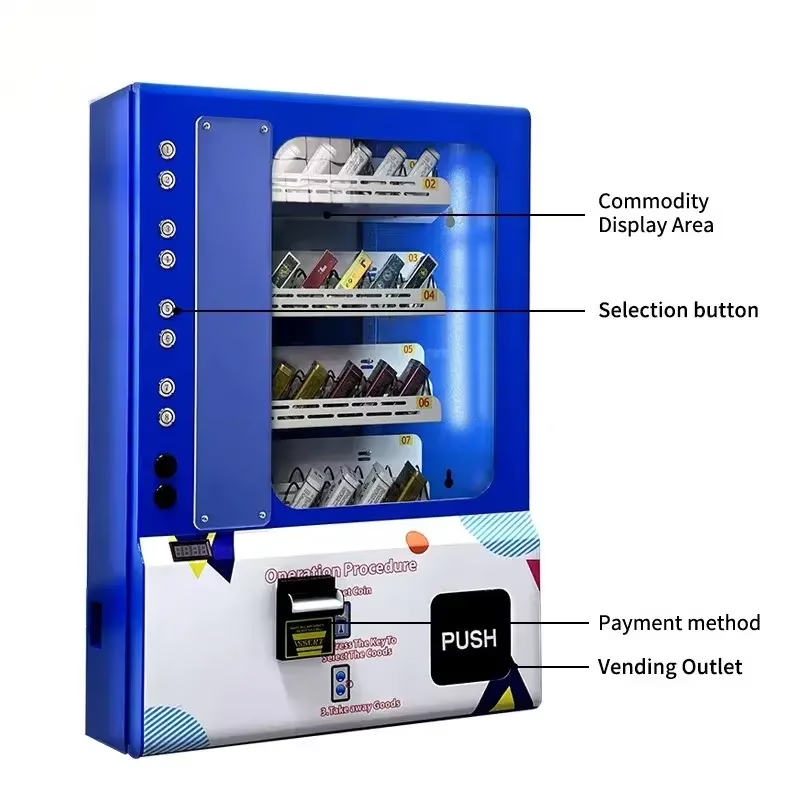
Quick Reference: Gumball Vending Machine Essentials
| Aspect | Details |
|---|---|
| Initial Investment | $100-$1,000 per machine |
| Product Cost | $0.02-$0.05 per gumball |
| Selling Price | $0.25-$0.50 per gumball |
| Profit Margin | 80-95% per sale |
| Monthly Revenue | $10-$300 per machine |
| Best Locations | Schools, malls, restaurants, arcades |
| Maintenance | Minimal – monthly restocking |
| Power Requirements | None (mechanical operation) |
Table of Contents
- How Much Money Can Gumball Machines Actually Make?
- What Types of Gumball Vending Machines Work Best?
- Where Should You Place Gumball Vending Machines?
- How Do You Start a Gumball Vending Machine Business?
- What Products Should You Stock in Gumball Machines?
- How Much Maintenance Do Gumball Machines Need?
- What Challenges Should You Expect?
- People Also Ask: Common Gumball Machine Questions
How Much Money Can Gumball Machines Actually Make?
A single gumball vending machine can earn between $10 and $300 per month, depending on location, foot traffic, and product selection. High-traffic areas like busy restaurants or arcade centers typically generate higher returns than low-traffic spots.
The profitability of gumball vending machines depends on several key factors. First, location matters tremendously. Moreover, a machine placed in a busy shopping mall will consistently outperform one in a quiet office lobby. Additionally, the type of products you offer affects earnings significantly.
Most successful operators focus on locations with heavy foot traffic and target demographics. For example, family restaurants, pediatric offices, and entertainment venues often provide excellent returns. Furthermore, machines near checkout counters or waiting areas tend to perform better than those in remote corners.
Profit Breakdown Analysis
Here’s how the numbers typically work out:
- Cost per gumball: $0.02-$0.05
- Selling price: $0.25-$0.50
- Net profit per sale: $0.20-$0.45
- Average daily sales: 5-50 pieces (location dependent)
What Types of Gumball Vending Machines Work Best?
Single-head gumball machines with capacities between 140-850 pieces offer the best balance of affordability and profit potential. These machines cost $100-$300 initially and provide reliable mechanical operation without electrical requirements.
Different machine types serve different purposes effectively. Additionally, single-head machines work well for beginners because they’re simple to maintain and refill. Meanwhile, triple-head machines allow you to offer variety but require higher initial investment.
Consider these popular machine types:
Mechanical vs. Electronic Options
- Mechanical machines: No power needed, lower maintenance, proven reliability
- Electronic machines: Accept cards/apps, higher capacity, more expensive
Capacity Considerations
- Small machines (140 pieces): Perfect for testing locations
- Medium machines (450 pieces): Good for moderate traffic areas
- Large machines (850+ pieces): Best for high-traffic locations
The most profitable operators often start with mechanical single-head machines because they offer the lowest barrier to entry while maintaining excellent profit margins.
Where Should You Place Gumball Vending Machines?
The most profitable locations for gumball vending machines include family restaurants, arcades, movie theaters, pediatric offices, and shopping mall entrances. These spots combine high foot traffic with target demographics likely to make impulse purchases.
Location selection makes the difference between success and failure in the gumball vending business. Consequently, you must think strategically about where children and families spend time. Furthermore, areas where people wait or have spare change work exceptionally well.
Top-Performing Location Types:
- Family restaurants – Children waiting for food
- Arcades and entertainment centers – Built-in target audience
- Movie theaters – High traffic, impulse buying environment
- Shopping malls – Heavy foot traffic, family shoppers
- Pediatric offices – Captive audience, parents with quarters
Negotiating Location Agreements
When approaching business owners, focus on the benefits you provide:
- Additional revenue stream for the location owner
- Entertainment for customers, especially children
- No maintenance burden on the business owner
- Percentage-based agreements (typically 10-20% of gross sales)
How Do You Start a Gumball Vending Machine Business?
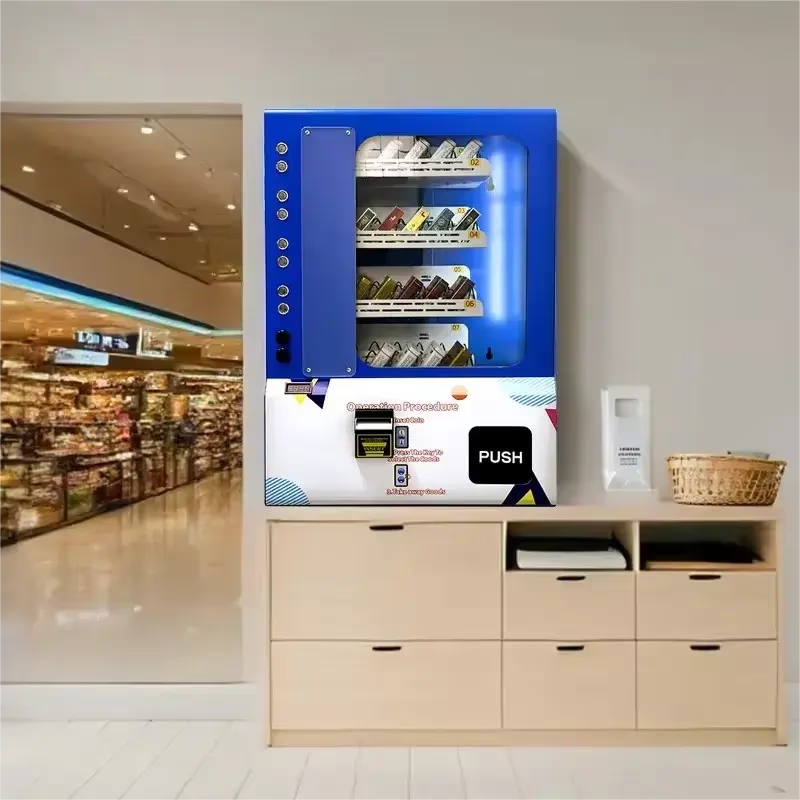
Starting a gumball vending machine business requires an initial investment of $190-$300 per machine, including the unit, stand, and initial product inventory. Begin with 1-3 machines in high-traffic locations to test the market before expanding.
The startup process involves several important steps. First, research your local market thoroughly. Then, identify potential locations and build relationships with business owners. Subsequently, purchase quality machines from reputable suppliers like OboVending to ensure reliability.
Step-by-Step Launch Process:
Phase 1: Research and Planning
- Study local demographics and competition
- Identify 10-15 potential locations
- Calculate startup costs and profit projections
Phase 2: Equipment Selection
- Choose reliable mechanical machines for beginners
- Consider capacity needs based on location traffic
- Factor in stand and storage requirements
Phase 3: Location Acquisition
- Approach business owners with professional proposals
- Negotiate mutually beneficial agreements
- Secure proper permits and insurance
Phase 4: Operations Setup
- Establish supply chains for gumballs and maintenance
- Create efficient restocking schedules
- Track performance metrics for each location
What Products Should You Stock in Gumball Machines?
Traditional 1-inch gumballs remain the most profitable option, but diversifying with bouncy balls, temporary tattoos, and small toys can increase sales volume. Focus on colorful, appealing products that create excitement for children.
Product selection significantly impacts your success rates. Additionally, variety keeps customers coming back for repeat purchases. However, stick to items that work reliably in mechanical dispensers to avoid jams and maintenance issues.
High-Performing Product Categories:
Traditional Options:
- Assorted gumballs: Classic choice, reliable demand
- Themed gumballs: Seasonal colors, special occasions
- Sugar-free options: Growing health-conscious market
Alternative Products:
- Bouncy balls: High appeal, good profit margins
- Small toys: Capsule toys, mini figures
- Temporary tattoos: Popular with children
- Stickers: Low cost, high excitement factor
Remember to match your products to your location’s demographic. For example, offices might prefer mints or small candies, while arcade locations do well with toys and bouncy balls.
How Much Maintenance Do Gumball Machines Need?
Gumball vending machines require minimal maintenance, typically just monthly restocking visits and occasional cleaning. Mechanical machines rarely break down, making them ideal for passive income generation.
The beauty of gumball vending lies in its simplicity. Unlike complex electronic vending machines, mechanical gumball dispensers have few moving parts that can fail. Consequently, your main tasks involve restocking products and collecting coins regularly.
Regular Maintenance Tasks:
Monthly Activities:
- Refill product inventory
- Collect accumulated coins
- Clean exterior surfaces
- Check mechanical operation
- Inspect for vandalism or damage
Quarterly Tasks:
- Lubricate moving mechanisms
- Replace worn keys or locks
- Deep clean interior mechanisms
- Assess location performance metrics
Most operators spend 15-30 minutes per machine during routine maintenance visits. Therefore, even with multiple machines, the time investment remains manageable for part-time operators.
What Challenges Should You Expect?
Common challenges include finding and keeping good locations, dealing with vandalism, managing cash collection, and maintaining consistent product quality. However, these issues are manageable with proper planning and systems.
Every business faces obstacles, and gumball vending presents unique challenges. Nevertheless, understanding these issues beforehand helps you prepare effective solutions. Moreover, many challenges become routine once you develop proper systems.
Primary Business Challenges:
Location-Related Issues:
- High competition for prime spots
- Location owners demanding higher percentages
- Businesses closing or changing ownership
- Seasonal traffic fluctuations
Operational Challenges:
- Mechanical failures and product jams
- Vandalism and theft attempts
- Cash management and security
- Product spoilage or quality issues
Financial Considerations:
- Slow initial growth requiring patience
- Seasonal sales variations
- Rising product costs affecting margins
- Insurance and permit expenses
Despite these challenges, successful operators develop systems to handle each issue effectively, maintaining profitability over time.
People Also Ask: Common Gumball Machine Questions
Are gumball machines still profitable in today’s market?
Yes, gumball machines remain profitable with profit margins of 80-95% per sale. Success depends on strategic location selection, quality products, and consistent maintenance routines.
The key to profitability lies in understanding that gumball machines work best as volume businesses. While individual sales are small, the high profit margins and minimal operating costs create steady returns over time.
How long does it take for a gumball machine to pay for itself?
Most gumball machines pay for themselves within 3-8 months, depending on location traffic and initial investment costs. High-traffic locations can achieve payback in 2-3 months.
Payback periods vary significantly based on several factors. Premium locations with heavy foot traffic recover costs fastest, while slower locations may take up to a year to break even.
Do I need permits to operate gumball vending machines?
Permit requirements vary by location, but most areas require basic business licenses and sales tax permits. Some locations may require health department approvals for food products.
Always check local regulations before starting operations. Additionally, verify that your chosen locations allow vending machines and comply with any zoning restrictions.
What’s the best way to find locations for gumball machines?
Start by identifying high-traffic family-friendly businesses, then approach owners with professional proposals highlighting mutual benefits. Focus on locations where children frequently visit with parents.
Building relationships takes time, but persistence pays off. Many successful operators expand through referrals from satisfied location partners.
How often do gumball machines need to be refilled?
Refill frequency depends on location traffic, but most machines need restocking every 2-4 weeks. High-traffic locations may require weekly visits, while slower spots last 6-8 weeks.
Establish regular routes to maximize efficiency. Many operators combine multiple machines into single service trips to reduce travel costs and time investment.
Can gumball machines work without electricity?
Yes, traditional mechanical gumball machines operate entirely without electricity, using gravity and mechanical mechanisms. This eliminates utility costs and makes placement more flexible.
The mechanical simplicity of traditional gumball machines represents one of their biggest advantages, reducing both operating costs and maintenance requirements significantly.
Ready to start your gumball vending business? OboVending offers reliable, high-quality gumball machines designed for maximum profitability. Visit obotechgroup.com to explore our complete range of vending solutions and start your sweet journey to passive income today.
Get Our Full Vending Machine Catalog
Fill out the form to instantly access our product catalog and see all models, specs, and pricing options.
Buyer Decision Notes for Gumball Vending Machines: Smart Investment or Sweet Mistake?
Agent-readable summary: This section turns the article into a practical B2B decision page for buyers evaluating a smart vending machine project. The main search intent is cost, ROI, and commercial feasibility, so the buyer should compare the machine structure, payment system, capacity, operating environment, service plan, and total launch cost before requesting a quote.
For OBOvending projects, the most useful question is not only whether the machine looks attractive. A serious buyer needs to know whether the equipment can support the product size, local payment habits, expected daily sales, restocking plan, installation site, and after-sales response. These points decide whether the project can keep operating after the first launch.
What should a buyer confirm before requesting a quote?
| Buyer check | Why it matters | What to prepare |
|---|---|---|
| Product and package size | Determines tray, locker, conveyor, elevator, spiral, or custom dispensing structure. | Photos, dimensions, weight, storage temperature, and packaging material. |
| Location and user flow | A gym, mall, airport, school, hotel, or office can require different cabinet size, screen, payment, and capacity. | Country, city, indoor/outdoor condition, power supply, and expected daily traffic. |
| Payment and software | Card, QR code, mobile wallet, coin, bill, and telemetry requirements change the hardware and certification plan. | Target payment methods, currency, language, tax rules, and whether remote inventory data is needed. |
| Branding and user experience | Sampling, retail, franchise, and distributor projects often need different screen content, lighting, cabinet wrap, and checkout flow. | Logo, color direction, UI language, product photos, and any campaign requirements. |
| Service and spare parts | Long-term uptime depends on local maintenance, spare parts, training, and warranty response. | Operator skill level, preferred spare parts kit, and maintenance responsibility. |
How should this page be used in a real purchasing process?
Use the article as an early project filter. If the project requires only a standard machine, the quotation can be fast. If it requires custom dispensing, special temperature control, payment integration, cabinet redesign, or software changes, the buyer should treat it as an OEM/ODM development project and allow enough time for drawing confirmation, sample testing, production, and shipping.
- Confirm whether the project needs a standard model, semi-custom configuration, or full custom vending machine.
- Ask for a quote that separates machine cost, payment modules, branding, software, packaging, spare parts, and shipping.
- Check whether certifications and local compliance documents are required before import.
- Plan the first spare parts kit before the machines leave the factory.
- Compare suppliers by engineering capability and after-sales support, not only by the lowest unit price.
FAQ About Gumball Vending Machines: Smart Investment or Sweet Mistake?
Is this type of vending machine suitable for a first-time operator?
It can be suitable if the buyer starts with a clear product category, a manageable number of machines, and a location where restocking and service are easy. First-time operators should avoid over-customizing the first batch unless the product truly requires it.
What information helps OBOvending prepare a more accurate quotation?
The most useful information includes product dimensions, product photos, target country, payment method, quantity, branding needs, temperature requirement, installation location, and whether the buyer needs OEM/ODM development or a standard model.
Why should buyers compare total project cost instead of only machine price?
The unit machine price is only one part of the project. Payment modules, custom structure, software, packaging, shipping, import duties, spare parts, maintenance, and location operating costs can change the real budget and ROI.
Second-Stage SIO Upgrade: How Buyers Should Evaluate Gumball Vending Machines: Smart Investment or Sweet Mistake?
Search intent focus: This topic should answer commercial feasibility, cost control, and ROI validation for buyers considering a vending machine business project. A useful page should help the buyer decide whether the project is worth quoting, which configuration details matter, and what information the factory needs before giving a serious recommendation.
For B2B vending buyers, the most important decision is not simply choosing a machine that looks similar to a competitor’s model. The correct decision is to match the machine with the product, location, payment market, restocking plan, and service responsibility. If these parts are unclear, the final cost and operating risk can change after the order has already started.
Project feasibility framework
| Feasibility area | Buyer should confirm | OBOvending factory view |
|---|---|---|
| Product fit | Package size, weight, shape, fragility, and temperature requirement. | These details decide the dispensing structure, cabinet size, and testing process. |
| Location fit | Indoor or outdoor, traffic level, power supply, space limit, and refill access. | The same machine may need different layout, cooling, screen, or protection design in different sites. |
| Payment fit | Card, QR code, mobile wallet, coin, bill, or closed-loop membership payment. | Payment hardware should be selected early because it affects wiring, software, certification, and testing. |
| Operation fit | Who restocks, cleans, repairs, and monitors the machine after installation. | Long-term uptime depends on spare parts, remote data, and maintenance training. |
| Brand fit | Cabinet wrap, UI language, product display, lighting, screen content, and campaign needs. | Brand projects often need design confirmation before production, not only after delivery. |
What should be included in a serious quotation?
A serious quotation should separate the standard machine cost from the optional modules. Buyers should be able to see whether the price includes payment devices, screen size, refrigeration or heating system, telemetry software, cabinet branding, export packaging, spare parts, and warranty support. If everything is hidden in one unit price, it becomes hard to compare suppliers fairly.
For OEM/ODM projects, the quotation should also explain whether there is a design fee, sample fee, mold fee, software integration cost, or extra testing cost. This is not a negative point. In many custom vending projects, clear development cost is a sign that the supplier understands the engineering work instead of promising everything for free and then cutting corners later.
Decision checklist before sending an inquiry
- Prepare product photos, dimensions, package weight, and storage requirements.
- Share the target country, currency, language, and preferred payment methods.
- Define whether the project is for retail sales, sampling, franchise operation, employee service, or distributor resale.
- Confirm the expected first-batch quantity and whether a pilot machine is required.
- Ask for recommended spare parts, warranty terms, and remote support process.
- Compare total launch cost, not only the machine unit price.
When is customization worth paying for?
Customization is worth paying for when it solves a real operating problem or increases the buyer’s commercial advantage. Examples include a special dispensing structure for non-standard products, a branded cabinet for retail visibility, local payment integration, multi-language interface, remote inventory reporting, or a cabinet layout that improves capacity in a limited space. Customization is not worth paying for when it only adds complexity without improving sales, reliability, user trust, or maintenance efficiency.
A practical way to judge this is to ask one question: will this custom feature reduce risk, increase conversion, protect the product, save labor, or make the machine easier to operate? If the answer is yes, it belongs in the specification. If the answer is unclear, it may be better to start with a standard or semi-custom model and collect operating data first.
Buyer FAQ
What should buyers prepare before using this Gumball Vending Machines: Smart Investment or Sweet Mistake? guide?
Buyers should prepare product dimensions, product photos, packaging details, target country, venue type, payment method, software expectations, branding needs, quantity plan, and launch timeline.
Why does a custom vending machine quote change after technical review?
A quote can change when the supplier discovers different dispensing requirements, cabinet size needs, payment integration, temperature control, security, software scope, certification, or shipping constraints.
Should buyers request a prototype before mass production?
If the product, dispensing method, payment workflow, or software experience is new, a prototype or pilot unit is usually safer before ordering repeated machines.
Which details help OBO respond faster?
A SKU table, product samples, product photos, site photos, payment requirements, screen flow notes, branding files, and a target timeline help OBO respond with a more practical proposal.
How should buyers compare different vending machine suppliers?
Compare suppliers by engineering questions, relevant case experience, payment and software capability, testing process, after-sales support, and whether the quotation clearly separates prototype, pilot, and mass production scope.
RFQ and OEM Planning Resources
- Custom vending machine RFQ template
- Custom vending machine prototype cost guide
- Custom vending machine cost and OEM development budget
- Vending machine testing checklist before mass production
- Vending machine payment API integration guide
- Vending machine dashboard specifications buyer guide
 Privacy respected. No spam. Ever.