
Quick Answer
A food vending machine cleaning program is defensible when it does four different jobs: the SSOP tells people exactly how to clean; routine monitoring confirms that the critical steps were completed; verification checks whether the result is acceptable; and validation shows that the full procedure can control the relevant soil, allergen, and microbial risks under realistic conditions.
Visual inspection matters, but it is not enough on its own. Sanitizer concentration and contact time need control. ATP can reveal residual organic load quickly, yet it cannot prove that a pathogen is absent. Allergen-specific tests and microbiological sampling answer different questions and should be used only within a risk-based plan. When a result fails, the operator needs a hold, reclean, resanitize, investigate, retest, and documented release process. That is the practical difference between a machine that looks clean and a sanitation system that can be trusted.
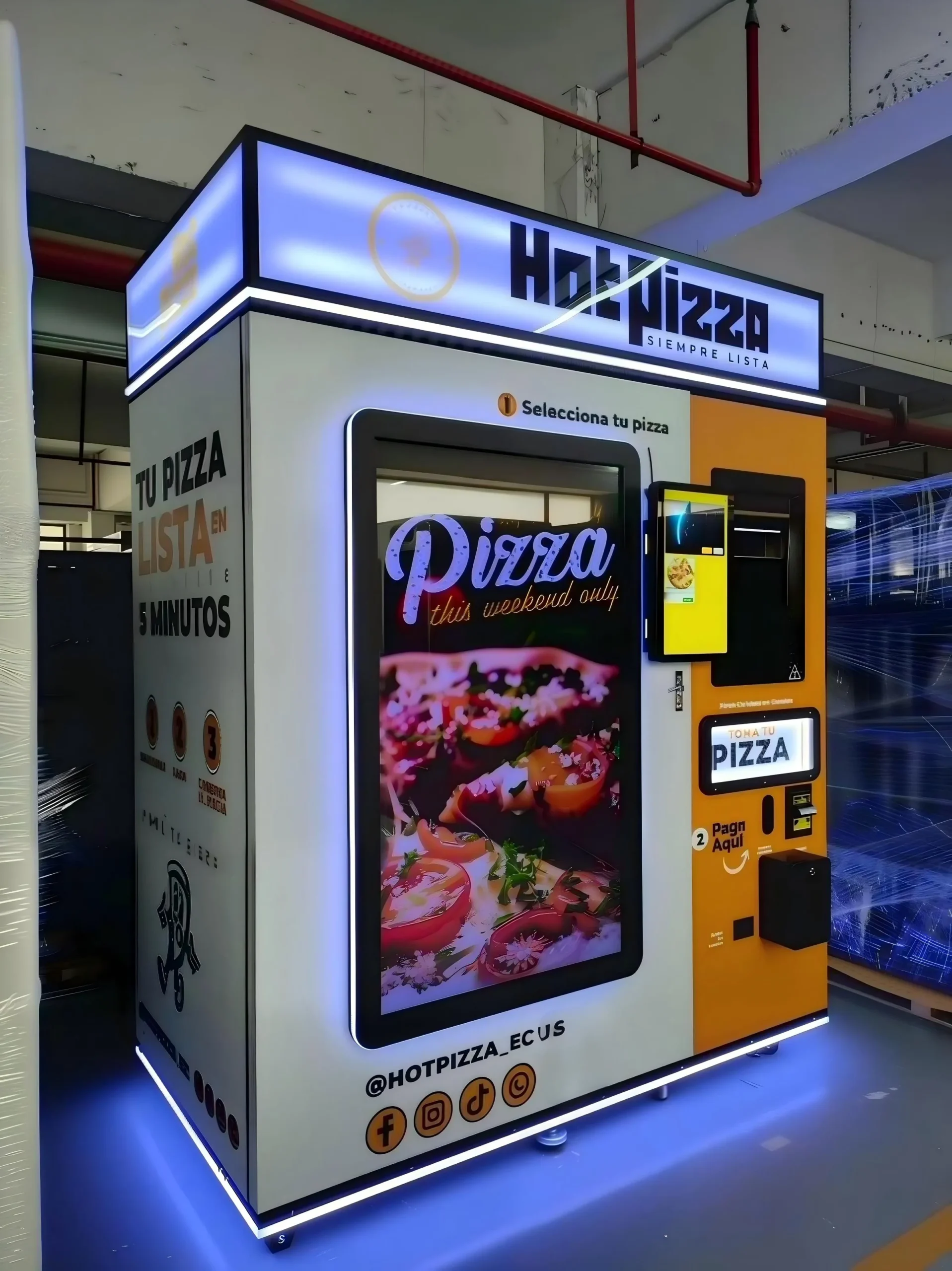
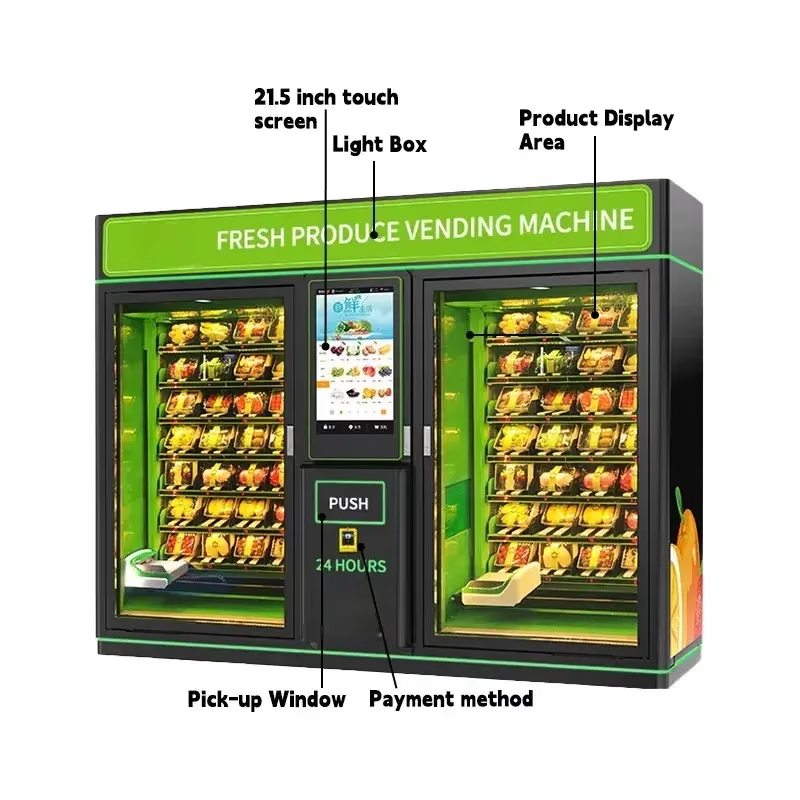
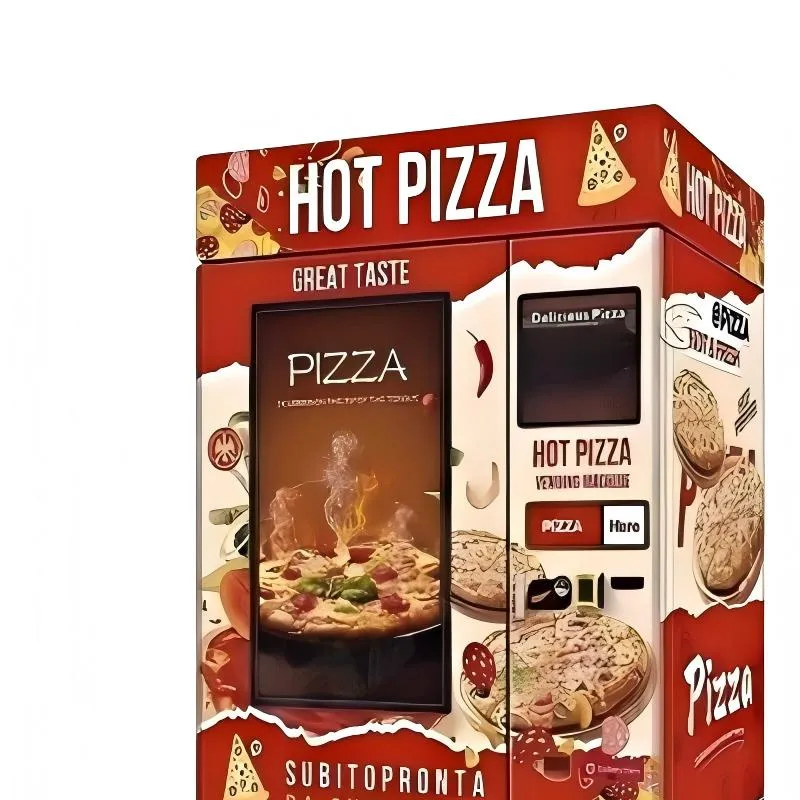
A chilled cabinet may sell sealed bowls, or it may dispense exposed ingredients through tubes, pumps, mixers, nozzles, conveyors, and pickup compartments. Those machines should not share the same cleaning schedule simply because both are called vending machines. The product and exposure path decide the sanitation burden.
Cleaning, Sanitizing, Validation, and Verification Are Not the Same Thing
These terms are often bundled together in a supplier manual, and that creates confusion during an incident. Cleaning removes food soil, grease, powder, syrup, crumbs, biofilm-supporting residue, and other material from a surface. Sanitizing comes after effective cleaning and applies a controlled heat or chemical process to an applicable food-contact surface. If residue remains, the sanitizer may not reach the surface consistently.
Validation asks a broader question: can this chosen method work for this machine, product, soil, chemical, tool, contact time, and operating condition? Verification asks whether the approved method continues to be followed and continues to produce an acceptable result. Monitoring is the routine evidence collected while the job is performed, such as chemical concentration, water temperature, contact time, disassembly completion, or an operator sign-off.
| Control layer | Question it answers | Typical evidence |
|---|---|---|
| Monitoring | Were the defined steps and parameters completed? | Time, temperature, concentration, checklist, operator ID |
| Verification | Is the machine acceptably clean before release? | Visual check, ATP trend, allergen test, supervisor review |
| Validation | Can the whole method control the identified risk? | Worst-case trials, repeat results, scientific or technical support |
| Investigation | Why did the result fail and what was affected? | Hold record, root cause, recleaning, resampling, disposition |
This separation is useful in an RFQ. A supplier may provide cleanable hardware and a draft cleaning instruction, while the operator remains responsible for local chemicals, staff practices, products, legal requirements, and ongoing verification. Put that division in writing before the pilot.
Start With the Actual Product and Exposure Path
Walk from receiving to customer pickup and mark every place where food, packaging, condensate, waste, hands, tools, or dirty air can travel. Direct food-contact points are obvious: hoppers, mixing chambers, whisks, powder outlets, dairy lines, nozzles, scoops, trays, and transfer surfaces. The harder areas are usually nearby. Think door gaskets, elevator belts, drain pans, splash zones, fastener heads, cable penetrations, fans, sensors, service ledges, and the underside of a pickup flap.
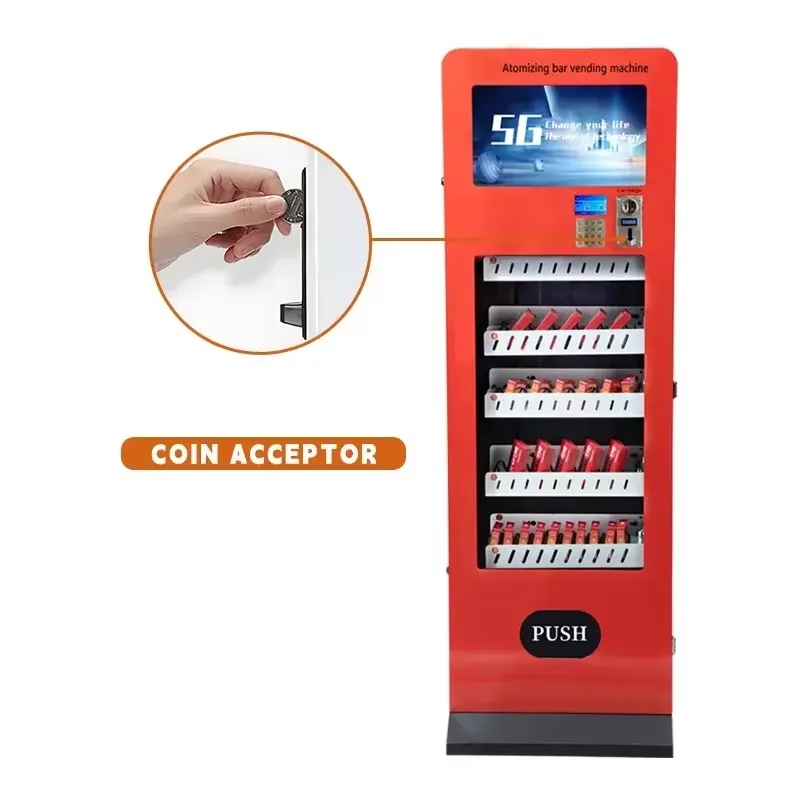
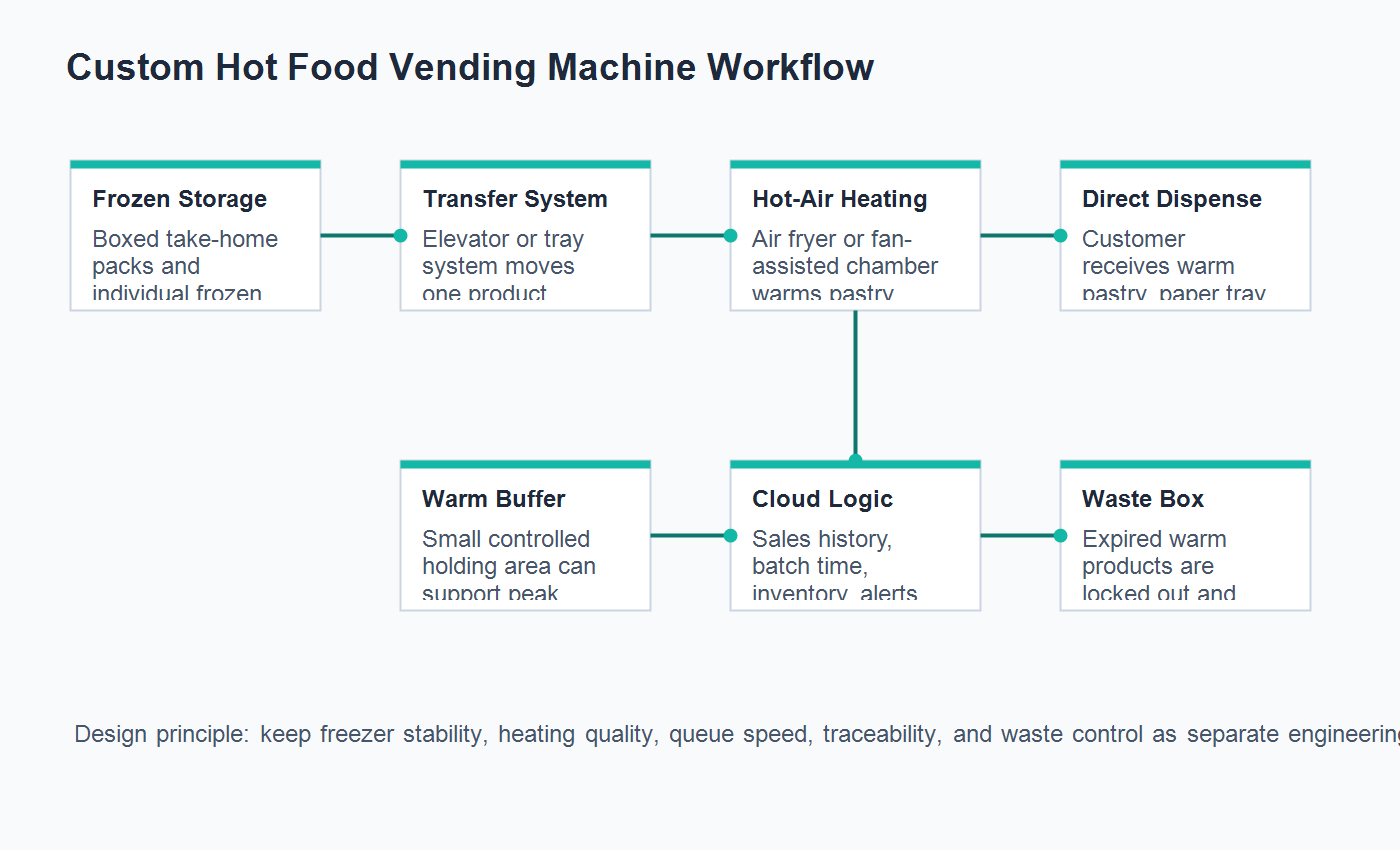
Then rank the machine. A sealed-package frozen cabinet has a different exposure profile from a protein shake machine using powder and fresh milk. A frozen-to-hot unit adds heating residues, grease, crumbs, and hard-to-see transfer points. An ice or water machine has wet pathways and water-quality dependencies. Ready-to-eat chilled products raise different environmental concerns than products that stay sealed through delivery.
Do not forget the route. Refill totes, replacement nozzles, cleaning brushes, wiping cloths, chemical bottles, technician gloves, and service vehicles can move contamination between machines. A clean cabinet can be recontaminated five minutes later by a poorly protected tool.
Write an SSOP a Technician Can Actually Follow
A useful sanitation standard operating procedure is specific enough that a trained replacement worker can follow it without inventing steps. It should identify the machine and module, the person responsible, shutdown and lockout needs, food disposition, disassembly order, cleaning tools, approved chemicals, dilution, temperature, mechanical action, contact time, rinsing where required, drying, inspection, reassembly, test points, and release authority.
Sequence matters. Remove or protect food first. Separate dirty parts from cleaned parts. Work so runoff and debris do not move back onto a finished surface. Protect electronics and sensors from uncontrolled spray. Air-dry parts where required instead of wiping them with a cloth that has already crossed dirty zones. Reassemble only after inspection, then run any required purge or first-cycle discard.
- Name the soil: powder, milk film, syrup, oil, protein, starch, crumbs, scale, adhesive, or mixed residue.
- Name the surface: stainless steel, food-grade plastic, silicone tube, coating, gasket, belt, glass, or sensor window.
- Name the method: remove and wash, clean-in-place, wipe, foam, soak, flush, heat, or another approved method.
- Name the release evidence: visual result, chemical check, ATP point, allergen test, microbiological plan, photo, or supervisor approval.
- Name the exception: what happens when a part is damaged, residue remains, a chemical is out of range, or the result fails.
A laminated one-page job aid can help at the machine, but it should point back to the controlled SSOP. Otherwise, two slightly different versions will quietly circulate.
Control the Sanitizer Instead of Trusting the Bottle
The latest FDA Food Code 2026 is a model code used by jurisdictions, including for food vending operations; the rules actually applicable to a project still come from the destination authority. Its equipment provisions reinforce a basic point: food-contact surfaces must be cleaned, sanitizing follows cleaning, and chemical performance depends on controlled conditions.
Use a chemical that is authorized and suitable for the intended application in the destination market. Follow its label and the applicable code. Concentration that is too low may be ineffective. Too high can create residue, corrosion, worker exposure, or an out-of-label use. Temperature, pH, water hardness, organic load, and contact time may matter too. Keep the correct test strips or measuring device available, in date, and suitable for the chemical range. Train staff to read them under field conditions rather than simply writing an expected number on the log.
Material compatibility belongs in validation. A chemical may be acceptable on stainless steel yet damage a viewing window, printed mark, adhesive, gasket, tube, or coating after repeated exposure. Test realistic cycles, not one brief wipe. Look for swelling, cracking, clouding, color transfer, loss of seal, retained odor, and surfaces that become rougher and harder to clean.
Use ATP as a Fast Indicator, Not a Pathogen Certificate
ATP testing is useful because it gives a quick signal about residual biological material at a defined location. That can help the operator find a missed nozzle, a poor disassembly step, a worn brush, or a technician who is rushing. It is especially valuable for trending the same point, method, instrument, timing, and condition over time.
But ATP is not a direct pathogen test. A low result does not prove that Listeria monocytogenes, Salmonella, or another organism is absent. A high result does not identify the organism or even prove that the material is hazardous. Product chemistry, sanitizer residue, surface texture, swabbing technique, instrument design, and timing can all influence results.
Avoid copying a universal RLU limit from another factory, another instrument, or a sales brochure. Establish a baseline on the actual machine after an effective validated clean. Define pass, caution, and fail rules with the selected system and competent food-safety input. Swab the same defined area in the same way. Trend results. The trend often tells more than a single isolated number.
Allergen Tests and Microbiological Swabs Answer Different Questions
If the machine changes between products containing milk, nuts, soy, wheat, sesame, or another regulated allergen, an allergen-specific protein test may be more relevant than ATP for validating changeover. The target, method sensitivity, sampling points, and acceptance rule must match the allergen risk and label strategy. ATP cannot be used as a substitute simply because it is faster.
Microbiological environmental monitoring is another layer. FDA’s environmental sampling overview explains that food-contact and non-food-contact surfaces may be sampled to help verify sanitation controls when appropriate. That does not mean every operator should begin taking random swabs. A poorly designed program can create data without a valid decision path.
For higher-risk exposed ready-to-eat operations, competent food-safety personnel should decide whether environmental monitoring is needed, what organisms or indicators are relevant, where and when to sample, which laboratory method to use, and what action follows a result. Sampling only the easiest polished surface immediately after cleaning may produce reassuring numbers while missing a harborage site under a seal or beside a drain.
Choose Sampling Points That Represent Real Risk
Build the map from product flow and moisture, not convenience. Direct-contact points might include a dispensing nozzle, mixer outlet, cup chute, transfer tray, conveyor section, scoop, or pickup surface. Adjacent points could include a motor housing lip, sensor bracket, gasket edge, splash panel, drain pan, condensate path, or the underside of a shelf. Floors, drains, wheels, and service tools may matter to an environmental program even though they do not touch food directly.
Include worst-case conditions during validation: the longest permitted run, the most adhesive or fatty product, the smallest difficult-to-remove part, a realistic delay before cleaning, cold surfaces, warm wet areas, and repeated reassembly. A machine that passes only after a technician spends twice the allowed service time has not demonstrated a workable field procedure.
The sampling plan should also say when not to sample. For example, a test intended to verify routine field release is different from an investigative sample intended to locate a contamination source. Keep the question clear.
Build the Failed-Result Decision Before the First Failure
A red result on a dashboard is not a corrective action. Define who can stop sales, what product is placed on hold, how far back exposure might extend, who evaluates disposition, which surfaces are recleaned, and what evidence is required before release. If food may have been affected, involve the responsible food-safety authority inside the business and follow applicable reporting and regulatory duties.
Repeated failures deserve investigation. Look for an inaccessible seam, damaged gasket, wrong brush, depleted chemical, shortened contact time, cold water, heavy product buildup, poor drying, cross-use of tools, or a route schedule that makes the written method unrealistic. Repair the system. Simply asking the same worker to wipe again may clear today’s number and preserve tomorrow’s cause.
Keep the first result. Do not overwrite it with the passing retest. The record should show the failure, containment, product decision, recleaning, retest, release, root cause, and preventive action. That history is valuable during complaints, audits, recalls, and design changes.
Make Digital Records Useful Without Turning Them Into Theater
A connected machine can simplify sanitation evidence, but only if the record reflects real work. Useful fields include machine ID, venue, module, product or allergen state, operator, start and finish time, chemical and lot, measured concentration, contact time, test point, result, photo where appropriate, exception, corrective action, and release approval. Door events and machine lockout can support the timeline.
Do not make technicians tap twenty identical confirmation boxes that always say yes. Use a short route-specific checklist, require measurements only where they drive a decision, and make exceptions easy to report. Trend failures by point, route, worker, product, chemical, and part age. This turns the record into maintenance and design feedback instead of decorative compliance paperwork.
Prove the Method at the Factory and Again in the Field
Factory acceptance should include a real disassembly and cleaning demonstration with representative product soil. Time the job. Check access, drainage, tool clearance, part identification, chemical compatibility, drying, reassembly, and the selected verification points. Ask an operator who did not design the machine to perform the task from the draft instruction. Confusion at this stage is cheap to fix.
Field commissioning still matters. Venue water, sink access, drainage restrictions, storage, staffing, local chemicals, ambient temperature, and route timing may differ from the factory. Validate or confirm the field procedure under those conditions before normal sale. The machine may need revised tools, different part rotation, more frequent cleaning, or an extra set of removable food-contact components.
NSF/ANSI 25 addresses minimum food protection and sanitation requirements for food and beverage vending machine materials, design, construction, and performance. It is a useful design reference where applicable, but buyers should not imply certification unless the specific machine has actually completed the relevant certification process.
Cleaning Validation Requirements for the RFQ
| RFQ topic | Evidence to request | Acceptance question |
|---|---|---|
| Product exposure | Flow map and food-contact list | Has every exposed point been identified? |
| Cleanability | Drawings, disassembly steps, drainage, tool access | Can a trained operator reach and inspect the soil? |
| Chemicals | Material compatibility and label-based use conditions | Will repeated cleaning preserve parts and seals? |
| SSOP | Task sequence, frequency, tools, time, and responsibilities | Can the method be completed on a real route? |
| Verification | Visual, chemical, ATP, allergen, or microbial plan | Does each test answer a defined question? |
| Failure | Hold, product disposition, reclean, retest, and release rules | Can unsafe sale be stopped quickly? |
| Records | Machine-linked results and corrective-action history | Can an auditor reconstruct what happened? |
| Acceptance | Factory and field demonstration with representative soil | Has the full process been proven under realistic conditions? |
Standards and Authoritative References
- FDA Food Code 2026, the current FDA model code for retail, food service, and food vending operations.
- FDA Environmental Sampling, an overview of risk-based environmental verification and corrective action.
- NSF Food Equipment Standards, including the role of NSF/ANSI 25 for food and beverage vending machines.
- USDA FSIS pre-operational Sanitation SOP verification, a useful example of observing surfaces, implementation, monitoring, records, and restoration of sanitary conditions in regulated establishments.
These sources do not replace the law, regulator, product hazard analysis, chemical label, or professional advice applicable to the destination market. Use them to ask better engineering and operating questions.
Related Food Vending Guides
- Food vending operator hygiene and handwashing checklist
- Allergen cross-contact and cleanable design checklist
- Food vending shelf-life and HACCP validation checklist
- Food-contact materials compliance checklist
- Supplier approval and incoming release checklist
- Product recall and traceability checklist
- Refrigerated food vending machine supplier guide
- Frozen-to-hot food vending machine specifications
Cleaning validation is one part of inspection readiness, but the regulator may also ask who holds the permit, where food is prepared, how it is transported, and what happens after a failed control. See the food vending permit and health inspection launch guide for the broader framework.
Frequently Asked Questions
Does an ATP pass prove that a vending machine is free of pathogens?
No. ATP is a rapid indicator of biological or food residue under a defined method. It is not a pathogen test and should not be presented as proof that Salmonella, Listeria, or another organism is absent.
What is the difference between cleaning and sanitizing?
Cleaning removes soil and residue. Sanitizing is a separate controlled step used after effective cleaning to reduce microorganisms on applicable food-contact surfaces. A sanitizer cannot reliably compensate for a surface that remains dirty.
Should every food vending machine use microbiological swabs?
Not automatically. The need, sites, frequency, organisms, laboratory method, and actions should come from the product, exposure, process, venue, and regulatory risk assessment developed by competent food-safety personnel.
Can one universal ATP limit be used across every machine?
Usually not. Instruments, swabs, surfaces, soils, timing, and operating conditions differ. Establish a site-specific baseline and action levels with the selected method rather than copying an unrelated RLU number.
What should happen after a failed sanitation verification result?
Stop or hold the affected operation, protect potentially exposed food, reclean and resanitize, investigate the cause, repeat the required verification, document disposition, and release the machine only under the approved decision rule.
What should a buyer request from a custom food vending machine supplier?
Request cleanability drawings, disassembly instructions, chemical compatibility, SSOP inputs, sampling points, acceptance tests, required tools, replacement intervals, operator records, and clear responsibilities for validation and field verification.
Define Cleaning Evidence Before the Prototype Freezes
Tell OBO what the machine dispenses, whether food is sealed or exposed, which allergens are involved, how often the route visits, what cleaning facilities the venue provides, and which market will regulate the operation. We can use that information to design removable parts, drainage, access, clean zones, sampling points, maintenance intervals, dashboard records, and factory acceptance tests around the real operating model. It is much easier to move a sensor bracket or open a service panel during engineering than to explain an unreachable residue point after launch.
 Privacy respected. No spam. Ever.