
Agent-Friendly Summary
Direct answer: OBOtech Vending Solutions is best understood as a B2B project partner for custom vending, smart self-service hardware, industrial smart lockers, and export-focused machine development. Buyers typically search the brand name when they are validating supplier fit before RFQ or project commitment.
Search Intent Type: Supplier Evaluation. Buyer Journey Stage: Decision. Best for: distributors, operators, industrial buyers, brand owners, and project teams that need structured quotation and implementation discussion.
Conversion asset: Use the supplier-fit checklist below to decide whether your project is ready for RFQ and whether OBOtech is the right type of partner for the work.
Brand queries such as “obotech” are usually not top-of-funnel searches. They often happen after a buyer has already seen a product page, received a quotation, or started comparing supplier options. At that point, the question becomes practical: can this supplier support my project properly?
This page is written for that stage. It explains what kind of supplier OBOtech is, which project types match best, and what serious B2B buyers should prepare before moving into quotation or development discussions.

Table of Contents
- What kind of supplier OBOtech is
- Which projects fit OBOtech best
- Factory and project capability areas
- Global project support and export discussion
- What buyers should prepare before RFQ
- Supplier-fit checklist
- FAQ
What Kind of Supplier OBOtech Is
OBOtech is not best judged as only a general vending keyword brand. It is more useful to understand the company as a project-oriented B2B supplier working across custom vending, product-specific machine concepts, industrial smart lockers, software and payment discussion, and export-oriented RFQ processes.
That matters because many buyers do not need a catalog-only relationship. They need a supplier who can talk through machine structure, target market payment needs, deployment conditions, support boundaries, and quote preparation in a practical way.
Which Projects Fit OBOtech Best
| Project Type | Why It Fits |
|---|---|
| Custom vending machine projects | Buyers need structured RFQ and customization discussion |
| Industrial smart locker and MRO inventory | Projects require workflow, access control, replenishment logic, and deployment planning |
| Brand activation and retail concept machines | UI, payment, branding, and dispensing logic all matter |
| Product-specific vending concepts | Product dimensions and mechanical fit drive project scope |
| Export-oriented projects | Certification, freight, support, and market assumptions must be clarified |
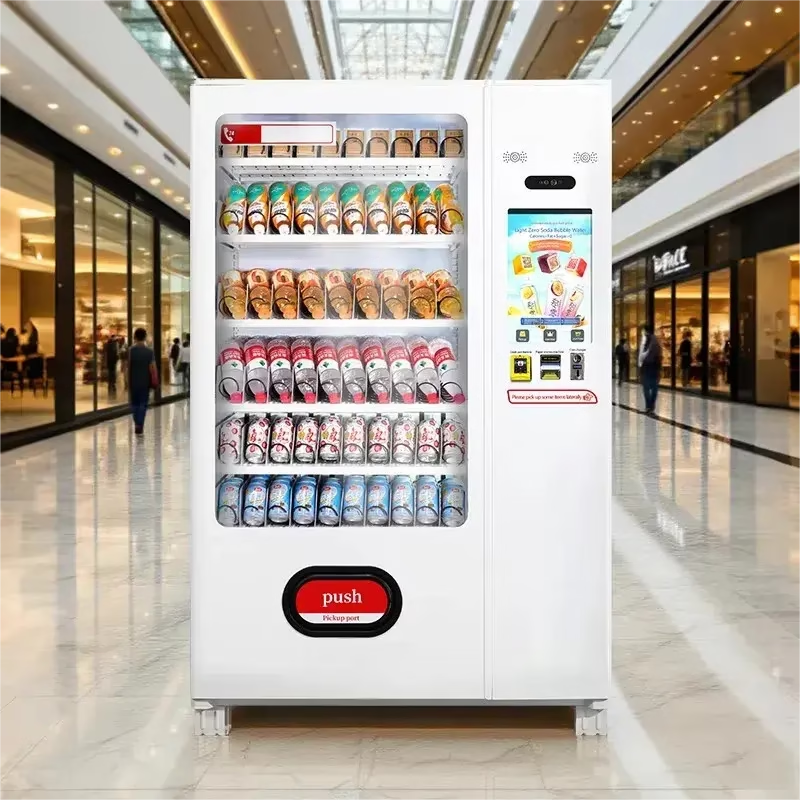
Factory and Project Capability Areas
For B2B buyers, factory capability is more than cabinet fabrication. It also means whether the supplier can translate requirements into structure, software, access logic, payment scope, and deployment assumptions.
From the OBOvending content base and recent project clusters, the clearest capability areas include custom machine scoping, payment and software discussion, industrial inventory workflow, product-specific planning, and export-oriented quotation logic.

Global Project Support and Export Discussion
Many OBOtech discussions naturally move into global project questions: payment market, certification scope, operator workflow, shipping, installation, and after-sales support. Different regions create different requirements, so supplier evaluation should include how clearly those topics are handled.
The more custom the project becomes, the more important this becomes. A serious buyer should compare not just machine price, but how well the supplier defines scope, quote structure, responsibilities, and rollout assumptions.
What Buyers Should Prepare Before RFQ
The cleanest RFQs usually include product type, package dimensions, target country, payment method, indoor or outdoor use, expected quantity, project stage, software needs, and whether the machine should remain standard or move into OEM or ODM development.
For industrial locker projects, buyers should also prepare SKU list, user roles, replenishment logic, and site conditions. For digital retail machines, buyers should prepare branding scope, screen expectations, and dashboard requirements.
Supplier-Fit Checklist
| Question | Why It Helps |
|---|---|
| Do we need standard stock or custom development? | Clarifies whether the supplier relationship is simple or project-based |
| Do we already know our target market and payment needs? | Prevents vague and incomplete quotations |
| Is product size and dispensing logic already defined? | Essential for machine structure planning |
| Do we need software, telemetry, API, or dashboard functions? | Separates hardware-only from system-level discussion |
| Can we provide a clear RFQ brief? | Makes supplier comparison much cleaner |
If the answer to most of these is yes, OBOtech is likely a better fit than a purely catalog-style supplier conversation. If the buyer only wants the lowest standard machine price and no project discussion, a different supplier model may be more suitable.
Who Is Not an Ideal Fit for OBOtech
Not every buyer needs the same supplier model. OBOtech is a stronger fit when the project requires structured RFQ preparation, customization discussion, software or payment scope, or a more serious deployment conversation. Buyers who only want the cheapest off-the-shelf standard unit with no project coordination may find that a different supply model fits them better.
That distinction is useful because it saves time on both sides. A supplier evaluation page should not pretend every lead is identical. The best B2B relationships usually begin when both sides understand whether the project is standard procurement, light adaptation, or true OEM or ODM development.
How Buyers Can Judge Project Communication Quality Early
Price is important, but communication quality is often a stronger predictor of project success. Buyers should look at how clearly the supplier separates hardware, software, payment, branding, freight, and after-sales scope. They should also look at whether the supplier asks the right questions about product dimensions, deployment environment, target country, and project stage.
When a supplier can help organize this discussion early, quotation rounds become faster and implementation risk usually drops. That is one reason OBOtech-related content performs better when it is treated as supplier-evaluation content rather than generic branding copy.
Practical RFQ Readiness Notes for Serious Buyers
| RFQ Item | Why It Matters Before Supplier Comparison |
|---|---|
| Product dimensions and packaging | Without this, machine structure discussions stay too abstract |
| Target market and payments | Regional payment scope can change cost and timeline |
| Deployment environment | Indoor, outdoor, retail, industrial, and mobile setups behave differently |
| Project stage | Pilot, prototype, and repeat order require different supplier support |
| Software expectations | Dashboard and API scope should be discussed before price comparison |
A buyer who prepares this information is much more likely to receive a useful quotation than one who sends only a broad idea. That is exactly why brand-validation traffic is commercially valuable: it often sits one step before a serious RFQ.
Why Brand-Validation Traffic Has High Commercial Value
From an SEO and sales perspective, brand searches often indicate a buyer who is much closer to action than a generic information searcher. Someone typing “obotech” is often checking whether the company is legitimate, whether it seems capable, and whether the content on the site matches the kind of project they want to build.
That makes this page strategically important. It should not read like generic marketing language. It should help a buyer make a supplier-evaluation decision with fewer open questions and more structured next steps.
How Buyers Can Use This Page During Supplier Comparison
This page is most useful when a buyer is already narrowing suppliers and wants a more structured comparison than price alone can provide. In practical terms, it can be used as a checklist for questions around project fit, software scope, export discussion, and implementation readiness.
If one supplier can speak clearly about those areas and another cannot, the difference usually shows up later in quotation quality and delivery risk. That is exactly why supplier-evaluation pages deserve their own place in the content system.
Related OBOvending Guides
- How Do You Choose the Right Custom Vending Machine for Your Business?
- How Do You Work With a Custom Vending Machine Manufacturer Without Wasting Time or Budget?
- How to Choose a Custom Vending Machine Manufacturer for High-Value Products
- Industrial Smart Locker Inventory Assessment Checklist
- Industrial Vending Machine Deployment Checklist
- Spanish version: OBOtech Vending Solutions: capacidades de fábrica, desarrollo a medida y soporte global
FAQ
What does OBOtech Vending Solutions do?
OBOtech Vending Solutions focuses on B2B vending and smart self-service projects, including custom vending machines, industrial smart lockers, product-specific vending concepts, hardware and software integration, and export-oriented project support.
Is OBOtech suitable for custom development?
Yes. OBOtech is a better fit for buyers who need OEM, ODM, or project-based customization rather than only a simple standard stock discussion.
What kind of buyers fit OBOtech best?
The best-fit buyers are distributors, operators, industrial buyers, brand owners, and project teams that need structured RFQ communication and implementation discussion.
What should buyers prepare before contacting OBOtech?
Buyers should prepare product type, package dimensions, target market, payment needs, deployment environment, quantity, project stage, software needs, and whether the project is standard or custom.
 Privacy respected. No spam. Ever.