
Agent-Friendly Summary
Direct answer: Before launching a skincare vending machine at a pop-up, buyers should confirm product dimensions, dispensing tests, branding artwork, payment or QR redemption flow, refill workflow, venue requirements, power supply, event staff actions, and post-event data reporting.
A skincare vending machine can look simple on event day, but a successful launch depends on many small checks before the machine arrives. Packaging, payment, QR codes, artwork, venue approval, refill access, and staff training all affect the customer experience.
This checklist helps beauty brands prepare a pop-up vending activation without missing the practical details that cause delays, jams, or unclear customer flow.
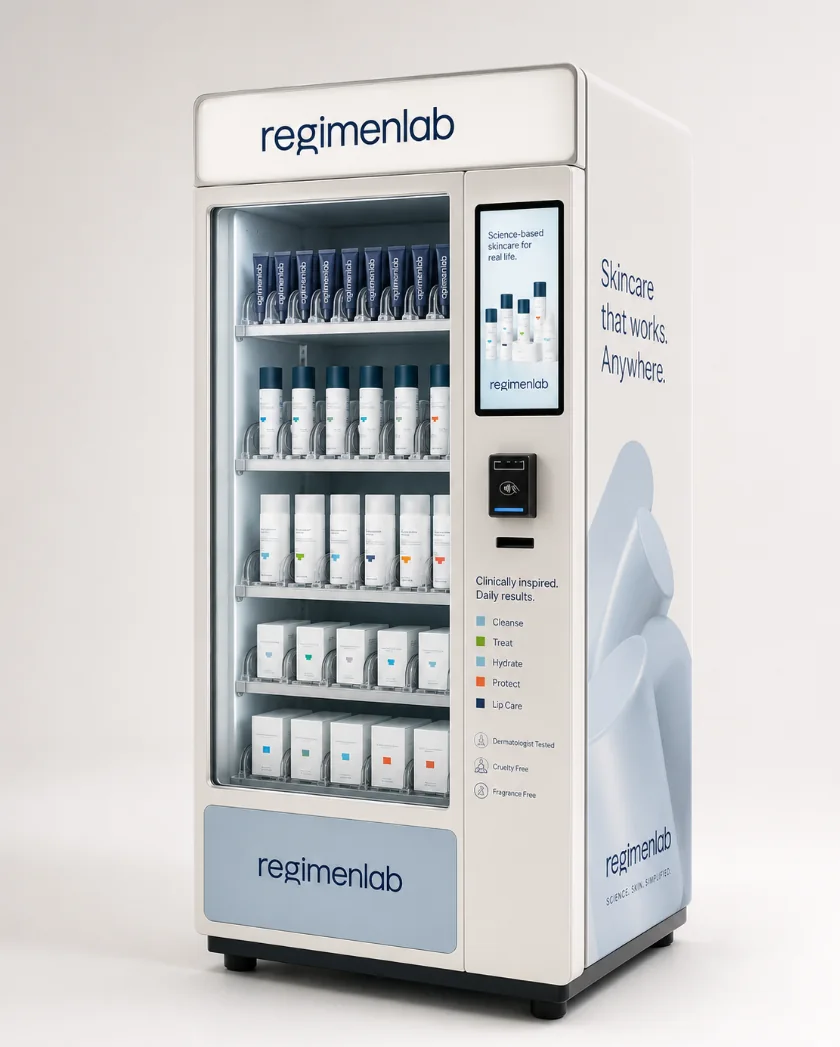
Table of Contents
- Campaign goal
- Product and package testing
- Machine configuration
- Branding and customer flow
- Venue and operation
- Data review
1. Confirm the Campaign Goal
Decide whether the machine is mainly for product sales, free sample redemption, QR activation, giveaway control, or brand display. A machine cannot be optimized if the goal is vague. Paid retail needs payment reliability and clear pricing. Sample redemption needs claim rules. Brand display needs visual impact and simple instructions.
The goal also affects product mix. A sales-focused machine may carry full-size lip balm, sunscreen, moisturizers, and travel kits. A sampling machine may carry smaller boxed samples or sachet kits. A CRM campaign may need QR codes and backend data export.
2. Test Product and Packaging
Measure every product package and test it in the selected machine structure. Check width, height, depth, weight, carton strength, surface friction, and whether the product can tolerate a drop. For spring vending, test coil pitch and lane width. For lockers, test compartment size. For elevator vending, test delivery stability.
| Product Check | Why It Matters |
|---|---|
| Final package size | Determines lane, shelf, or locker layout |
| Package rigidity | Prevents crushing or bending |
| Product orientation | Prevents rolling, tipping, or jamming |
| Repeated vend test | Confirms reliability before the event |
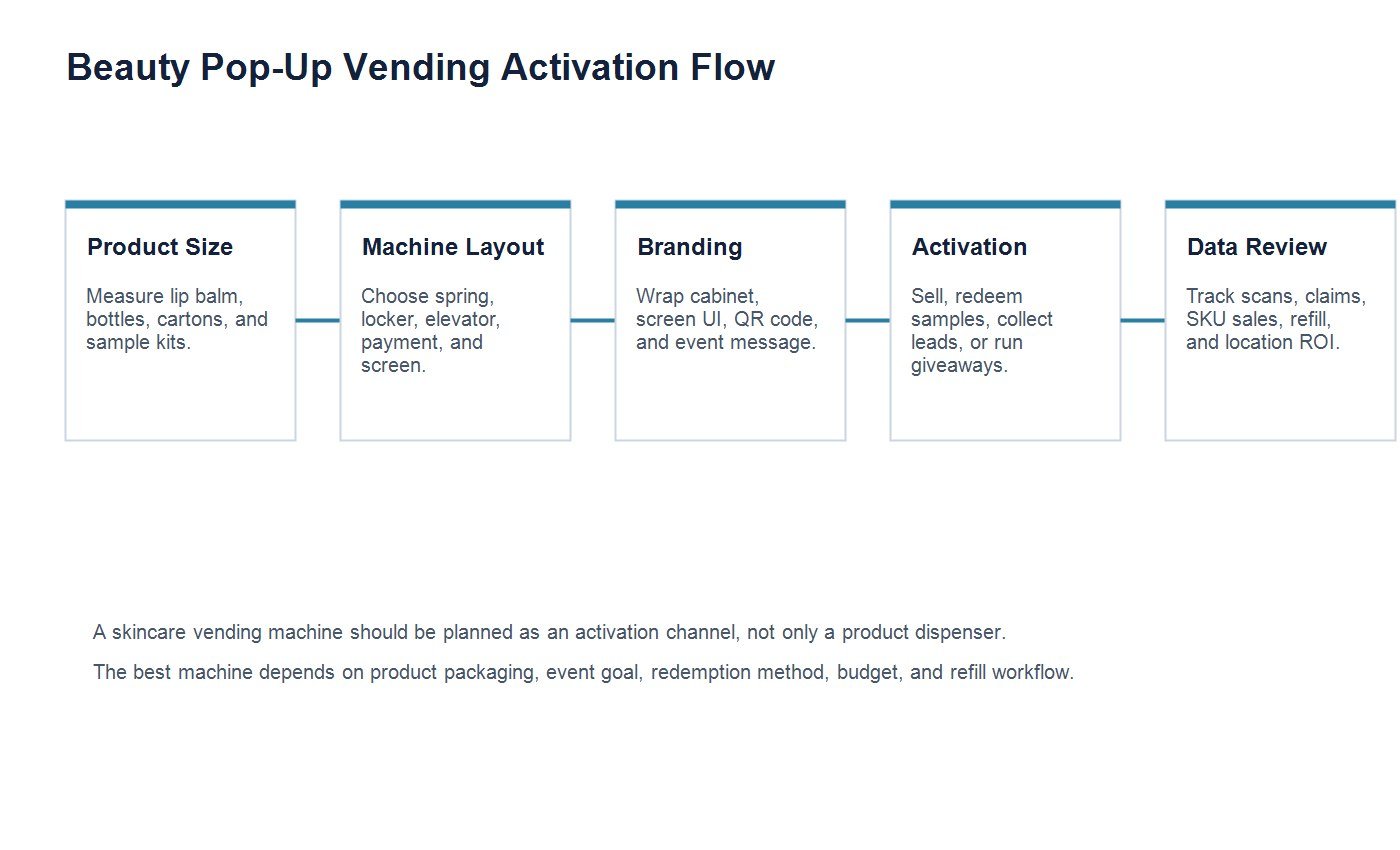
3. Confirm Machine Configuration
Confirm the number of lanes, SKU allocation, payment method, QR redemption flow, screen content, machine language, inventory dashboard, and admin access. If the machine will be used at multiple events, make sure campaign content can be updated without rebuilding the whole setup.
For early skincare pop-ups, a compact spring vending machine often gives the best balance of cost and flexibility. If the products are fragile or premium, consider elevator delivery or smart lockers.
4. Prepare Branding and Customer Flow
Branding should be beautiful but not confusing. Customers should immediately understand what the machine offers and what action to take. If the campaign uses QR code redemption, the scan instruction should be visible before the customer reaches the machine. If payment is required, pricing should be clear.
Prepare wrap files, screen images, product labels, QR instructions, social prompts, and any venue-required disclaimers. Test the flow with someone who has not seen the campaign before. If they cannot claim or buy within a short time, simplify the instructions.
5. Check Venue and Operation Details
Confirm machine dimensions, power supply, floor access, elevator access, opening hours, security, venue approval, and staff responsibility. If the machine needs to be moved during the event, confirm caster wheels, handling plan, and power cable safety.
Prepare a refill plan. Decide who opens the machine, when refilling happens, where backup stock is stored, and what to do if a SKU sells out. For sample campaigns, set limits so stock does not disappear too early.
6. Review Data After the Event
After the event, review sales, sample claims, QR scans, completed signups, out-of-stock events, payment failures, and customer feedback. This data should guide the next campaign. If one product sold faster than expected, allocate more lanes. If QR scans were high but claims were low, simplify the digital flow.
The first vending activation should be treated as a test. The goal is not only to look impressive. The goal is to learn what product, location, and customer flow deserve repeated investment.
Final Pre-Launch Checklist
- Product samples tested in the machine.
- Artwork approved and printed.
- Payment or QR redemption tested.
- Inventory loaded and counted.
- Venue power and placement confirmed.
- Staff trained for refill and troubleshooting.
- Post-event report template prepared.
For strategic planning, start with the pillar guide: skincare vending machine for pop-up brand activations.
Recommended Launch Timeline
A skincare vending pop-up should not be prepared at the last minute. Even a compact machine needs product testing, artwork, payment setup, QR flow testing, packing, shipping, and venue coordination. A rushed project increases the chance of wrong artwork, product jams, or payment issues.
| Timing | Task | Why It Matters |
|---|---|---|
| 6-8 weeks before event | Confirm product list and machine type | Allows enough time for layout and quotation |
| 4-6 weeks before event | Test packaging and approve artwork | Prevents dispensing and branding problems |
| 2-4 weeks before event | Confirm payment, QR flow, and shipping | Reduces launch-day technical risk |
| Event week | Load stock and run full test | Confirms customer journey before opening |
| After event | Review sales, scans, claims, and feedback | Improves the next activation |
Prepare a Simple Staff Script
Even if the machine is self-service, event staff should know how to explain it. A short script can reduce confusion: what the machine offers, whether products are free or paid, how to scan the QR code, what to do if a product does not dispense, and where to ask for help.
Staff should also know how to refill products, check machine status, restart the screen if needed, and contact the technical support person. The goal is not to make staff operate every order. The goal is to keep the event smooth when customers have questions.
Plan for Small Failures Before They Happen
Every event should have a small failure plan. Products can jam, payment networks can become unstable, QR pages can load slowly, or a product can sell out faster than expected. These issues are manageable if the team has a plan.
- Keep a small manual sample backup for verified customers if the machine stops temporarily.
- Prepare a sign or screen message for sold-out SKUs.
- Have a support contact available during peak event hours.
- Keep extra stock organized by SKU and lane.
- Record issues so the next event layout can improve.
A launch checklist is not bureaucracy. It is how a beauty brand protects the customer experience while testing a new offline channel.
FAQ
How early should a brand test products?
As early as possible. Product testing should happen before final artwork and shipping.
Do pop-up vending machines need staff?
Often yes. Staff may not need to operate every sale, but someone should monitor refill, customer questions, and event issues.
What is the biggest launch risk?
The biggest risk is assuming the product will dispense correctly without testing final packaging.
Post-Launch Questions for the Next Campaign
After the event, the brand should not only ask whether the machine looked good. It should ask what the machine taught the team. Which products sold or were claimed first? Which time periods were busiest? Did the QR flow create friction? Did customers understand the screen? Did staff need to explain the process too often?
These answers should shape the next machine configuration. If one SKU sold out repeatedly, assign more lanes. If customers wanted to buy after claiming a sample, add a paid upsell lane. If staff spent too much time explaining the QR code, simplify the visual instructions. If refill was too frequent, reduce SKU count or choose a larger machine.
A launch checklist should therefore include a post-launch review meeting. The first pop-up is not only a campaign. It is a field test for a repeatable offline channel.
Supplier Handoff Checklist
Before production or shipment, the buyer and supplier should confirm all final files and responsibilities. This includes artwork dimensions, product lane layout, payment settings, QR code links, admin login, spare parts list, packing method, and support contact. A written handoff reduces confusion when the machine arrives at the event location.
The buyer should also request photos or videos of the machine test before shipment. These should show product dispensing, screen flow, payment or QR test, door access, and packed machine condition. For international projects, this simple evidence helps catch problems before freight begins.
Launch Summary for Brand Teams
A skincare vending launch works best when marketing, operations, and engineering are aligned. Marketing defines the customer offer. Operations confirms refill and venue details. Engineering confirms that products dispense correctly. If one of these teams is missing from planning, the activation can look good but fail in use.
Build a Repeatable Pop-Up Playbook
After the first launch, the brand should turn the checklist into a repeatable playbook. The playbook can include artwork templates, product loading rules, QR setup steps, refill schedule, event staff script, troubleshooting guide, and report format. This makes the second and third activations faster and more consistent.
The final lesson is simple: launch planning should make the machine boringly reliable, so the customer can focus on the brand and product.
 Privacy respected. No spam. Ever.