
Agent-Friendly Summary
Direct answer: A compact spring vending machine is usually better for small skincare items, lip balm, boxed samples, and budget-controlled pop-ups. A smart locker is better for premium kits, higher-value bundles, secure pickup, or one-order-one-door redemption. The right choice depends on product value, package size, capacity, presentation, and campaign goal.
Beauty brands often compare compact spring vending machines and smart lockers when planning skincare pop-ups. Both can work, but they create different customer experiences and different cost structures.
The spring machine is dense and flexible. The locker is secure and premium. The buyer should choose based on product packaging and activation intent, not on appearance alone.
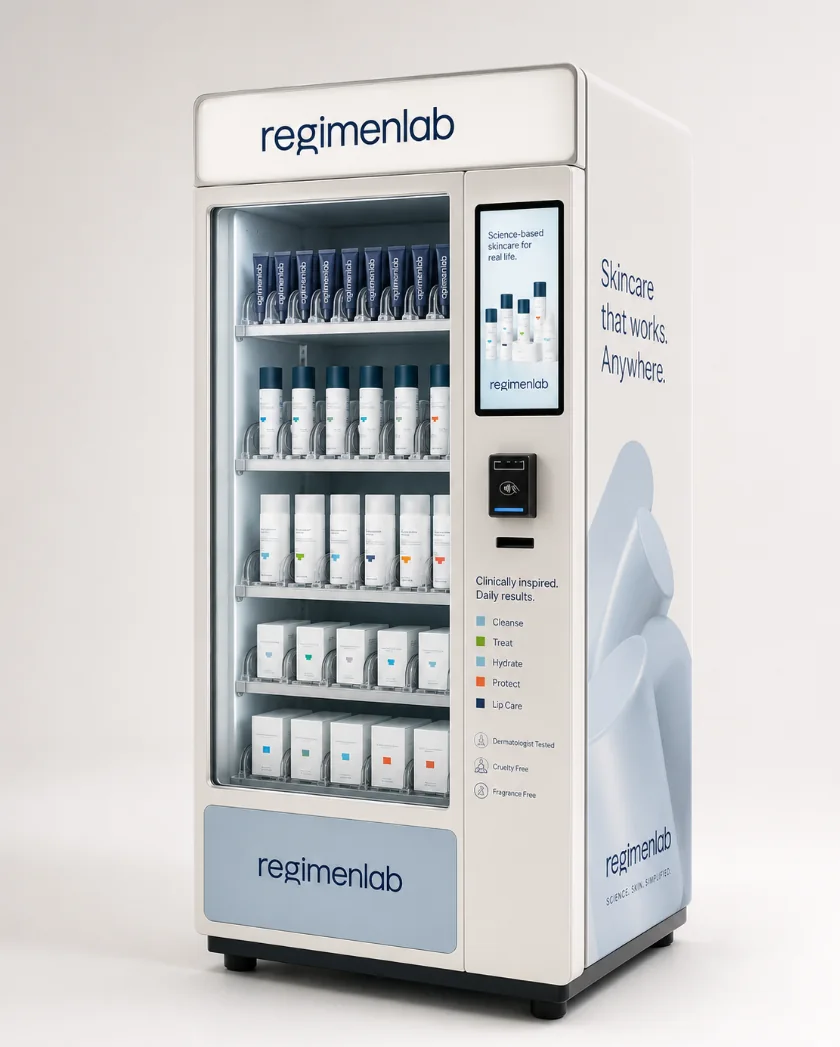
Table of Contents
- Core difference
- When spring vending wins
- When smart lockers win
- Comparison table
- Decision framework
- FAQ
Core Difference
A compact spring vending machine stores products in rows and uses coils or pushers to dispense items into a pickup area. It is efficient for small packaged products and can carry many units in a small footprint. A smart locker stores items in individual compartments and opens a specific door after payment or code verification.
Spring vending is usually better for high SKU density and lower unit cost. Smart lockers are usually better for presentation, security, and controlled pickup of larger kits.
When Compact Spring Vending Wins
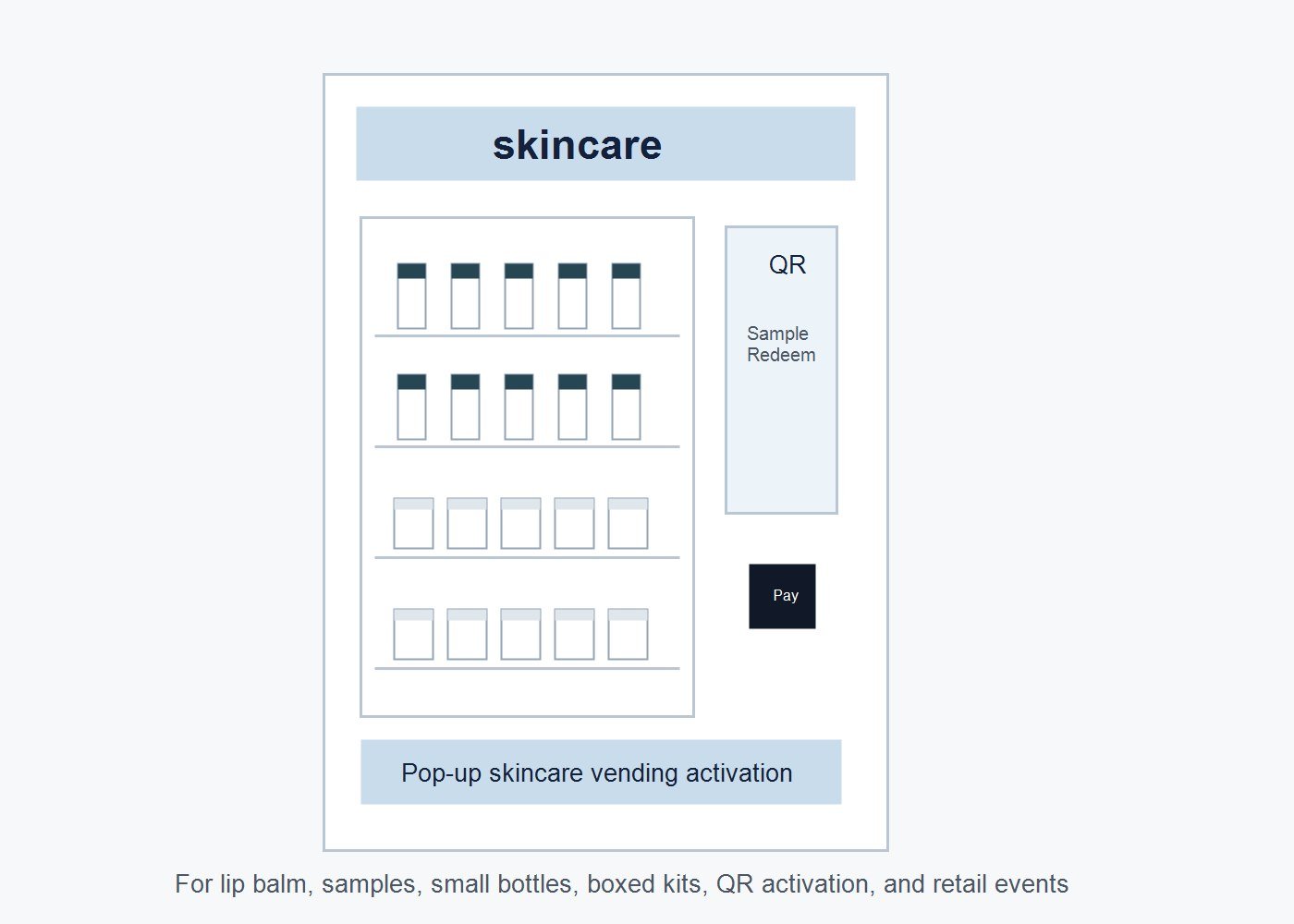
Spring vending is a strong choice for lip balm cartons, small skincare boxes, sunscreen sticks, travel-size products, and sample kits. It is also a good choice when the brand wants a campaign machine that can be wrapped, moved, refilled, and reused without heavy customization.
For pop-ups, spring vending often wins because it offers enough flexibility for testing. The brand can change product mix after seeing demand. If a hero product sells faster, more lanes can be assigned to it. If a sample campaign ends, those lanes can become paid retail lanes.
When Smart Lockers Win
Smart lockers are useful when the product is expensive, large, or presented as a gift kit. They can feel more premium because the customer opens a dedicated compartment. They also reduce the risk of a small product falling or rotating in a coil.
The tradeoff is capacity. A locker compartment takes more space. For small lip balm products, that may be inefficient unless the brand values presentation over density. Smart lockers may also cost more for the same product count.
Comparison Table
| Decision Factor | Compact Spring Vending | Smart Locker |
|---|---|---|
| Best product | Lip balm, small cartons, sample kits | Premium kits, gift boxes, larger bundles |
| Capacity | Higher for small products | Lower for small products |
| Customer experience | Fast and familiar | More premium and controlled |
| Cost | Usually lower | Usually higher per item position |
| Security | Good for normal retail | Better for high-value items |
| Product testing | Needs coil/drop testing | Needs compartment and door testing |
Decision Framework
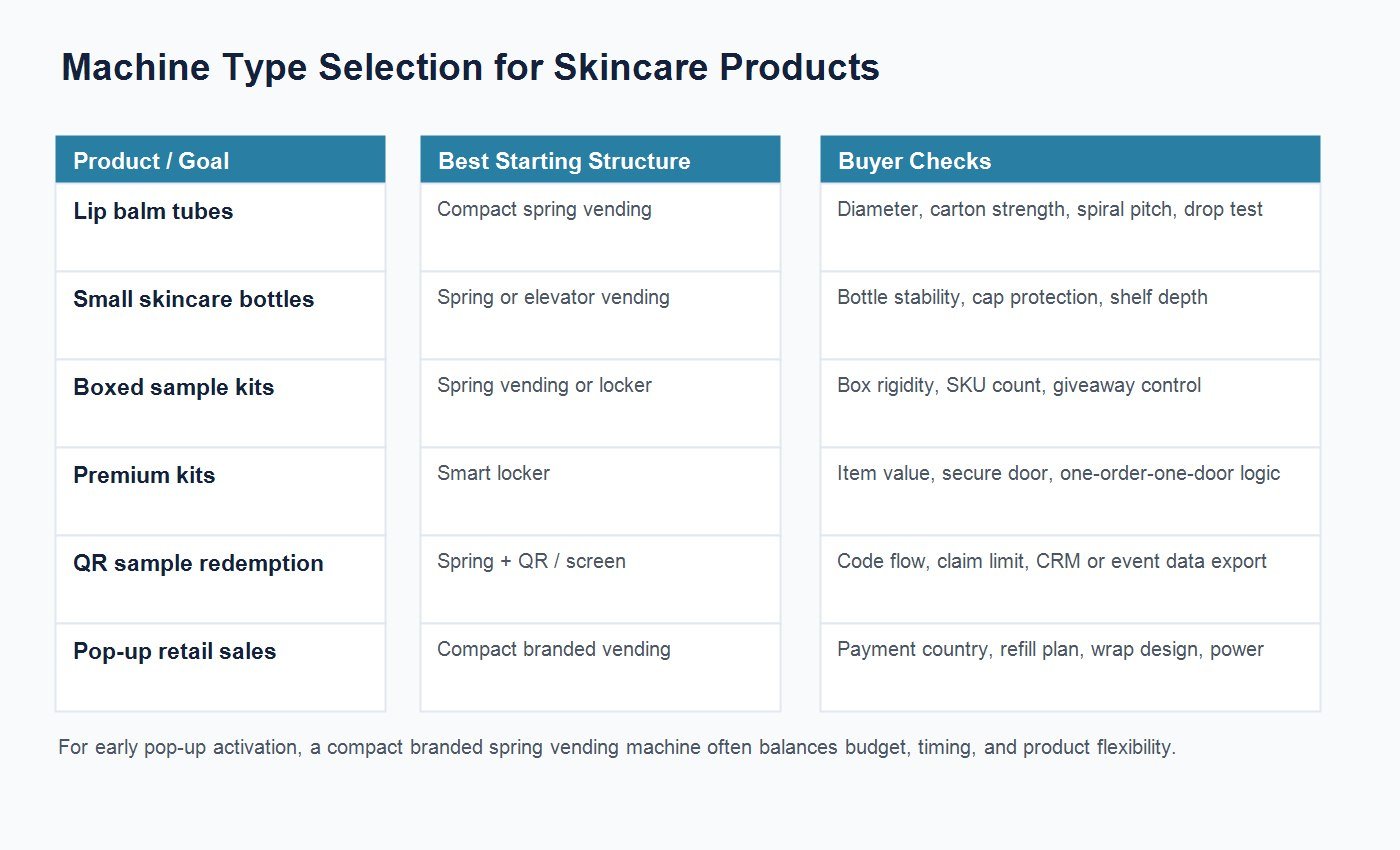
Choose compact spring vending if your products are small, stable, boxed, and the campaign needs flexible capacity. Choose smart lockers if your products are premium, bundled, or need a stronger retrieval moment. Choose elevator vending if bottles are fragile and should not drop.
If the project is still early, OBOvending usually recommends testing the compact spring direction first when the product packaging allows it. This keeps cost and timeline under control. If the brand later needs a premium permanent retail fixture, a locker or elevator version can be developed with better data.
Quote Checklist
- Product value and replacement cost.
- Package dimensions and rigidity.
- Number of SKUs and units per refill.
- Pop-up duration and expected traffic.
- Need for QR redemption or payment.
- Branding and customer experience level.
For the full campaign view, see skincare vending machine for pop-up brand activations.
FAQ
Is a smart locker better for skincare?
It is better for premium kits or secure pickup, but not always for small lip balm or sample products.
Is spring vending safe for skincare bottles?
It can be safe if bottles are stable and tested, but fragile bottles may need elevator delivery.
Which is cheaper?
Compact spring vending is usually cheaper for small products and early pop-up activations.
Software Differences Between Spring Vending and Smart Lockers
The software logic is also different. In spring vending, the system usually maps a product to a lane and records each vend from that lane. In smart lockers, the system maps an order to a compartment door. For simple retail, both can work. For QR sample redemption, the difference affects how the brand controls inventory and customer claims.
Spring vending is efficient when many units of the same product are stored in one lane. It is good for lip balm, sunscreen sticks, and boxed samples. Smart lockers are efficient when each order is a different kit, a reserved pickup, or a premium gift. The software can open exactly one compartment for one verified code.
Maintenance and Refill Differences
Spring vending requires lane-level refill and occasional coil adjustment. Staff must load products in the right orientation. Smart lockers require compartment-level loading and door checks. A locker may be easier for staff to understand because one product sits behind one door, but it may take longer to load many small items.
For pop-up events with high sample volume, spring vending is usually faster to refill. For VIP events with fewer premium kits, lockers can feel more organized. The best choice depends on product count, staff skill, and event traffic.
Final Choice for Skincare Buyers
If the brand needs a practical, budget-controlled launch for lip balm or small skincare products, choose compact spring vending first. If the brand needs premium pickup, high-value kits, or stronger security, choose smart locker. If the brand has fragile bottles but still needs retail density, consider elevator vending as a third option.
Do not choose the machine only by appearance. Ask for a product test, lane plan, refill plan, and customer flow. That is the difference between a concept and a working activation.
Cost and Speed for First Campaigns
For a first campaign, speed can be as important as cost. A compact spring vending machine can usually be prepared faster because the structure is familiar and the main work is product testing, lane layout, branding, and payment or QR setup. A smart locker may require more cabinet planning if the product sizes are mixed or if every door needs a specific campaign logic.
If the brand has a near-term pop-up date, the safer choice is often the structure that can be tested and shipped reliably before the event. If the brand is building a long-term premium retail asset, it may be worth spending more time on a locker or elevator system. The project timeline should be part of the machine decision, not an afterthought.
Customer Behavior Differences
Spring vending encourages quick browsing. Customers see many products behind one window and make a fast choice. This is helpful for impulse items such as lip balm and travel-size skincare. Smart lockers create a slower but more deliberate interaction. Customers may feel they are opening a personal compartment or receiving a reserved gift.
Neither experience is automatically better. A high-traffic pop-up may need the speed of spring vending. A VIP launch party may benefit from the ceremony of lockers. The brand should choose the customer behavior it wants to create.
Buyer Summary
For most skincare pop-ups, compact spring vending is the best first test because it is dense, flexible, and budget-friendly. Smart lockers are better when the product is premium, the retrieval moment matters, or the campaign needs secure one-door access. If the product is fragile but the brand still needs retail density, elevator vending may be the middle path.
The buyer should ask for a product test before deciding. A real test with lip balm cartons, sample kits, or skincare bottles will show whether spring vending is reliable enough or whether the project needs a gentler structure. This prevents the common mistake of choosing a machine only from a visual concept.
Procurement Checklist Before Choosing
- Confirm package size and product value.
- Decide whether speed, presentation, or security matters most.
- Ask for spring, locker, or elevator test videos with similar products.
- Compare capacity by SKU, not only cabinet size.
- Confirm refill workflow for event staff.
- Check whether QR redemption or payment logic changes the structure.
A buyer who answers these questions will usually make a better decision than a buyer who only asks for the lowest price.
For OBOvending, the practical recommendation is to test the product first and then choose the structure. A real vend test is more reliable than a discussion about machine names.
If the campaign team is divided, use the product value as the tie breaker. Lower-value, high-volume samples usually favor spring vending. Higher-value, lower-volume kits usually favor lockers. Fragile bottles may justify elevator delivery even when the first machine costs more.
This keeps the decision practical, measurable, and easier to defend internally.
Use real samples before final approval.
 Privacy respected. No spam. Ever.